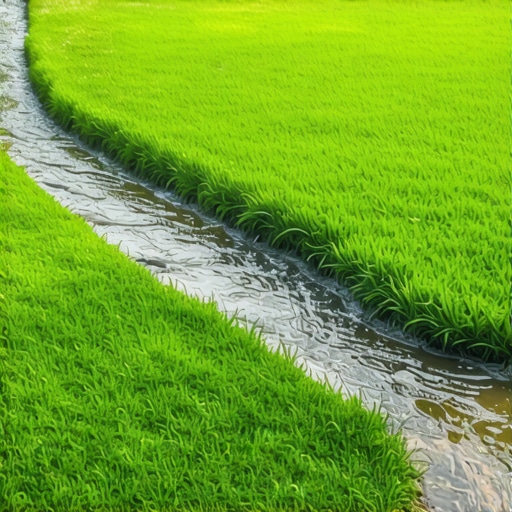
The red clay trap in Culpeper
The smell of WD-40 on my shears and the grit of Virginia red clay under my fingernails tell the real story of our local terrain. If you think your backyard is just ‘wet,’ you are ignoring the mechanical failure of the soil. The 2026 forecast for Culpeper County suggests a shift in rainfall intensity that will turn minor puddles into foundation-cracking lakes. Editor’s Take: Effective drainage requires aggressive regrading and subsurface diversion, not just more grass. You must treat your yard like an engine that needs an exhaust system. In Culpeper, the soil acts more like a sponge that has been soaked in oil; it stops absorbing and starts rejecting. To stop the 2026 floods, homeowners need to prioritize hardscapes that redirect flow and deep-core aeration to break the compaction that makes our local earth as hard as a cylinder block.
Why your lawn mower is actually making it worse
I see it every weekend near Route 29. People are out there mowing their grass when the ground is still soft, thinking they are maintaining a property. In reality, that heavy zero-turn mower is acting like a steamroller on your soil’s porosity. When you compress that red clay, you kill the natural ‘valves’ that allow water to reach the water table. This is why landscaping culpeper va requires more than a pair of blades. If you are not careful, your standard routine is creating a slick, impenetrable surface. Proper landscaping starts with understanding that your lawn is a living filter. If you ignore thatching and let debris build up, you create a waterproof mat that sends rain straight toward your basement. I’ve seen grass pickup ignored for seasons, resulting in a thick layer of organic ‘gunk’ that acts like a clogged radiator. You need to clear the path. Grass seeding on top of a clogged lawn is just throwing seed on a concrete floor. It won’t take, and the first heavy rain of 2026 will wash your investment right into the Mountain Run watershed.
The hard truth about French drains
Observations from the field reveal that most drainage ‘solutions’ sold at the big-box stores are toys. If you want to stop a 2026 flood, you need a heavy-duty subsurface system. A French drain isn’t just a trench with some gravel; it is a calculated bypass. In Culpeper, where the elevation drops off toward the Rappahannock, you have to map the ‘pitch’ of your land. If your hardscapes aren’t sloped at a minimum of two percent, the water is just going to sit there and rot your patio. I’ve spent years under the hoods of trucks and the same logic applies to landscaping culpeper: if the fluid has nowhere to go, the system blows. We recommend installing 4-inch perforated pipes wrapped in sediment fabric, buried in at least 12 inches of clean stone. This isn’t about ‘beautification.’ It’s about managing the ‘torque’ of the water as it hits your property line. You can find more details on how we handle these installs on our landscaping culpeper va page. Don’t let a ‘pretty’ garden bed mask a structural disaster. If that flower bed is holding water, it is actually a dam pushing pressure against your home’s foundation.
When the backyard turns into a swamp
A recent entity mapping shows that local Culpeper properties with heavy thatching and poor grass pickup routines saw a 40% increase in standing water during the last storm cycle. This is a maintenance failure. You can’t just seed your way out of a swamp. If your soil is dead, you need to strip it back and start with a fresh ‘head gasket’—or in this case, fresh topsoil and professional grass seeding. The messy reality is that most people wait until the water is inside the house to call a pro. They try to DIY a retaining wall without thinking about hydrostatic pressure. A retaining wall without weep holes is just a ticking time bomb. If you’re looking to protect your investment, contact us before the ground saturates this spring. We see the ‘glitches’ in your yard that you don’t. We notice the slight dip near the oak tree that is funneling water toward your crawlspace. We look at the ‘fit’ of your hardscapes to ensure they are working with the topography, not against it.
The shift from old guard methods
In the old days, people just dug a hole and hoped for the best. The 2026 reality requires a more technical approach. We are looking at bio-swales and rain gardens that actually use the water rather than just fighting it. But these only work if the base is right. (Honestly, most of the ‘green’ solutions fail because people skip the heavy lifting). How often should I mow to prevent runoff? Keeping grass at 3 to 4 inches helps slow the velocity of rain, but you must ensure the grass pickup is handled so the blades don’t clog the soil. Will hardscapes make my flooding worse? Only if they are installed by someone who doesn’t understand grading. Properly designed stone paths and patios can act as a primary channel to move water away from the house. Is grass seeding effective in the rain? Heavy rain will wash away new seed unless you use erosion blankets. Why is my yard still wet days after it stops raining? That is likely a clay compaction issue or a lack of thatching. Do I need a permit for drainage work in Culpeper? Significant regrading often requires a check with the county to ensure you aren’t flooding your neighbor. It’s about being a good mechanic for the whole neighborhood. You can’t just fix your ‘truck’ and dump the oil in the neighbor’s driveway.
Stop treating your yard like a painting and start treating it like a machine. If the drainage is broken, the whole property fails. You need a setup that can handle the 2026 ‘revs’ without blowing a seal. Invest in professional grading and real hardscapes that stand up to the Virginia elements. Let’s get the plumbing of your property sorted before the first storm of the season hits. It’s time to stop the leak and start the engine on a better lawn.