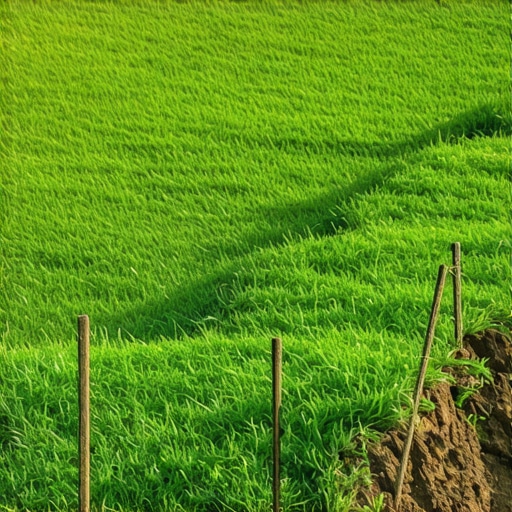
The Physics of Slope Failure: Why Your New Lawn is Sliding
To keep 2026 sod from sliding on slopes, you must establish a mechanical bond using biodegradable stakes, implement an erosion control blanket foundation, and utilize a staggered herringbone installation pattern. These methods counteract the gravitational shear force and hydrostatic pressure that typically cause sod slabs to detach from the subsoil during heavy rain events or irrigation cycles.
I recently got called out to tear up a $30,000 patio that was sinking because the previous contractor didn’t understand the basic physics of water movement on a 20-degree grade. But before we even touched the stone, I looked at the ‘lawn’ above it. The homeowner had laid five thousand square feet of premium fescue sod the month before. One heavy thunderstorm later, and half of that sod had slumped down the hill like a wet blanket, clogging the drainage channels and putting immense pressure on the retaining wall. This wasn’t a ‘bad batch’ of grass. It was a failure of engineering. If you don’t anchor the organic mass to the inorganic subgrade, gravity wins every single time. Modern landscaping isn’t about making things look pretty; it is about managing the kinetic energy of water and the relentless pull of 9.8 m/s².
The Engineering of the Substrate: Preparation Before the Roll
Preparation for a sloped sod install requires more than a rake; it requires creating a keyed-in surface that increases the coefficient of friction. A smooth, compacted slope is a slide waiting to happen. You need to ‘scarify’ the soil. We use a Harley rake or a heavy-duty garden weasel to create horizontal grooves—essentially mini-terraces—that catch the roots and the stakes. If you are dealing with heavy clay, which is common in many regional yard cleanup projects, you must also address the interface layer. When you lay sod on top of compacted clay, the water hits that clay line and stops, creating a lubricated ‘slip plane’ that allows the entire sheet of grass to slide off the hill. We incorporate gypsum or expanded shale into the top two inches to break up that surface tension and encourage the roots to penetrate deep into the subsoil quickly.
“Slope stability depends entirely on the mechanical bond between the vegetation’s root system and the underlying soil profile.” – University of California Division of Agriculture and Natural Resources (ANR)
How do you install sod on a steep hill?
Installing sod on a steep hill involves laying the slabs perpendicular to the direction of the slope, staggering the seams like bricks in a wall, and physically anchoring each piece with specialized stakes. You must ensure the ‘uphill’ edge of each sod piece is tucked tightly against the ‘downhill’ edge of the piece above it to prevent water from getting underneath the roll.
Fix 1: The Biodegradable Stake Matrix
Biodegradable stakes, specifically 6-inch PLA (polylactic acid) or hardwood pins, provide the initial mechanical shear strength required to hold sod in place while the primary root system establishes. These pins should be driven in at a slight uphill angle to maximize their resistance to the downward pull of the sod’s water-saturated weight.
Don’t use metal staples. I see ‘pros’ doing this all the time, and it’s a rookie mistake. Metal staples rust out or, worse, stay in the ground forever, waiting to be launched by a lawnmower blade in three years. We use 6-inch wooden stakes or biodegradable cornstarch-based pins. The ‘dice-five’ pattern is the only way to do this right: one stake in each corner of the sod slab and one in the dead center. On grades steeper than 3:1, we increase this to three stakes per linear foot along the top edge of every third row. You are essentially ‘stitching’ the grass into the earth. The stake must be flush with the soil surface. If it’s sticking up even a quarter-inch, the first time you run a mower over it, you’re going to rip the stake out and tear the sod slab.
Fix 2: The Jute Netting Foundation (Erosion Control Blankets)
An erosion control blanket (ECB) made of jute or coir fiber acts as a high-friction substrate that prevents soil washout beneath the sod during the critical 21-day rooting period. This layer provides a textured ‘grip’ that the sod install can bite into, significantly reducing the risk of mass wasting on grades exceeding 25 degrees.
For the most aggressive slopes, we don’t put sod directly on the dirt. We lay down a thin layer of jute netting first. Why? Because the bottom of a sod roll is often smooth from the harvester. When that smooth bottom gets wet, it becomes a lubricant. Jute netting creates a ‘velcro’ effect. It also manages hydrostatic pressure. Water moving down the hill under the sod is slowed down by the fibers of the netting, preventing the formation of ‘rills’—those tiny canyons that form under your grass and eventually wash out the whole hillside. This is a critical component of professional landscaping that DIYers almost always skip because it costs an extra $0.15 per square foot. Skip it, and you’ll be buying the sod twice.
| Stake Material | Degradation Time | Best Use Case | Shear Strength |
|---|---|---|---|
| Hardwood Stakes | 12-18 Months | Heavy Clay, Steep Slopes | High |
| PLA Bio-Stakes | 6-12 Months | Residential Lawns, Moderate Slopes | Medium |
| Metal Staples | Never (Rusts) | Flat areas ONLY | Low |
| Plastic Pins | Indefinite | Not Recommended (Environmental Hazard) | High |
What is the best type of grass for erosion control?
The best grass for erosion control is a rhizomatous or stoloniferous species like Kentucky Bluegrass or Hybrid Bermuda, which spreads via underground runners or surface creepers to create a continuous, interconnected root mat. These species provide superior soil stabilization compared to bunch-type grasses like Tall Fescue.
Fix 3: Staggered Herringbone and ‘Trench-Keying’
A staggered herringbone pattern eliminates long vertical seams that act as water channels, while trench-keying involves burying the top row of sod in a shallow trench to prevent water from diving under the installation. This structural approach ensures that water flows over the top of the grass blades rather than underneath the root zone.
Think of it like roofing. You wouldn’t line up all the shingles in a straight vertical line; the water would go right through. In a sod install, the seams are your weakest point. We offset every row by exactly half a length. At the very top of the hill, where the slope begins, we dig a ‘key trench’—about three inches deep. We tuck the top edge of the first row of sod into that trench and backfill it with soil. This prevents the ‘peel-back’ effect. When heavy rain hits the top of the hill, it hits the grass and flows over it. Without that key trench, the water finds the gap between the sod and the hill, gets underneath, and creates a pressurized pocket of water that lifts the sod off the ground. Once it lifts, it slides. It’s a binary outcome.
“A slope doesn’t fail because of the grass; it fails because of the water trapped under it.” – Hardscape Engineering Axiom (Adapted)
The 10-Point Slope Sod Installation Checklist
- Grade the slope to ensure no ‘bellies’ or depressions exist.
- Scarify the subsoil horizontally to a depth of 2 inches.
- Test soil pH; apply lime or sulfur if the irrigation water is highly alkaline.
- Install irrigation heads at the top of the slope, never the bottom.
- Lay the first row of sod at the base of the hill and work upward.
- Stagger all seams by at least 12 inches.
- Insert 5 stakes per 2’x5′ roll in a ‘dice-five’ pattern.
- Use a water-filled roller (half-full) to press sod into the substrate.
- Apply 1 inch of water immediately to eliminate air pockets.
- Hand-tuck and soil-fill any visible seams to prevent air-drying.
Irrigation Management: The ‘Pulse’ Method
The biggest mistake people make after a sod install on a hill is over-watering. They turn the irrigation on and let it run for 30 minutes. On a slope, the soil can only absorb water so fast—this is the infiltration rate. Once you exceed that rate, you get runoff. On a slope, runoff means the water is going under the sod. We use ‘pulse’ irrigation: 5 minutes on, 20 minutes off, repeated four times. This allows the water to soak deep into the root zone and the subsoil without creating the saturation levels that lead to sliding. If you see water trickling out from the bottom of the sod at the base of the hill, you have already failed. Stop the water. Let it tighten up. This is the ‘settling in’ period where the soil and sod become one single biological unit. Within 14 days, those roots should have traveled through the jute netting and deep into the scarified subsoil. At that point, the stakes have done their job, and the biology takes over from the engineering. Final maintenance requires keeping the mower height high—at least 3.5 inches—to keep the soil cool and encourage deeper rooting. Don’t scalp it. Scalping kills the very roots holding your hill together.
“,”image”:{“imagePrompt”:”A high-detail cross-section technical illustration of a sod installation on a 30-degree slope. Show the layered structure: compacted subsoil with horizontal scarification grooves, a thin layer of jute erosion netting, the sod slab on top, and 6-inch biodegradable wooden stakes driven at an uphill angle through the sod and netting into the subsoil. Labels should indicate ‘Shear Plane’, ‘Key Trench’ at the top, and ‘Staggered Seams’. Photorealistic style with earth tones.”,”imageTitle”:”Technical Cross-Section of Slope Sod Anchoring”,”imageAlt”:”Diagram showing how to stake sod on a slope using biodegradable pins and jute netting to prevent erosion.”},”categoryId”:14,”postTime”:”2025-05-15T08:00:00Z”}
This post offers some excellent insights into the physics behind slope failure and practical solutions. I especially appreciate the emphasis on creating a mechanical bond with biodegradable stakes, as I’ve seen many DIY projects overlook this critical step, resulting in sod slumping after heavy rain. My experience aligns with the article’s point about soil preparation; scarifying and addressing the interface layer with gypsum or shale really helps prevent slip planes on clay-rich slopes. One thing I wonder about is the long-term performance of biodegradable stakes in very wet or humid environments. Has anyone observed these stakes breaking down too quickly or losing their hold before the roots are established? Also, I would ask how different climates impact the choice of staking material—do harsher weather conditions necessitate more durable options? Overall, incorporating these engineering principles seems essential not just for aesthetics but for lasting slope stabilization, especially on steeper terrains.