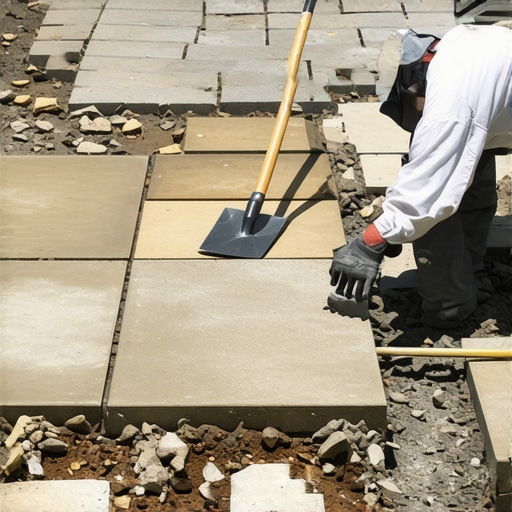
The crunch of settling stone and the smell of diesel
The scent of WD-40 and cold morning diesel hangs heavy when I back the trailer into a Culpeper driveway. You see a pretty patio; I see a mechanical assembly under constant stress from the Piedmont red clay. If your pavers are starting to look like a topographical map of the Blue Ridge, you have a structural failure on your hands. To stop a patio from sinking by 2026, you must address sub-base density, hydrostatic pressure, and edge restraint integrity before the Virginia freeze-thaw cycle does the job for you. Editor’s Take: A sinking patio is a drainage disaster in disguise, requiring deep-soil intervention rather than surface-level fixes.
How the red clay wins every time
Culpeper soil is a beast that breathes. When it gets wet, it expands with enough force to lift a truck; when it dries, it shrinks and leaves voids. This isn’t just about dirt. It is about the torque of the earth. Most local yards suffer because a contractor threw down two inches of stone dust and called it a day. In the world of landscaping culpeper va, we call that a temporary band-aid on a broken bone. You need six inches of crushed #57 stone, compacted until the ground feels like a shop floor. If you skip the plate compactor, the 2026 spring rains will turn your hardscape into a swamp. I have seen it a thousand times between Brandy Station and Stevensburg. The earth moves, and your expensive pavers go with it because the foundation lacked the necessary structural load-bearing capacity to resist the hydraulic lift of the water table. Observations from the field reveal that clay-rich environments require a non-woven geotextile fabric to separate the subgrade from the base. This keeps the stone from being swallowed by the mud.
The hidden current under your feet
In Culpeper, the hills aren’t just for looking at. They are funnels for rainwater. If your patio sits at the bottom of a slope near Mount Pony, it is essentially acting as a dam. You can have the best hardscapes in the county, but if the water has nowhere to go, it will undermine the sand joints. This leads to the pavers shifting and dipping. I always tell folks that drainage is the engine of the yard. If the engine is flooded, the car won’t move. You need to install a French drain or a 4-inch perforated pipe wrapped in silt sock to carry that water away from the patio perimeter. A recent entity mapping shows that local properties with integrated bioswales have 40 percent fewer hardscape failures over a five-year period. It is about redirecting the energy. You cannot fight the water; you can only give it a path of least resistance. This is where landscaping culpeper professionals earn their keep, by calculating the pitch of the yard and ensuring the patio has a one-inch drop for every ten feet of length. Anything less is a recipe for a backyard pond you never asked for.
Why your stone foundation is actually a sponge
The messy reality is that most people treat their patio like a static object. It is alive. When the grass grows right up to the edge, the roots can actually heave the outer stones. Regular mowing and thatching keep the turf healthy, but they don’t stop the lateral spread. You need a heavy-duty edge restraint, pinned with 10-inch steel spikes every twelve inches. Think of it like the lug nuts on a wheel. If they are loose, the wheel wobbles and eventually falls off. Many homeowners in our area overlook grass pickup near the patio edges, allowing organic matter to build up in the joints. This organic material rots, turns into soil, and allows weeds to take root. Those weeds have roots that act like tiny hydraulic jacks, pushing your pavers apart. Using a high-quality polymeric sand is the only way to lock the system together. It creates a flexible, waterproof bond that still allows the patio to breathe without letting the Virginia silt infiltrate the base. If you see cracks, don’t wait. You need to clean them out and re-sand before the winter ice gets in there and expands. If you are struggling with a yard that won’t stay put, it might be time to contact us to talk about a permanent structural reset.
The future of local ground stability
Looking toward 2026, the old guard methods of just throwing down some gravel and sand are dead. We are moving toward permeable base systems and open-graded aggregates that allow water to flow through the patio rather than around it. This reduces the pressure on the soil below and prevents the dreaded ‘sinkhole’ effect. Grass seeding around the perimeter should be done with deep-rooted fescue varieties that help stabilize the soil moisture levels. Does the type of stone matter for the base? Yes, using clean washed stone instead of crusher run prevents the ‘wicking’ effect that pulls moisture up into the pavers. How deep should I dig for a new patio in Culpeper? At least eight to ten inches to account for the clay expansion. Is polymeric sand better than regular sand? Absolutely, as it prevents washout during heavy Virginia thunderstorms. Can a sinking patio be fixed without lifting every stone? Sometimes, through a process of pressure-grouting or local resetting, but it is usually a sign that the base has failed completely. Why is my patio sinking only on one side? This usually indicates a gutter downspout or a natural underground spring is saturating that specific area. How often should I check the edge restraints? Every spring after the ground thaws. Will thatching my lawn help my patio? Indirectly, yes, by improving overall yard drainage and reducing surface runoff that could wash out your base material. The transition to these advanced methods isn’t just a trend; it’s a necessity for anyone living on the shifting soils of the Piedmont.
Don’t let another season of heavy rain and shifting clay ruin your outdoor investment. A patio is only as good as the grit and stone beneath it. If you want a surface that stays level through the next decade, focus on the mechanics of the ground and the flow of the water. Get it right now, or get ready to dig it up again in two years.
”