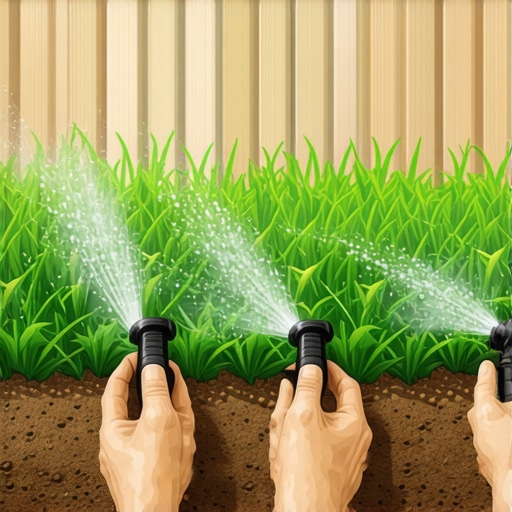
The Forensic Autopsy of a Dying Lawn
You see a brown patch and your first instinct is to dump more water on it. That is the mark of an amateur. When I walk onto a site with ‘dry spots,’ I do not see a thirsting lawn; I see a mechanical failure or a structural deficiency in the soil profile. I always drill into my new crew members: if you don’t fix the soil grading and irrigation coverage first, every plant you put in the ground is just expensive compost. Most homeowners are currently fighting a losing battle against 2026 drought restrictions because their systems were installed by ‘mow-and-blow’ crews who do not understand the physics of hydraulics. If your turf feels crunchy while the area three feet away is a swamp, you are dealing with poor distribution uniformity (DU). We are going to strip back the topsoil and look at the engineering reality of why your irrigation is failing.
“Distribution uniformity is the single most important factor in irrigation efficiency; without it, you are merely creating pockets of salt accumulation and anaerobic soil conditions.” – Irrigation Association Standards
H1: Nozzle Matching for Matched Precipitation Rates
To eliminate 2026 sprinkler dry spots, you must ensure matched precipitation rates (MPR) across the entire zone by replacing mismatched nozzles that deliver different volumes of water. If you have a full-circle head and a quarter-circle head on the same line, the quarter-circle area is getting four times the water. This is basic math that most installers ignore.
The Science of GPM and Arc
Every nozzle has a Gallons Per Minute (GPM) rating. In a standard zone, a 360-degree head must have a nozzle with four times the GPM of a 90-degree head. If they both have ‘2.0’ nozzles, the 90-degree corner will be flooded, and the 360-degree center will be a dust bowl. Look at the top of your heads. If you see the same nozzle color in every head regardless of the arc, your system was built by a hack. You need to pull the manufacturer’s spec sheet (Hunter, Rain Bird, or Toro) and match the nozzle to the degrees of rotation. This ensures every square inch of turf receives the same depth of water in a given timeframe.
How do I choose the right irrigation nozzle?
Selecting the right nozzle requires calculating the square footage of the coverage area and matching it to the manufacturer’s PSI-to-GPM chart to ensure head-to-head coverage. Do not guess. Use a pressure gauge at the head to confirm you have at least 30-40 PSI for rotors; otherwise, the spray pattern will collapse before reaching the next head, creating a ‘donut’ dry spot around the base of the sprinkler.
H2: Pressure Regulation and Friction Loss Hacks
Irrigation system pressure regulation is critical because high PSI causes misting and wind drift, while low PSI leads to poor head-to-head coverage and localized dry spots. Managing the friction loss in your lateral lines ensures every head performs at its engineered capacity without wasting water to evaporation.
| Nozzle Type | Optimal PSI | Typical Radius (ft) | GPM Range |
|---|---|---|---|
| MP Rotator | 40-45 PSI | 8-35 | 0.20 – 4.0 |
| Standard Spray | 30 PSI | 5-15 | 1.0 – 5.0 |
| Gear-Driven Rotor | 45-55 PSI | 25-50 | 2.0 – 10.0 |
If your heads are ‘fogging’—meaning the water looks like a fine mist—you are losing 30% of your water to the wind. This is usually caused by excessive pressure. Conversely, if the stream is weak and doesn’t reach the next head, you have too many heads on one zone or a leak. Install pressure-regulating stems (like the Rain Bird 1800-SAM-P45) to lock in the PSI at the head. This single adjustment can fix dry spots by forcing the water into heavy droplets that actually hit the ground.
“Evapotranspiration rates dictate the metabolic demand of turfgrass, yet most homeowners overwater by 30% while leaving spots dry due to pressure-related spray pattern collapse.” – Texas A&M Agrilife Extension
H3: Soil Compaction and the Hydrophobic Barrier
Hydrophobic soil remediation involves breaking through compacted clay layers or heavy thatch that prevents water from reaching the root zone. Even a perfectly adjusted sprinkler head cannot fix a dry spot if the soil surface tension is so high that water beads up and runs off onto the sidewalk.
The Screwdriver Test
Take a 6-inch screwdriver and try to push it into a dry spot. If it stops at 2 inches, your soil is compacted. This is common in high-traffic areas or where ‘sod install’ was done over un-tilled construction grade clay. To fix this, you need a core aerator. Not the spikes—those just compress the soil further. You need a machine that pulls 3-inch plugs out of the ground. Once aerated, apply a surfactant or ‘wetting agent.’ This chemical breaks the surface tension of the water, allowing it to penetrate the soil particles rather than sitting on top. This is the ‘secret sauce’ we use on golf courses to keep greens alive during 100-degree heat waves.
Checklist for Irrigation Zone Audits
- Confirm head-to-head coverage (water from one head should hit the next head).
- Inspect for ‘leaking seals’ that bleed pressure from the zone.
- Clear grass tall enough to block the spray trajectory (a common ‘yard cleanup’ oversight).
- Check for clogged nozzle filters (unscrew the head and rinse the screen).
- Verify the controller’s ‘Cycle and Soak’ settings to prevent runoff on slopes.
H3: How much water does my lawn actually need in 2026?
Your lawn needs exactly 1 to 1.5 inches of water per week, delivered in two deep sessions rather than daily light mists. Daily watering encourages shallow roots that fry the moment the sun comes out. By watering deeply (30-45 minutes per zone, depending on nozzle type), you force the roots to chase the moisture down into the cooler sub-layers of the soil. This creates a drought-tolerant turf that survives while your neighbor’s lawn turns to straw.
Long-Term System Resilience
Fixing dry spots is not about buying a bigger pump; it is about the surgical adjustment of the hardware you already have. Check your GPM, match your nozzles, and kill the compaction. If you ignore the physics of your yard, you are just throwing money down the storm drain. Dig deep. Check your pressure. Fix the soil. That is how you maintain a professional-grade landscape.