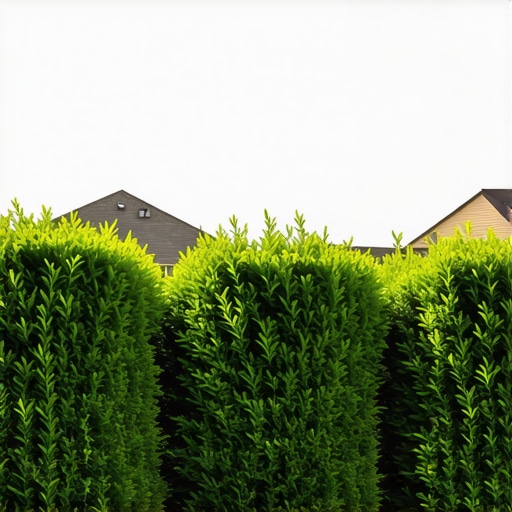
The Engineering of a Living Barrier
To block neighbors effectively by 2026, you need fast-growing, evergreen species like American Pillar Arborvitae, Nelly Stevens Holly, or Skip Laurel, spaced according to their mature width to ensure air circulation while maintaining a solid visual barrier against unwanted eyes. Most homeowners fail because they think of a hedge as a decoration. It is a biological wall. I always drill into my new crew members: if you don’t fix the soil grading first, every plant you put in the ground is just expensive compost. A privacy screen requires more than just digging holes; it demands an understanding of soil compaction, drainage patterns, and the specific landscaping requirements of your site. If the site has standing water, those roots will suffocate in anaerobic conditions long before you get any privacy.
The Apprentice Lesson: Soil First, Plants Second
When I started this firm twenty years ago, I saw a homeowner spend five figures on mature evergreens only to see them brown out within six months. The issue wasn’t the plants; it was the sod install they did right up to the trunks and the lack of a proper drainage plan. They had zero irrigation strategy for deep-root establishment. I tell my guys that the rhizosphere is where the money is. If the soil pH is off or the bulk density is too high from construction equipment, those plants are trapped in a concrete-like tomb. We test the soil. We check the percolation. We don’t guess.
“Proper plant selection involves matching the plant’s biological needs to the site’s environmental conditions, including soil pH, drainage, and light exposure.” – Penn State Extension
1. Thuja occidentalis ‘American Pillar’
The American Pillar Arborvitae is the professional’s choice for tight spaces because it provides a vertical growth rate of up to three feet per year while maintaining a narrow footprint of only four feet wide. Unlike the more common ‘Green Giant’, which can eventually swallow a small backyard, the ‘American Pillar’ stays disciplined. It is resistant to the common ‘splitting’ issues seen in heavy snow loads. We install these to create a dense, fine-textured wall. Don’t crowd them. Even with their narrow habit, they need airflow to prevent needle blight. We calculate the spacing based on a 48-inch center-to-center measurement to ensure the canopy closes by 2026 without the plants competing for nutrients.
How do I stop my arborvitae from turning brown?
Arborvitae browning is usually a symptom of desiccation or spider mites. Deep irrigation during the first two growing seasons is non-negotiable to prevent the root ball from drying out while the surrounding native soil remains damp—a common phenomenon called the ‘teacup effect.’ Use a drip system with emitters placed at the root flare, not the foliage.
2. Ilex x ‘Nelly R. Stevens’ (Nelly Stevens Holly)
Nelly Stevens Holly offers a formidable, prickly barrier that serves as both a visual screen and a physical deterrent, reaching heights of 15-25 feet with a naturally pyramidal shape. This is the ‘tank’ of the hedge world. It handles the heat of the South and the clay of the Mid-Atlantic with equal resilience. Its leathery, dark green leaves have a high wax content, which helps it retain moisture during drought periods. However, don’t let its toughness fool you. If you bury the root flare—the point where the topmost roots join the trunk—you are inviting stem-girdling roots and eventual decline. We always plant ‘proud,’ meaning the root ball is slightly above the surrounding grade to allow for settling and gas exchange.
“Effective screening requires an understanding of the growth habit and potential mature height of the selected species to avoid future utility interference.” – Texas A&M AgriLife
Comparison of 2026 Privacy Hedge Candidates
| Plant Species | Growth Rate (Annual) | Mature Width | Soil Preference | Best Feature |
|---|---|---|---|---|
| American Pillar | 30-36 Inches | 4 Feet | Loamy/Well-Drained | Small Footprint |
| Nelly Stevens Holly | 12-24 Inches | 8-12 Feet | Acidic/Clay Tolerant | Physical Barrier |
| Skip Laurel | 24-30 Inches | 5-7 Feet | Versatile/Shade Tolerant | Elegant Texture |
3. Prunus laurocerasus ‘Schipkaensis’ (Skip Laurel)
The Skip Laurel is the elite choice for shaded properties, offering broad, glossy foliage that creates a sophisticated screen where most evergreens would fail due to low light. It is more cold-hardy than other cherry laurel varieties and can handle a wide pH range. We use these for yard cleanup projects where the homeowner wants to replace a messy, overgrown fence line with something structured. The key with Skip Laurels is the prune. To get a dense wall by 2026, you must perform ‘heading cuts’ in early spring to encourage lateral branching. If you just let them grow, they can become leggy. A dense hedge is a result of consistent, professional maintenance, not just luck.
How much modified gravel do I need for a patio base?
While this article focuses on hedges, many privacy projects involve hardscaping. For a standard patio base, you need 6 inches of compacted 21A or 3/4-inch modified gravel. Calculation: (Length x Width x 0.5) / 27 = Cubic Yards needed. Compaction is king. If you don’t use a vibratory plate tamper every 2 inches of lift, your stone will settle, and your wall will lean.
The Installation Checklist for 2026 Success
- Site Marking: Call 811. Don’t sever a fiber optic line for a Holly.
- Soil Modification: Incorporate organic compost if your clay is heavy, but don’t over-amend the hole; the roots must learn to grow in native soil.
- Root Flare Visibility: Ensure the ‘knob’ where roots start is visible at the soil surface.
- Irrigation Setup: Install a dedicated drip line. Hand-watering is for hobbyists; consistency is for professionals.
- Mulching: Use 2-3 inches of aged hardwood mulch. Do not touch the trunk. No mulch volcanoes.
Landscape success is built on the microscopic level. You are managing the exchange of cations in the soil and the hydrostatic pressure in the root zone. A hedge planted in 2024 with the correct engineering will be a fortress by 2026. Skip the shortcuts. Buy nursery-grade stock, not the root-bound remnants from a big-box store. Your privacy depends on the biological vigor of the specimens you choose today.