The smell of damp earth and old limestone
The air in Culpeper today carries that heavy scent of wet red clay and the faint metallic tang of masonry dust. It is a specific aroma that any veteran who works with stone knows well. If you walk across your patio right now and see those hairline fractures snaking through your pavers, you are looking at a countdown. By the time 2026 rolls around, these small gaps will become structural failures. The Editor’s Take: Hardscape sealing is not about aesthetics; it is about preventing the Culpeper freeze-thaw cycle from shattering your investment into gravel. Most homeowners think a quick wash is enough, but without a deep-penetrating sealant, you are just watching your money dissolve into the Virginia soil. I have spent years restoring things people thought were broken, and I can tell you that a patio is no different than a piece of fine mahogany furniture. If you do not protect the grain, the weather will eat it alive.
The physics of failing stone joints
Hardscapes in our region fail because of a simple, brutal mechanical process. Water enters the pores of the stone or the sand in the joints. When the temperature drops near the Blue Ridge, that water expands. It pushes. It grinds. It creates space where there should be none. Professional landscaping culpeper va experts know that sealing acts as a molecular shield. It is not just a coat of paint. A high-quality silane-siloxane sealer creates a hydrophobic barrier that forces water to bead up and roll off rather than soaking in. This process preserves the structural integrity of the polymeric sand. If that sand washes out, your pavers begin to shift. Once they shift, the level is lost. You aren’t just looking at a crack anymore; you are looking at a tripping hazard and a complete teardown. I have seen too many beautiful walkways ruined because someone chose a cheap, plastic-based acrylic that peeled within six months. You need something that breathes, something that understands the stone.
Why Culpeper red clay demands a different strategy
Our local geology is a nightmare for rigid structures. The heavy clay content in Culpeper County soil retains moisture far longer than the sandy loams you find toward the coast. This means your patio is essentially floating on a giant, wet sponge. When we talk about contact us for professional help, we are talking about localized knowledge. A contractor from outside the area might not realize that the drainage patterns around a house near Commonwealth Park differ wildly from one up by Hazel River. You need to ensure that before any sealant is applied, the substrate is bone dry. Sealing in Virginia humidity is a fool’s errand. If you trap moisture under that sealant, you get a milky white haze known as efflorescence. It is a chemical ghost that haunts your stone and is nearly impossible to remove without harsh acids. I prefer the old ways: patience, timing, and a deep respect for the hygroscopic nature of the material. We aren’t just throwing chemicals at a problem; we are stabilizing a foundation.
The disaster of the big box store solution
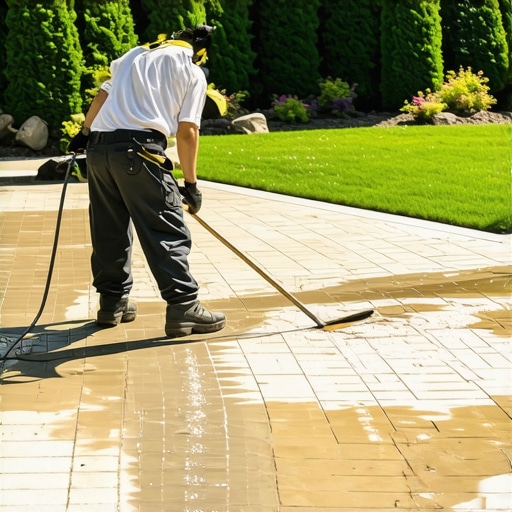
I see it every spring. A well-meaning homeowner goes to a warehouse store, buys a five-gallon bucket of ‘Wet Look’ sealer, and slaps it on with a thick roller. By August, it is flaking off like a bad sunburn. The friction here is that most consumer-grade sealers are too high in solids. They stay on the surface. They don’t penetrate. True protection comes from a low-solids, deep-penetrating formula that bonds with the minerals inside the paver. It is like the difference between a cheap varnish and a hand-rubbed oil finish. One sits on top and fails; the other becomes part of the object. Furthermore, if you haven’t performed a proper soft wash to remove organic growth like moss and lichen, you are just sealing the rot into the stone. You are literally protecting the weeds. A real professional approach involves a multi-step cleaning process, re-sanding with specialized polymeric blends, and then a precision application that respects the porosity of the specific stone type, whether it is local slate or imported travertine.
The evolution of Virginia stone preservation
We used to just throw some mortar in the cracks and hope for the best. Those days are gone. Modern hardscape technology allows for a flexibility that the old guys couldn’t imagine. We can now seal a patio and have it remain breathable, allowing water vapor to escape while blocking liquid water from entering. This is vital for the health of your home’s foundation. How often should I seal my patio in Culpeper? Generally, every three to five years, depending on sun exposure and traffic. Can I seal over old sealer? Only if it is the same chemical base; otherwise, they will react and create a sticky mess. Does sealing make the stones slippery? Not if you use a penetrating sealer or add a shark-grip additive to a topical one. Will it stop weeds forever? No, but it makes the environment so inhospitable that they rarely take root. Is it too late if I already have cracks? No, we can bridge small cracks with specialized resins before sealing. Can I seal in the winter? Absolutely not; the temperature must be consistently above fifty degrees for the chemical bond to form. What happens if it rains right after? You start over. Moisture is the enemy of the curing process.
The final word on lasting value
Your outdoor space is an extension of your home’s soul. It is where you spend those long Virginia evenings when the fireflies are out and the heat finally breaks. Don’t let that space crumble because of a weekend of neglect. Sealing is the final touch in a master craftsman’s workflow. It ensures that the hard work of laying those stones isn’t undone by a single harsh winter. If you want a patio that looks as good in 2030 as it did the day it was installed, you have to treat it with the respect it deserves. Stop settling for temporary fixes and invest in a shield that actually holds the line against the elements. Your future self will thank you when the neighbors are all ripping up their cracked concrete while yours remains pristine and solid. “,