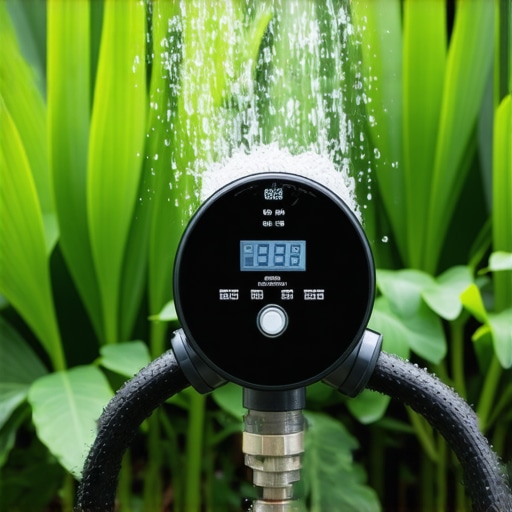
The Forensic Audit of a Failed Landscape Strategy
I always drill into my new crew members: if you don’t fix the soil grading first, every plant you put in the ground is just expensive compost. Most homeowners think water waste is just a leaky faucet or a broken head. It is deeper than that. I recently walked a site where the owner spent five figures on a sod install only to watch it rot within three months. The culprit was not the grass. It was a controller programmed by a hack who didn’t understand soil saturation points. We are entering 2026 with higher water rates and stricter municipal oversight. You cannot afford to run a system on a 1990s logic. Efficient landscaping requires a surgical approach to irrigation timing. It requires an understanding of hydrostatic pressure and soil microbiology. If your timer is set to water for 20 minutes every morning, you are likely killing your lawn and flushing your bank account into the storm drain.
Smart Irrigation Timer Fixes for Maximum Efficiency
Smart irrigation timer fixes involve migrating from static schedules to dynamic, sensor-based adjustments that account for evapotranspiration (ET) rates and local weather data. By calibrating your controller to 2026 standards, you reduce landscaping runoff and ensure sod install longevity through deep root stimulation. This is not about cutting water; it is about surgical application.
“Irrigation efficiency is not just about the timer; it is about matching the application rate to the soil’s infiltration capacity to prevent runoff and deep percolation.” – Texas A&M AgriLife Extension
How much water does my lawn actually need in 2026?
The average turfgrass requires exactly 1 inch of water per week, including rainfall. However, in 2026, we focus on net irrigation requirements. This means calculating the 1 inch minus the local humidity and precipitable water. Do not guess. Measure. Use a rain gauge or a smart weather feed. Anything more than 1.5 inches per week in most climates is just feeding fungus.
Fix 1: The Seasonal Scaling Protocol
Most people set their timer in April and do not touch it until November. That is amateur hour. In 2026, you must use the Seasonal Percentage Adjust feature. Plants do not need the same volume of water in the humid days of June as they do in the dry heat of August. I tell my clients to adjust their scale every two weeks. If your controller has a Wi-Fi link, it should do this automatically based on ET data. ET is the sum of evaporation from the land surface plus transpiration from plants. When the ET rate is high, you scale up. When it is low, you scale down. If you do not have a smart timer, buy one. It will pay for itself in one season of landscaping bills. I have seen 40 percent reductions in water bills just by enabling this one feature. It is the difference between a swampy yard and a resilient one.
Fix 2: Implementing Cycle and Soak for Heavy Soils
If you have clay soil, you cannot dump 30 minutes of water on it at once. The infiltration rate of heavy clay is often less than 0.2 inches per hour. Most rotors put out 0.5 inches per hour. Do the math. You are creating a river on your sidewalk. The Cycle and Soak method is the fix. You break that 30-minute run into three 10-minute cycles, with an hour of soak time in between. This allows the water to actually reach the root zone instead of sheeting off the surface. This is critical during a yard cleanup or after a fresh sod install. New sod needs moisture, but it also needs oxygen. Drowning the soil profile kills the microbes necessary for nitrogen cycling. Don’t be the person who drowns their investment.
| Controller Feature | Water Savings Est. | Primary Technical Benefit |
|---|---|---|
| Seasonal Scaling | 15-25% | Adjusts for Evapotranspiration (ET) |
| Cycle and Soak | 10-15% | Eliminates surface runoff in clay |
| Flow Sensing | 90% of leak waste | Shuts down system during line breaks |
| Soil Probes | 30% | Direct measurement of root zone moisture |
Fix 3: Integrating Flow Sensors for Leak Detection
A single 1-inch lateral line break can dump 30 gallons per minute. If that happens at 3:00 AM while you are sleeping, you will lose 1,800 gallons in one hour. By 2026, a flow sensor is not an luxury; it is a necessity. A flow sensor connects to your smart timer and monitors the GPM (gallons per minute). If the flow exceeds a preset threshold, the controller kills the master valve. It saves your landscaping from being washed away and prevents massive utility bills. I have seen retaining walls fail because a broken irrigation line saturated the backfill, creating immense hydrostatic pressure. A $200 sensor could have saved a $15,000 wall. It is basic engineering. Do not skip this.
How do I know if my irrigation zone is leaking?
Check your water meter while the system is off. If the dial is spinning, you have a leak. If the system is running and you see a drop in PSI (pounds per square inch) at the heads, or if one area of the yard is consistently muddy, you have a lateral line failure. A flow sensor automates this diagnosis. It is the smartest investment for any yard cleanup professional.
Fix 4: Soil Moisture Sensors vs. Weather Data
Weather-based controllers are good, but soil moisture sensors are better. Weather data is an estimate. A soil probe is a fact. In 2026, we are installing probes at the root flare of trees and 4 inches deep in turf. These sensors tell the timer: “The soil is at 15 percent moisture; do not water today.” This prevents over-watering during those humid weeks when the air is wet but it hasn’t rained. For a successful sod install, these sensors are vital. They ensure the delicate new roots stay moist without becoming anaerobic.
“A retaining wall doesn’t fail because of the stone; it fails because of the water trapped behind it.” – Hardscape Engineering Axiom
This principle applies to your lawn too. Excess water creates a barrier that prevents oxygen from reaching the roots. It will rot. Don’t let it happen.
The 2026 Irrigation Efficiency Checklist
- Inspect every nozzle for lime scale and debris during your yard cleanup.
- Ensure rain sensors are not blocked by overgrown tree canopies.
- Verify the master valve is functioning to prevent constant line pressure.
- Update your controller firmware to the latest 2026 security and weather patches.
- Check for head-to-head coverage to ensure no dry spots are triggering extra run time.
Final System Audit and Performance Metrics
Water management is a game of inches and percentages. In 2026, the hacks will still be over-watering, but the professionals will be using data. If you implement these four fixes, you are doing more than saving money. You are protecting the structural integrity of your landscaping and ensuring your sod install survives the first critical year. Always remember: deep, infrequent watering is the goal. Force those roots to chase the water down 6 or 8 inches. That is how you build a drought-tolerant yard. Stop treating your irrigation like a toaster. It is a life-support system. Treat it with the technical respect it deserves.