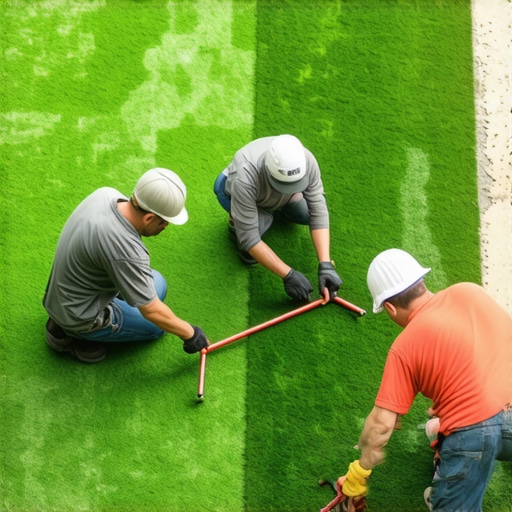
Stop 2026 Sod Gaps: 3 Tactics for a Flush Level Install
Installing sod is not just laying green carpet over dirt. It is a biological transplant operation that involves complex soil physics and hydraulic engineering. If you treat it like a weekend DIY project without understanding soil bulk density and capillary action, you will face massive gaps, brown edges, and a lumpy surface by the second season. I always drill into my new crew members: if you don’t fix the soil grading first, every plant you put in the ground is just expensive compost. I have seen too many rookies slap down high-quality Kentucky Bluegrass or Bermuda on top of compacted clay only to wonder why the yard looks like a topographical map of a disaster zone six months later. You cannot bypass the mechanical requirements of the earth. Success starts four inches below the surface. This guide breaks down the engineering requirements for a flush, gap-free installation that lasts for years, focusing on the interface between the root zone and the native soil profile.
The Critical Importance of Sub-Grade Preparation and Soil Grading
A flush sod installation requires precise soil grading and consistent substrate compaction to prevent future settling and seam separation. By achieving a 95% compaction rate on the sub-base and ensuring a 1% slope away from the primary structure, you eliminate the air pockets that cause the inevitable sod gaps seen in failed 2026 landscapes. Most contractors skip the rough grade. They think the sod will hide the sins of the dirt. It won’t. Soil settles. If your subgrade has a two-inch dip, your sod will eventually sink into that dip, pulling the seams apart from the surrounding pieces. This is where the gaps come from. We use laser levels to ensure the rough grade is perfect before the first pallet arrives. It is about managing the physics of the site. You are building a foundation for a living organism. If that foundation is uneven, the organism will suffer unevenly.
“Uniform irrigation distribution is impossible if the grade has depressions greater than 0.5 inches over a 10-foot span.” – Irrigation Association Standards
How much soil prep is needed for new sod?
Effective soil preparation for new sod requires a minimum of four to six inches of loosened, amended topsoil to facilitate rapid root penetration and moisture retention. You must remove all debris, including rocks larger than one inch, and incorporate organic matter to improve the cation exchange capacity of the root zone. I see people trying to install sod on compacted till. It is like trying to grow hair on a billiard ball. The roots hit that hardpan and just stop. They grow sideways. This leads to a shallow root system that cannot survive a three-day heatwave. We use a power rake to shatter the surface tension of the existing soil. This allows the new roots to knit into the native earth immediately. If you don’t see a transition zone between your new soil and the old dirt, you have failed the install.
| Soil Type | Drainage Rate (In/Hr) | Compaction Risk | Amendment Required |
|---|---|---|---|
| Heavy Clay | Less than 0.05 | High | Gypsum and Coarse Sand |
| Sandy Loam | 0.5 to 2.0 | Low | Composted Organic Matter |
| Silty Clay | 0.1 to 0.5 | Medium | Aeration and Calcined Clay |
Tactic 1: The Mechanical Interface and Seam Compression
To prevent sod gaps, you must implement mechanical seam compression during the installation phase to ensure that every individual piece of turf is physically forced against its neighbor. This involves slightly ‘peaking’ the seams so that they are under lateral pressure, which compensates for the natural desiccation and shrinkage that occurs during the initial 48-hour moisture loss period. Sod is roughly 80% water by weight. As it dries out on the pallet and immediately after laying, it shrinks. If you lay it butt-to-butt without tension, that shrinkage creates a quarter-inch gap. That gap exposes the edges of the roots to air. Air kills roots. We call this ‘root desiccation.’ Once those edges die, the gap becomes permanent and weeds move in. We use a specific technique where we tuck the edges under each other slightly, then press them down with the heel of our hand. It creates a seamless carpet that can handle the minor shrinkage of the drying cycle. Don’t leave it to chance.
“Soil-to-root contact is the single most critical factor in determining the survival of transplanted sod during the first 14 days.” – University of Florida IFAS Extension
Tactic 2: Hydraulic Management and Irrigation Calibration
Eliminating sod gaps requires precise hydraulic management that maintains the field capacity of the soil without inducing anaerobic conditions that lead to root rot. You must calibrate your irrigation system to deliver deep, infrequent cycles that encourage the roots to chase the moisture deep into the subgrade, rather than staying in the top inch of the thatch layer. A common mistake is watering for ten minutes every day. This keeps the surface wet but the root zone dry. It also encourages fungal pathogens. You need to measure your output. Put out tuna cans or rain gauges. You want one inch of water per week, delivered in two heavy applications. This forces the roots down. Deeper roots mean a more stable plant. A stable plant doesn’t shrink. We monitor the moisture levels using tensiometers. If the soil is too wet, the oxygen is pushed out. No oxygen means no root growth. It is a delicate balance of air and water in the pore spaces of the soil.
Why does my new sod have gaps?
Sod gaps typically occur due to improper seam tension during installation or rapid desiccation of the turf edges because of inadequate subgrade moisture. When the sod pieces are not tucked tightly together, the exposed edges dry out faster than the center, causing the organic matter in the sod to shrink and pull away. You also have to look at the soil beneath. If you have high spots in the dirt, the sod will ‘bridge’ over them. This creates an air pocket. The grass over that air pocket will die, and the whole piece will contract. It is a mechanical failure. You fix it by rolling the sod with a water-filled roller immediately after installation. This 200-pound pressure forces the roots into the dirt. It gets rid of the air. No air, no gaps. It is that simple. Don’t skip the roller. If the roller isn’t bouncing slightly off the ground, you don’t have enough weight.
Tactic 3: Advanced Nutrient Cycling and Soil Chemistry
Long-term levelness in a sod install is maintained through balanced nutrient cycling and the management of the soil pH to ensure optimal microbial activity. You must apply a high-phosphorus starter fertilizer to stimulate root elongation, followed by a slow-release nitrogen program that prevents the rapid, leggy growth that leads to excessive thatch accumulation and uneven settling. Thatch is the enemy of a level yard. Thatch is a layer of dead and living organic matter that builds up between the grass and the soil. If your thatch gets too thick, the grass is essentially growing in a sponge. When that sponge dries out, it shrinks unevenly. This creates a bumpy, low-quality surface. We test the soil pH before we ever order the sod. If the pH is off, the nutrients are locked up. It doesn’t matter how much fertilizer you throw at it; the plant can’t eat it. We target a pH of 6.5 for most turf varieties. It is the ‘sweet spot’ where most macro and micronutrients are most available to the root system.
- Verify utility marking via 811 before any excavation begins.
- Test soil pH and adjust with lime or sulfur 30 days prior to install.
- Excavate exactly 3 inches below the desired finished grade of walkways.
- Apply a 10-20-10 starter fertilizer at a rate of 5 lbs per 1,000 sq ft.
- Roll the sod within 30 minutes of laying to ensure root-to-soil contact.
- Perform a deep soak irrigation cycle immediately following the rolling process.
The Long-Term Maintenance Horizon
Once the sod is down and the gaps are sealed, the work is only 20% done. The first 2026 season will determine if your yard becomes a legacy or a liability. You have to watch the corners. You have to watch the edges of the driveway. Those are the hot spots. Heat from the concrete wicks moisture out of the soil, causing those perimeter pieces to shrink and gap. We often install a separate irrigation zone for the perimeter or use drip lines to keep those areas hydrated. Yard cleanup is also vital. Do not let leaves or debris sit on the new sod for more than 48 hours. They will block the sun, trap heat, and kill the young blades. This leads to thinning and, you guessed it, more gaps. Landscaping is a game of details. If you ignore the small things, the big things will fail. Keep your mower blades sharp. Dull blades tear the grass, leading to moisture loss. Cut it high for the first few months. Let the plant photosynthesize. It needs the energy to build that root system. If you scalp it early, you are starving the engine. Take care of the biology, and the engineering will hold firm.