
That sickening squish under your boots isn’t just a nuisance; it is the sound of your property value eroding. When you walk across a lawn and water wells up around your soles, you are witnessing a failure of civil engineering at the residential scale. Backyard ponding in 2026 is becoming more frequent as weather patterns shift toward high-intensity, short-duration rain events that overwhelm standard yard cleanup efforts and legacy irrigation designs. As a veteran with 20 years in the dirt, I can tell you that most ‘landscaping’ companies solve this by throwing more sod at the problem. It fails every single time. You cannot fix a hydraulic problem with a biological band-aid. You have to move the water or the water will move your soil.
The Hardscape Autopsy: Why Your Last Drainage Project Failed
To understand how to stop ponding, we have to look at why systems fail. I recently got called out to tear up a $30,000 patio that was sinking because the previous contractor ignored the hydrostatic pressure building up in the clay subgrade. They laid beautiful pavers, but they didn’t install a single exit point for the water. Within two seasons, the base material turned into a slurry, the polymeric sand washed out, and the entire structure began to heave and dip. This is what happens when you prioritize aesthetics over physics. If you don’t fix the soil grading first, every plant you put in the ground is just expensive compost. Most homeowners think a ‘wet spot’ is just a dip in the dirt, but it’s actually an indicator of poor soil porosity and lack of positive pitch.
Tactical Method 1: The High-Performance French Drain
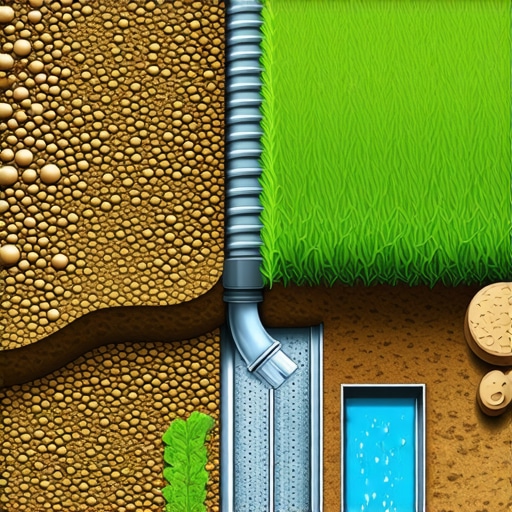
French drains prevent backyard ponding by creating a path of least resistance for subsurface water, utilizing perforated PVC piping and washed aggregate to intercept and redirect groundwater before it reaches the surface. This tactic requires a minimum 1% slope (a 1-inch drop for every 8 feet of run) to ensure gravity overcomes the friction of the pipe walls.
“A retaining wall doesn’t fail because of the stone; it fails because of the water trapped behind it.” – Hardscape Engineering Axiom
Many hacks use corrugated black pipe because it is cheap and flexible. Do not do this. Corrugated pipe has ridges that catch sediment, leading to clogs that are impossible to snake. We use Schedule 40 or SDR 35 perforated PVC. We wrap the trench in a non-woven geotextile fabric to prevent fines from migrating into the 3/4-inch washed stone. This is not a ‘weekend warrior’ project; it is a permanent infrastructure upgrade. If you are doing a sod install over a newly drained area, the soil must be compacted to 95% Proctor density to prevent future settling while still allowing for capillary action.
Tactical Method 2: Engineered Swales and Strategic Yard Cleanup
Engineered swales are shallow, broad channels designed to convey large volumes of surface runoff toward a safe discharge point, such as a municipal storm drain or a dry well. Unlike a trench, a swale is integrated into the landscaping as a dry creek bed or a grass-lined depression, utilizing rip-rap stone or deep-rooted fescue to prevent soil scouring during peak flow.
How deep should a French drain be?
For standard residential applications, a French drain should be 18 to 24 inches deep. This puts the pipe below the root zone of most turf grasses and ensures you are intercepting the water table before it saturates the surface. When performing a yard cleanup, we often find that previous ‘mow-and-blow’ crews have blown debris into these swales, effectively damming the system. You must maintain a clear flow path.
| Drainage Component | Primary Function | Estimated Lifespan |
|---|---|---|
| SDR-35 PVC Pipe | Subsurface Conveyance | 50+ Years |
| Catch Basins | Surface Water Capture | 25+ Years |
| Dry Wells | On-site Infiltration | 20-30 Years |
| French Drains | Groundwater Management | 30+ Years |
Tactical Method 3: Catch Basins and Hydrostatic Pressure Relief
Catch basins act as the primary collection points for localized ponding, using a grated inlet to capture surface water and a sump area to trap sediment before it enters the discharge line. By installing these at the lowest points of your property, you relieve the hydrostatic pressure that causes basement leaks and foundation cracks.
“Effective drainage systems must account for the peak flow rates of 10-year storm events to prevent catastrophic soil erosion.” – Penn State Agricultural Extension
If you have an irrigation system, ensure it isn’t contributing to the problem. Many automated systems are set to ‘spray and pray,’ dumping 2 inches of water on soil that can only absorb 0.5 inches per hour. This leads to instant runoff and ponding. We often integrate drainage with new irrigation installs to ensure the water we put down is actually utilized by the plants rather than sitting in a pool.
Can I install sod over wet ground?
No. Installing sod over saturated or ponding soil will lead to root rot and anaerobic conditions. You must first address the underlying drainage issues and ensure the soil pH is between 6.0 and 7.0 before laying any new turf.
- Check utility lines (811) before any excavation.
- Calculate the total square footage of the drainage area.
- Determine the discharge point (daylight or dry well).
- Excavate trench with a minimum 1% slope.
- Install geotextile liner and 2 inches of bedding stone.
- Lay perforated pipe with holes facing DOWN.
- Backfill with AASHTO #57 washed stone.
Proper drainage isn’t about hiding water; it’s about mastering it. It requires an understanding of soil mechanics and hydraulic load. If you ignore the science, you will be back out there in 2026 with a shovel, wondering why your lawn is a swamp again. Do it right the first time. Use heavy-duty materials, respect the slope, and never trust a contractor who doesn’t own a laser level.