
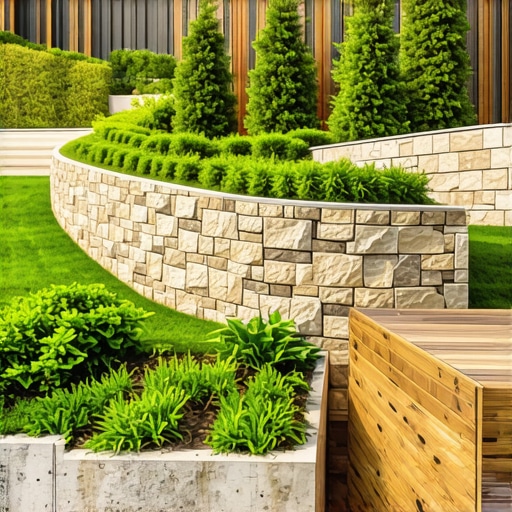
Modern sloped yard management in 2026 requires more than just stacking stones; it demands a deep understanding of hydrostatic pressure, soil mechanics, and sub-surface drainage systems. To build a wall that outlasts a mortgage, you must prioritize the structural integrity of the base-layer compaction and the integration of permeable backfill materials to prevent catastrophic failure. Forget the aesthetics for a moment and focus on the physics. If the engineering is flawed, the most expensive stone is just future rubble.
The Hardscape Autopsy: Why Most Sloped Yard Walls Fail
I recently got called out to tear up a $30,000 patio that was sinking because the previous contractor thought they could skip the geogrid and use rounded pea gravel for the base. Within two seasons, the soil migrated, the base shifted, and the entire structure began to lean toward the neighbor’s property. The hydrostatic pressure from a heavy rain turned that beautiful stone wall into a slow-motion landslide. It was a textbook case of ignoring the fundamentals of soil friction and water egress. You cannot cheat gravity. When you are dealing with a sloped yard, the weight of the water-saturated soil behind the wall can reach thousands of pounds per square foot. If you don’t provide a path for that water to escape, it will find one by pushing your wall over. This is the reality of hardscaping. It is 10% stacking and 90% dirt surgery.
“A retaining wall doesn’t fail because of the stone; it fails because of the water trapped behind it.” – Hardscape Engineering Axiom
How much modified gravel do I need for a patio base?
Calculating gravel for a retaining wall or patio base requires a minimum of 6 inches of 3/4-inch clean crushed stone (AASHTO #57) for the footer and 12 inches of the same material for the drainage chimney. For every 100 square feet of base at 6 inches deep, you need approximately 2.5 cubic yards of material, compacted in 2-inch lifts to ensure 95% Proctor density.
1. The Tiered Gabion-Wood Hybrid System
The Tiered Gabion-Wood Hybrid is a modern engineering solution that utilizes galvanized steel cages filled with angular rock to provide massive weight and permeability while softening the look with thermally modified timber. This system is superior for steep slopes because it allows for 100% water transparency, meaning water flows through the wall rather than building up pressure behind it. By 2026 standards, we are moving away from solid barriers and toward breathable structures. The gabion baskets provide the structural mass, while the timber tiers allow for native planting pockets that help with yard cleanup and long-term soil stabilization. Do not use rounded river rock in these cages. You need angular stone that interlocks under pressure. If the stones can roll, the wall can bulge.
| Feature | Gabion-Wood Hybrid | Modular Block Wall | Poured Concrete |
|---|---|---|---|
| Permeability | 100% (High) | Low (Requires Pipe) | Zero (Requires Weep Holes) |
| Flexibility | High (Self-adjusting) | Medium | Zero (Cracks) |
| Installation Speed | Fast | Medium | Slow (Cure Time) |
| Average Lifespan | 50+ Years | 30-40 Years | 50+ Years (if engineered) |
2. Low-Profile Permeable Gravity Walls
Modern Permeable Gravity Walls utilize the sheer weight of oversized, interlocking dry-stack units to resist soil pressure without the need for deep concrete footings. In 2026, we are seeing a shift toward large-format wet-cast concrete units that mimic natural granite but offer precise engineering tolerances. These walls are ideal for landscaping projects where you need to reclaim flat space from a slope. The key to these walls is the batter, or the slight backward lean into the hill. A 1:12 batter is standard, but steeper slopes may require more. This design works in tandem with sod install projects because it creates clean, level tiers that are easy to mow and maintain. You must ensure the irrigation lines are set at least 3 feet behind the wall to prevent localized saturation of the backfill.
What is the best drainage for a retaining wall?
The gold standard for retaining wall drainage is a 4-inch perforated SDR-35 pipe wrapped in a geotextile sock, placed at the bottom of a 12-inch wide clean stone drainage chimney. This pipe must be vented to daylight or a dedicated storm drain. Without this system, soil becomes fluid under heavy rain, leading to wall rotation or total collapse.
3. Smart-Irrigated Vertical Planter Walls
In 2026, the intersection of technology and biology is best seen in Smart-Irrigated Vertical Planter Walls, which use structural cells to hold both soil and water delivery systems. These are not simple garden walls; they are engineered living retaining structures that utilize drip-line irrigation sensors to maintain plant health while the internal structure holds back the slope. This is the ultimate solution for urban yards with limited space. The irrigation system is buried within the drainage layer, using moisture probes to ensure the soil pH and hydration levels stay optimal for sod install and perennial growth. This prevents the common issue of “mulch volcanoes” or over-saturated root zones that lead to plant rot. It is precision horticulture. It is engineering with a heartbeat.
- Excavate the trench to a depth of at least 12 inches below grade.
- Install a non-woven geotextile fabric to separate the subgrade from the base gravel.
- Compact 6 inches of 3/4-inch clean stone in 2-inch increments.
- Set the first course of block perfectly level; this is the most important step.
- Backfill with clean stone, never dirt, for at least 12 inches behind the wall.
- Install geogrid every two courses for walls over 3 feet tall.
“Soil is a living ecosystem, but in hardscaping, it is a structural load that must be managed with physics, not just aesthetics.” – Agronomy Manual for Site Prep
Before you even think about sod install or the final yard cleanup, you have to address the irrigation. Many contractors make the mistake of running lines too close to the wall face. This is a recipe for disaster. If a line leaks, it will wash out the fines in your base material. We call this internal erosion. It will kill your wall. Keep your main lines away from the wall and use only low-flow emitters for the plants on the tiers. This protects the structural integrity of the landscaping while keeping the biology alive. Digging 811 before you start isn’t just a legal requirement; it is common sense. Hitting a lateral line can turn a three-day build into a two-week nightmare. Do it right the first time. Don’t be the guy whose wall I have to autopsy in five years.