
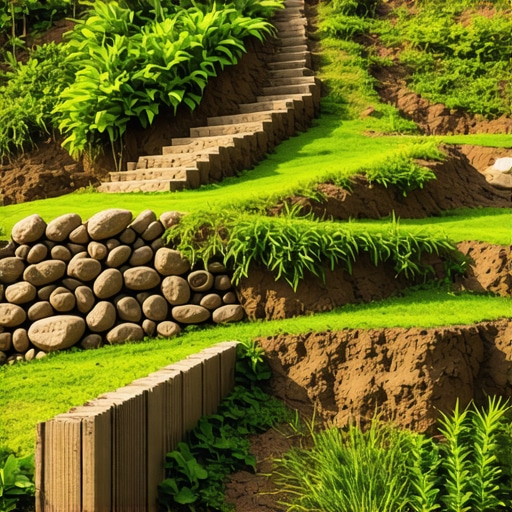
The first sign of failure isn’t the landslide; it’s the brown river of topsoil carving a jagged trench through your lawn after a three-inch rain. I recently got called out to tear up a $30,000 patio that was sinking because the previous contractor ignored the 25-degree grade behind it. They stacked heavy pavers on top of uncompacted fill dirt and walked away with a check. Six months later, the hydrostatic pressure from trapped groundwater pushed the base out, and the entire structure buckled. It was a forensic autopsy of pure negligence. If you don’t respect gravity and hydraulic pressure, the earth will move. Period.
The Structural Fix: Engineered Retaining Walls and Terracing
Retaining walls stop erosion by physically intercepting the gravitational pull on soil and managing hydrostatic pressure through engineered drainage layers. By creating level terraces, you break the velocity of runoff, allowing water to infiltrate the soil profile rather than stripping the surface of its organic matter. It is the most permanent solution for steep grades.
“A retaining wall doesn’t fail because of the stone; it fails because of the water trapped behind it.” – Hardscape Engineering Axiom
How much modified gravel do I need for a patio base?
For a standard retaining wall or patio base on a slope, you need a minimum of 6 inches of compacted 2A modified stone or #57 clean crushed limestone. On steep slopes, this base often needs to be 12 inches deep to provide adequate shear resistance. Never use rounded river rock or pea gravel for structural fill. They act like ball bearings. You need angular stone that locks together under compaction. I use a plate compactor to hit 95% Proctor density. Anything less is a gamble.
| Material Type | Erosion Resistance | Permeability | Typical Cost (per ton) |
|---|---|---|---|
| 2A Modified Stone | Extreme | Moderate | $35 – $50 |
| #57 Clean Stone | High | High | $40 – $60 |
| Shredded Hardwood Mulch | Low | High | $30 – $45 |
| Rip-Rap (Large Rock) | Extreme | Extreme | $70 – $110 |
The Biological Solution: Deep-Rooted Native Groundcovers and Sod
Deep-rooted vegetation and sod installation secure slopes by creating a root matrix that binds soil particles together like biological rebar. Unlike shallow turf grass, native species reach depths of 3 to 10 feet, anchoring the subsoil layers and increasing soil porosity for better irrigation efficiency. This is living engineering.
“Soil erosion on slopes exceeding 15% requires structural or vegetative stabilization to prevent the loss of topsoil and structural integrity.” – Penn State Agricultural Extension
While most homeowners reach for standard Kentucky Bluegrass, it is often a mistake on steep inclines. Turf grass roots are shallow. They are basically a rug sitting on a greased slide. You need plants that actually bite into the earth. I look for Panicum virgatum (Switchgrass) or Rhus aromatica (Fragrant Sumac). These aren’t just “bushes.” They are anchors. I also advise against using standard wood mulch on steep grades. It floats. When the rain hits, your $500 mulch job ends up in the storm drain. Use a jute mat or coconut coir blanket to hold the soil while your plants establish their rhizosphere.
What is the best irrigation for steep slopes?
The best irrigation system for a steep slope is pressure-compensating drip tubing installed under a heavy-duty erosion blanket. Overhead sprays are useless here. The water hits the slope too fast, causes surface crusting, and runs off before it ever hits the roots. Drip irrigation delivers water at a slow, measured rate of 0.6 to 0.9 gallons per hour. This prevents the soil from becoming a liquid slurry that slides down the hill.
The Hydrological Approach: French Drains and Managed Runoff
French drains and surface swales stop erosion by redirecting stormwater runoff away from vulnerable slopes into a stabilized discharge point. By managing the volume and velocity of water, you prevent rill erosion and gullying that typically destroys a landscaping project within the first year. Water is the enemy. Control it or it will control you.
Don’t use that cheap, corrugated black plastic pipe you buy at big-box stores. It collapses. It clogs. It’s garbage. I only install SDR-35 PVC with solvent-welded joints. We wrap the pipe in a non-woven geotextile fabric and surround it with clean stone. This creates a permanent subsurface drainage artery. If you’re doing a yard cleanup after a major storm and you see silt in your drains, your filter fabric has failed. Total excavation is usually the only fix. Don’t skip the fabric. It’s the only thing keeping the fines out of your pipes.
- Site Analysis: Measure the slope percentage using a transit level.
- Utility Marking: Always call 811 before digging for drains or walls.
- Soil Testing: Check pH levels; acidic soil (below 5.5) will kill your stabilizing plants.
- Compaction: Compact in 2-inch lifts, not 6-inch chunks.
- Armoring: Use rip-rap at the bottom of the slope to prevent undercut.
Landscaping on a 2026 slope isn’t about aesthetics. It’s about civil engineering. You have to think about soil microbiology, compaction ratios, and fluid dynamics. If you ignore the science, your yard will literally walk away from you. Spend the money on the base. Spend the money on the drainage. The plants are just the final coat of paint. Focus on the bones of the hill. That is how you stop erosion.