
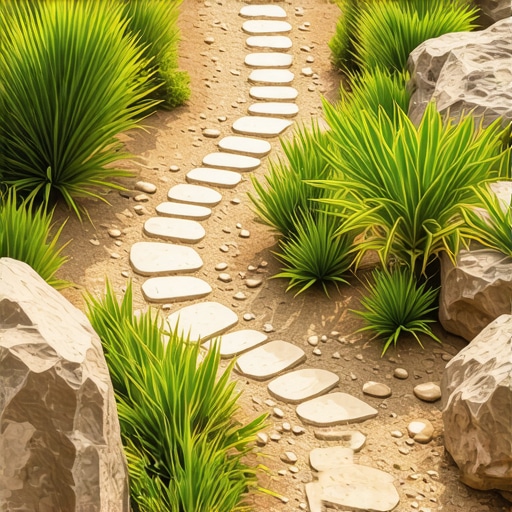
The Hardscape Autopsy: Why Foundation Matters More Than Aesthetics
I recently got called out to tear up a $30,000 patio that was sinking because the previous contractor failed to account for hydrostatic pressure and used a substandard base. The stones were premium, the layout was architecturally sound, but the engineering was a disaster. This is the reality of modern landscaping. As we approach the projected droughts of 2026, the margin for error in your yard disappears. You cannot hide poor soil work behind a thick layer of sod anymore. If the foundation isn’t built to manage heat and water retention at a molecular level, the entire install will fail within two seasons. We are moving away from the high-maintenance water-hogs of the past and toward a methodology rooted in geological permanence.
Site Preparation and Soil Engineering for Arid Success
Successful rock garden layouts require intensive site preparation that focuses on soil drainage and hydrostatic pressure management. By utilizing modified gravel bases and non-woven geotextiles, contractors ensure that the heavy rock placements remain stable even as soil moisture levels fluctuate during extreme drought conditions. Don’t skip the excavation. Most hacks just dump rock over existing turf. That leads to decomposition gases and nitrogen spikes that kill everything nearby. You need to strip the organic layer entirely. We use a 5-inch minimum excavation depth for heavy boulders. The soil isn’t just dirt; it’s a structural medium. We test for bulk density. If your soil is compacted, roots won’t penetrate. If it’s too loose, your $500 boulders will migrate two inches south after the first heavy rain.
“A retaining wall doesn’t fail because of the stone; it fails because of the water trapped behind it.” – Hardscape Engineering Axiom
How much modified gravel do I need for a patio base?
To calculate gravel needs, multiply the square footage of the area by the desired depth in feet, then divide by 27 to get cubic yards. For a standard 4-inch base on a 500-square-foot area, you need roughly 6.2 cubic yards of 21A or 57 stone. Standardize your measurements.
| Material Type | Drainage Rating | Load Bearing Capacity | Primary Use Case |
|---|---|---|---|
| Crushed Granite (Decomposed) | High | Moderate | Pathways and Infill |
| River Rock (Rounded) | Moderate | Low | Dry Creek Beds |
| Basalt Boulders (Igneous) | Low (Surface) | High | Structural Focal Points |
| #57 Limestone | Very High | High | Sub-base and French Drains |
The Physics of Stone Placement and Thermal Mass
Designing for the sun requires an understanding of **thermal mass** and how **igneous rocks** like basalt or granite absorb and radiate heat. In a high-end **rock garden**, stones act as a heat sink, protecting the **soil microbiology** beneath from the scorching 100-degree surface temperatures common in 2026 climate models. It is not about throwing rocks in a pile. It is about orientation. We bury the bottom third of every large boulder. This mimics natural outcroppings and provides structural stability. If the rock is just sitting on top, it’s a lawn ornament, not a landscape feature. We look at the grain of the stone. We align it with the prevailing winds to create micro-pockets of still air. This reduces the evapotranspiration rate of the surrounding plants. It is physics, not gardening.
- Conduct a 24-hour percolation test to determine drainage speed.
- Mark all underground utilities via 811 before any excavation.
- Remove all invasive species and organic debris during yard cleanup.
- Apply a 4-ounce non-woven geotextile to separate subgrade from aggregate.
- Install a dedicated drip irrigation system with pressure-compensating emitters.
- Select boulders with a minimum 2.5 specific gravity for longevity.
- Grade the site at a 2% slope away from all residential structures.
- Edge the perimeter with steel or heavy-duty poly to prevent stone migration.
- Use a plate compactor with at least 4,000 lbs of centrifugal force.
- Top-dress with a 2-inch layer of angular fines to lock the structure.
Integrated Irrigation and Native Biology
Precision **irrigation** systems are the lifeblood of a drought-resistant landscape, utilizing **subsurface drip lines** that deliver water directly to the **root flare** of native species. This approach eliminates the 30-40% water loss caused by evaporation and wind drift associated with traditional **sod install** spray heads. I see it every day: people plant a beautiful agave and then blast it with a rotor head. It will rot. Roots need oxygen just as much as water. If you saturate the soil, you’re drowning the microbiology. We install emitters that pulse water, allowing the soil to maintain its pore space. We also look at the Cation Exchange Capacity (CEC) of the soil infill. High CEC means the soil can hold onto nutrients better, which is vital when you are watering less frequently. We use a custom blend of 70% mineral grit and 30% organic compost for our rock garden pockets.
“Native plants in rock gardens require 80% less supplemental water once established, provided the soil pH is maintained within a 6.0 to 7.5 range.” – Texas A&M AgriLife Extension
What are the best drought-resistant plants for full sun rock gardens?
The most resilient species include **Agave ovatifolia**, **Sedum spurium**, and **Hesperaloe parviflora**. These plants utilize CAM photosynthesis, opening their stomata only at night to minimize water loss. Ensure the soil mix has high porosity to prevent root rot during winter months. Avoid heavy clays.
The Transition from Sod to Stone
The transition from a high-maintenance lawn to a managed rock garden is a surgical process, starting with a comprehensive **yard cleanup** that eliminates the **thatch layer** and neutralizing the nitrogen-heavy fertilizers left over from previous seasons. Most homeowners think they can just stop watering the grass. That leaves a mat of dead organic matter that acts as a sponge for fungus. You have to scalp it, spray a non-selective herbicide if necessary, and then physically remove the root mass. Only then do you have a clean slate for a rock garden. This isn’t a weekend DIY project. It’s an overhaul of the property’s ecosystem. We focus on the long game. A properly engineered rock garden will look better in ten years than it does on day one. It doesn’t need a mower. It doesn’t need a chemical program. It needs a leaf blower once a month and a sharp eye for the occasional weed. That is the future of sustainable landscaping.