
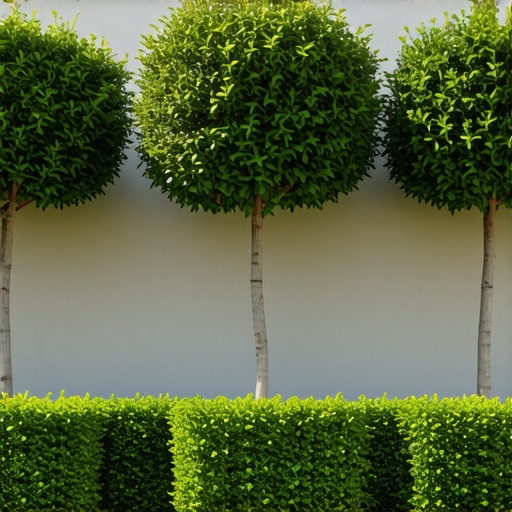
3 Low-Water Privacy Hedges for High-Heat 2026 Summers
I always drill into my new crew members: if you don’t fix the soil grading and chemistry first, every plant you put in the ground is just expensive compost. Last July, I saw a homeowner waste four grand on Italian Cypresses that turned into $4,000 toothpicks within sixty days. Why? Because they treated the soil like a sandbox instead of a biological engine. They didn’t check the compaction levels. They didn’t test the pH. They just dug holes and prayed. In this business, prayer isn’t a strategy. As we head into the projected extreme heat of 2026, the old standards like Emerald Green Arborvitae are going to fail. They can’t handle the atmospheric demand. You need plants engineered by evolution for high-heat, low-moisture environments. You need a landscape that functions under pressure.
The Critical Failure of Traditional Privacy Screens
Traditional privacy hedges fail in high-heat summers because they lack the physiological adaptations to combat high evapotranspiration rates and soil moisture deficits. Homeowners often choose plants based on aesthetics rather than USDA hardiness zones or drought tolerance, leading to widespread root desiccation and vascular collapse when temperatures exceed 100 degrees Fahrenheit for extended periods.
“A retaining wall doesn’t fail because of the stone; it fails because of the water trapped behind it, just as a hedge fails not from the sun, but from the inability of the root system to meet the hydraulic demand of the canopy.” – Hardscape Engineering Axiom
How much water do new privacy hedges need?
New hedges require deep, infrequent watering to establish a resilient root structure. For the first year, provide 5 to 10 gallons of water per plant once or twice a week, depending on soil drainage. Use a drip irrigation system with 2.0 GPH emitters to ensure water reaches the root flare without evaporating. It will rot if you keep the surface wet but the core dry. Don’t skip the moisture meter check.
1. Arizona Cypress (Cupressus arizonica)
The Arizona Cypress is a premier choice for high-heat privacy because it utilizes a deep taproot and glaucous, waxy foliage to minimize water loss. This species thrives in well-drained soil and can withstand temperatures that would scorch traditional evergreens, making it an ideal landscaping solution for the 2026 climate shift.
When you plant Arizona Cypress, you aren’t just putting a tree in the dirt; you are installing a windbreak that can handle 110-degree spikes. I prefer the ‘Blue Ice’ cultivar for its structural integrity. You have to watch the soil pH; they hate wet feet. If your site has heavy clay, you must amend it with expanded shale or crushed granite to increase the macropore space. Without oxygen in the soil, the roots will suffocate. This isn’t optional. I’ve seen $10,000 installs die because the contractor ignored hydrostatic pressure and drainage in the planting trench. It is a slow death by root rot.
2. Wax Myrtle (Morella cerifera)
Wax Myrtle serves as a hardy, fast-growing privacy screen that adapts to various soil types while maintaining high heat resistance through nitrogen-fixing root nodules. It provides a dense, 15-foot living fence that requires significantly less irrigation than standard privet or boxwood once the root system is established.
This plant is a workhorse. It doesn’t care if your soil is poor. The symbiotic bacteria in its roots actually pull nitrogen from the air and feed the plant. This makes it a superior choice for yard cleanup and reclamation projects where the soil has been stripped of nutrients. However, you must avoid “mulch volcanoes.” Piling mulch against the trunk traps moisture and creates a bridge for fungal pathogens. Keep the mulch three inches away from the bark. Let the root flare breathe. If you bury the flare, you’re just timing the funeral.
3. Texas Privet (Ligustrum japonicum ‘Texanum’)
Texas Privet is a resilient, evergreen shrub designed for extreme heat, offering thick, leathery leaves that resist wilting and reflect intense UV radiation. Unlike common hedges, this variety maintains its sod install-compatible footprint without encroaching on structures, provided the landscaping plan accounts for its mature spread of 6 to 8 feet.
Don’t confuse this with the invasive varieties. The ‘Texanum’ is a controlled grower. It’s the brick wall of the plant world. I use it when a client has a hardscape patio that reflects massive amounts of heat. The leaf cuticle is thick, which acts like a thermal shield. When planting these, we use a modified gravel base at the bottom of the trench if the site has poor percolation. We shoot for a soil compaction rate that allows for root penetration while preventing settling. If the plant settles too deep, the stem will rot. Simple as that.
What is the best soil for drought-tolerant hedges?
The best soil for drought-tolerant hedges is a sandy loam with at least 5% organic matter to facilitate capillary action while ensuring drainage. Avoid pure clay, which holds too much water, or pure sand, which leaches nutrients too fast. Aim for a pH level between 6.0 and 7.5 for optimal nutrient bioavailability.
| Hedge Species | Growth Rate (per year) | Mature Height | Water Requirement | USDA Zone |
|---|---|---|---|---|
| Arizona Cypress | 24-36 inches | 30-40 feet | Very Low | 7-9 |
| Wax Myrtle | 36-48 inches | 15-20 feet | Low | 7-11 |
| Texas Privet | 12-24 inches | 8-12 feet | Low/Moderate | 7-11 |
The Engineering of a Living Screen
A successful living screen requires precise engineering of the subsurface environment to manage moisture levels and nutrient delivery. This involves calculating irrigation run times based on evapotranspiration (ET) rates and ensuring that the soil structure can support the weight and wind-load of mature plants.
“High-heat environments increase evapotranspiration rates, requiring a 30% increase in mulch depth to maintain soil moisture and prevent thermal shock to the rhizosphere.” – Texas A&M AgriLife Extension
We don’t just dig a hole; we excavate a system. We check for utility marking via 811 before any sod install or digging begins. We look at the cation exchange capacity (CEC) of the soil. If the CEC is low, the soil can’t hold onto the potassium and magnesium these plants need to regulate their stomata during a heatwave. We amend with high-quality compost, not the bagged trash from big-box stores. You want biology, not just filler. I’ve seen “professional” crews throw down 10-10-10 fertilizer in the middle of a 100-degree heatwave. That is a death sentence. The salts in the fertilizer pull water out of the roots. It’s called osmotic stress. It kills. Don’t do it.
Privacy Hedge Installation Checklist
- Call 811 to mark underground utility lines 48 hours before digging.
- Conduct a percolation test to ensure the site drains at least 1 inch per hour.
- Test soil pH and adjust to 6.5 using elemental sulfur or lime as needed.
- Dig the planting hole twice as wide as the root ball but no deeper.
- Scarify the sides of the hole to prevent root circling in clay soils.
- Install a 17mm inline drip tube for consistent hydration.
- Apply 3 inches of double-ground hardwood mulch, keeping it clear of the trunk.
- Set the plant slightly above grade (1-2 inches) to allow for settling.
- Water immediately to settle air pockets and maximize soil-to-root contact.
- Prune only dead or crossing branches in the first year to allow for root focus.
Landscaping in 2026 is going to be about survival of the fittest. You can’t cheat physics. If you want a hedge that actually blocks the neighbors and doesn’t turn into a brown skeleton, you have to invest in the engineering. Use the right plants. Fix the soil. Install smart irrigation. Do the work once, or do it twice and pay me double the second time. The choice is yours.