
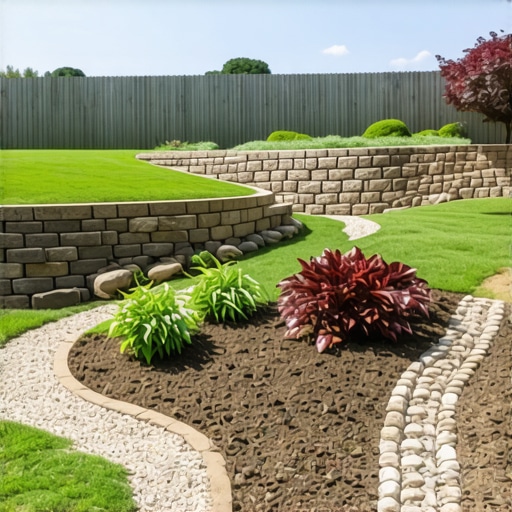
Engineering the Stable Slope: Why Soil Science Prevents Failure
Stopping topsoil erosion fast requires a mechanical understanding of slope stabilization, hydrostatic pressure management, and root-zone architecture. By implementing engineered terracing, subsurface drainage, or biological geotextiles, you can arrest the movement of sediment and preserve the nutrient-rich topsoil necessary for a sustainable landscaping ecosystem. I always drill into my new crew members: if you don’t fix the soil grading first, every plant you put in the ground is just expensive compost. I have watched $50,000 projects slide down a hill because the contractor ignored the angle of repose. You can buy the most expensive nursery stock in the state, but if your slope is washing out the nitrogen and exposing the root flare, you are just burning the client’s money. Soil is a living, structural material. When gravity acts on saturated silt, it behaves like a liquid. You must treat it like a civil engineering project. It will fail otherwise. Check the base. Water is heavy. One cubic foot of saturated soil can weigh over 100 pounds. Multiply that by a 20-foot slope and you have a massive lateral force pushing against your yard. Most hacks just throw some mulch and a few hostas at it. That is a waste of time. You need a yard cleanup that includes the removal of loose, non-compacted organic debris followed by a sod install or hardscape intervention. Deep, infrequent irrigation is the final step to force roots down, locking the soil matrix together. Stop looking at your yard as a garden. Start looking at it as a structural slope.
How much modified gravel do I need for a patio base or slope footer?
Calculating base aggregate volume requires multiplying the square footage by the desired depth in feet, then dividing by 27 to find cubic yards. For a standard 6-inch footer on a slope, multiply the length by width by 0.5 feet and add a 10 percent waste factor for compaction. Use 2A modified stone. It locks together. Round stone rolls. Do not use round stone for footers. Compaction is non-negotiable.
1. Structural Terracing with Integrated French Drains
To stop topsoil erosion fast on a steep grade, structural terracing using 6-inch compacted gravel bases and Segmental Retaining Walls (SRW) provides the most immediate result. This engineering approach physically prevents soil creep and manages stormwater runoff through subsurface perforated pipe networks. Terracing is about breaking the velocity of water. When water gains speed, it gains carrying capacity. Faster water carries more dirt. By creating flat benches, you force water to stop and sink. This is where your irrigation efficiency increases. Vertical drops must be supported by a solid base. We dig a trench at least 12 inches deep. We fill it with 6 inches of 2A modified stone. We hit it with a plate compactor until it rings. The tamper should literally bounce off the compacted base. If it sinks, keep going. You are looking for a 95 percent Proctor density. Behind the wall, you need a 12-inch chimney of clean 3/4 inch stone. This allows water to drop straight down into the French drain rather than pushing against the blocks.
“A retaining wall doesn’t fail because of the stone; it fails because of the water trapped behind it.” – Hardscape Engineering Axiom
This is the most expensive option but the only one that guarantees a 20-year lifespan. It is the gold standard for landscaping on a hill. Don’t skip the geogrid. Geogrid anchors the wall into the hillside. It uses the weight of the dirt to hold the wall in place. Physics works if you let it.
What is the best ground cover for steep slopes?
The best ground cover for steep slopes includes deep-rooted species like Creeping Juniper or Native Switchgrass, which reach depths of 5 to 10 feet. Unlike standard turf, these plants create a biological anchor that resists shear forces during heavy rain events. Turf grass only goes down a few inches. On a steep hill, that is not enough. You need the big guns. Native species are adapted to your local USDA Hardiness Zone. They don’t need constant coddling. They just need a good yard cleanup to start. Clean the weeds. Lay the fabric. Plant the plugs. It takes time to establish. Be patient.
2. Bio-Engineering with High-Density Geotextiles and Native Plugs
For slopes where hardscaping is not feasible, bio-engineering using coconut coir logs and high-density geotextiles creates a temporary erosion control barrier while native root systems establish. This method relies on the tensile strength of the fabric to hold the topsoil in place for 2 to 3 years as the plants take over the structural load.
“Effective erosion control on slopes exceeding a 3:1 gradient requires a combination of structural barriers and vegetative stabilization to maintain soil integrity.” – Penn State Extension
We start by clearing the slope of invasive brush. This is a hardcore yard cleanup. We strip it to the bare earth. Then we lay down a heavy-duty jute or coir mat. We pin it every 12 inches with steel staples. If you don’t pin it, the wind will take it. Or the water will flow under it. We then cut small X-patterns in the mat and plant native plugs. These aren’t your big-box store annuals. We use Panicum virgatum or Schizachyrium scoparium. These grasses have roots that dive deep. They act like rebar in concrete. While the matting eventually rots, the root matrix remains. This is how you build a living wall. It requires a specific irrigation setup. You want low-flow drip emitters. High-pressure sprays will just cause surface rilling. You need to keep the mat moist to encourage the seeds to bite. It is a slow process but incredibly effective for large acreage.
| Stabilization Method | Erosion Reduction (%) | Material Cost | Lifespan |
|---|---|---|---|
| SRW Terracing | 98% | High | 25+ Years |
| Bio-Engineering | 85% | Medium | 10 to 15 Years |
| Sod + Pinning | 60% | Low | 5 to 7 Years |
This table shows that you get what you pay for. Don’t expect a sod install to hold a 45-degree cliff forever. Use the right tool for the job.
3. Strategic Sod Installation and Subsurface Irrigation
A sod install on a slope can be effective for stopping topsoil erosion fast if the sod is pinned correctly and supported by a subsurface irrigation system that prevents surface saturation. Laying sod on a hill is not like laying it on a flat lawn. You must lay the strips perpendicular to the flow of water. Think of them as tiny speed bumps. If you lay them parallel, the seams become rivers. The water will find the path of least resistance. It will wash the dirt out from under your new lawn. We use 6-inch biodegradable sod staples. We use two per square foot. We hammer them in flush. This keeps the sod in contact with the topsoil. Contact is everything. If there is a gap, the roots will dry out. They will die. The whole sheet will slide off the hill like a carpet. You also need to manage the irrigation carefully. Standard pop-up heads often put out too much water too fast. On a slope, the water runs off before it can soak in. This is called runoff waste. We use rotary nozzles with a low precipitation rate. They apply water slowly. This allows the soil profile to absorb the moisture. It forces the roots to grow deep into the topsoil to find water. Deep roots equal a stable slope. This is the landscaping secret that most guys won’t tell you. They want to sell you more fertilizer. I want to sell you a lawn that actually stays put.
Does sod stop erosion on hills?
Yes, sod stops erosion by providing immediate ground cover that absorbs the kinetic energy of raindrops, but it must be mechanically anchored with staples on slopes greater than 3:1. Without stapling and proper perpendicular installation, the sod can delaminate from the subgrade during heavy saturation. It is a temporary fix if not maintained. You need the right NPK balance to keep the roots aggressive. Nitrogen for the top, Phosphorus for the roots. Don’t skimp on the P. Phosphorus is what locks the hill down.
The Professional Slope Stabilization Checklist
- Call 811 to mark all underground utilities before any excavation or landscaping.
- Perform a soil pH test to determine if lime or sulfur is needed for plant health.
- Calculate the slope percentage (Rise divided by Run) to choose the correct material.
- Procure 2A modified stone for hardscape bases and clean 3/4 inch stone for drainage.
- Excavate footers to a minimum depth of 12 inches for walls over 2 feet tall.
- Use a plate compactor in 4-inch lifts to ensure maximum soil density.
- Install a 4-inch perforated drain pipe wrapped in geotextile fabric.
- Pin all sod or erosion blankets with 6-inch steel staples.
- Set irrigation controllers to cycle-and-soak modes to prevent runoff.
Long-term soil governance is about consistency. You can’t just set it and forget it. After the first big storm, get out there. Look for rills. Look for settling. If you see a small crack in the soil, fill it. If a staple popped, replace it. Nature is constantly trying to level your yard. Your job is to fight back with better engineering and better biology. That is the difference between a professional landscaping firm and a guy with a truck. We build for the next decade. Not the next weekend.