
Why Your Expensive Pavers Are Turning White
Paver efflorescence is the crystalline deposit of water-soluble salts that migrates to the surface of concrete pavers through capillary action, resulting in a white, chalky haze that ruins the aesthetic of your hardscape. This chemical process occurs when moisture reacts with calcium hydroxide in the cement, forming calcium carbonate upon contact with carbon dioxide in the air.
I recently got called out to tear up a $30,000 patio that was sinking because the previous contractor failed to address the basic hydraulics of the site. They didn’t just mess up the modified gravel base; they ignored the hydrostatic pressure building up behind the retaining wall. As the water sat under those pavers, it didn’t just cause settling; it triggered a massive breakout of efflorescence that looked like someone had dumped bags of flour across the entire job site. It was a forensic disaster. The homeowner thought the pavers were defective. They weren’t. The installation was. Every time it rained, the water wicked upward, bringing every salt in that sub-par base material to the surface. It was a $30,000 lesson in why drainage is the most important part of any landscaping project.
“A retaining wall doesn’t fail because of the stone; it fails because of the water trapped behind it.” – Hardscape Engineering Axiom
The Science of the White Haze
Efflorescence isn’t a stain; it’s a growth. Concrete is porous. When you have a sod install happening right next to your patio, your irrigation system is pumping gallons of water into the soil. If your yard grading is off, that water migrates under your pavers. This moisture dissolves the calcium oxide inherent in the concrete. As the sun draws the moisture up, the solution evaporates, leaving the solid calcium carbonate behind. If you leave it too long, it hardens into a calcified shell that no garden hose will ever touch. You need a chemical intervention.
How much modified gravel do I need for a patio base?
To calculate modified gravel needs, multiply the total square footage by the depth (standard 4-6 inches for patios, 8-12 for driveways), then divide by 27 to get cubic yards; add 20% for compaction. A 4-inch base requires approximately 1.25 tons of 2A modified stone per 100 square feet to ensure structural integrity and prevent the moisture retention that feeds efflorescence. Don’t eyeball it. Use a plate compactor in 2-inch lifts. If the tamper doesn’t literally bounce off the ground, it’s not dense enough.
| Acid Type | Dilution Ratio | Best For | Risk Level |
|---|---|---|---|
| Muriatic Acid | 10:1 (Water:Acid) | Heavy calcification, stubborn salts | High (Corrosive) |
| Phosphoric Acid | 12:1 (Water:Acid) | Light haze, newer pavers | Medium |
| Vinegar (Acetic) | 1:1 (Water:Vinegar) | Minor surface dust | Low |
The $20 Acid Wash Remediation Protocol
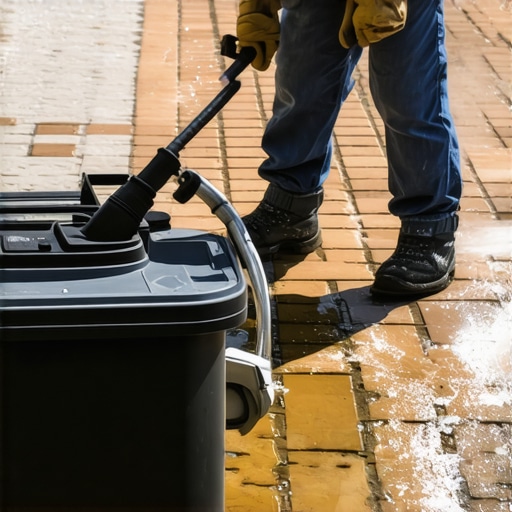
The solution is an acid wash, but you have to do it right or you’ll etch the pavers and ruin the finish. You can buy a gallon of muriatic acid for under $20 at any masonry supply house. This acid reacts with the calcium carbonate, dissolving it instantly. [image_placeholder_1]
- Saturation: Soak the pavers with clean water first. The pavers must be saturated so the acid stays on the surface and doesn’t soak into the core.
- The Mix: Add 1 part acid to 10 parts water in a plastic watering can. Always add acid to water, never water to acid.
- The Scrub: Apply the mixture to a 10×10 section. Use a stiff-bristled nylon brush. Scrub quickly.
- The Neutralizer: After 60 seconds, flood the area with water. If you leave it too long, the acid will eat into the aggregate.
- The Cleanup: Perform a final yard cleanup to ensure no acidic runoff hits your new sod install or sensitive plant roots.
Is acid washing safe for all pavers?
Acid washing is generally safe for concrete pavers but should be avoided on natural stone like limestone or marble, as the acid will cause permanent surface etching and structural degradation. Always perform a test patch in a hidden corner to verify that the pigment in your concrete pavers won’t be bleached or altered by the chemical reaction. Most high-end pavers use iron oxide pigments that are acid-resistant, but cheap big-box alternatives often use dyes that can fail under chemical stress.
“Effective pavement drainage systems must be designed to handle both surface runoff and subsurface water migration to prevent the accumulation of soluble salts.” – ICPI Tech Spec 19
Maintenance to Prevent Reoccurrence
Once you’ve cleared the salts, you have to stop the water. Check your irrigation heads. If they are over-spraying onto the hardscape, you’re just feeding the cycle. Ensure your landscaping beds are graded at a 2% slope away from the patio. If the white haze returns, it means you have a drainage problem under the pavers. It will rot. You can’t just hide it with a sealer; sealing efflorescence into the stone is a death sentence for the finish. Use a breathable, silane-siloxane sealer only after the pavers have been salt-free for at least 60 days. Don’t skip this. It’s the difference between a patio that lasts 30 years and one that looks like a salt mine in 2026.