
The Autopsy of a Dying Hedge: Why Your Boxwoods Are Melting
You see the straw-colored patches first. Then the leaves drop. Within two weeks, your expensive Buxus hedge looks like a collection of blackened sticks. This is not winter burn and it is not simple drought stress. It is Boxwood Blight (Calonectria pseudonaviculata), a fungal pathogen that turns a high-end landscaping project into a pile of expensive compost in a single season. Most homeowners make the mistake of thinking more water or a handful of 10-10-10 fertilizer will fix it. They are wrong. It will rot. The fungus thrives on moisture and stagnant air. If your irrigation system is hitting the foliage directly, you are essentially feeding the pathogen. To save your yard in 2026, you have to stop thinking like a gardener and start thinking like a surgical engineer.
The Apprentice Lesson: Why Grading and Airflow Matter
I always drill into my new crew members: if you don’t fix the soil grading first, every plant you put in the ground is just expensive compost. I remember a job in ’18 where a client spent twelve grand on mature English Boxwoods. The previous contractor had buried the root flares and set the sod install right up against the stems. No air could move. The humidity stayed trapped in the lower canopy. By the time I arrived, the blight had claimed 60% of the hedge. We had to excavate, fix the drainage to prevent hydrostatic pressure buildup near the root zones, and teach the homeowner that boxwoods need to breathe from the inside out. Don’t skip this. If your soil doesn’t drain, the roots suffocate before the fungus even arrives.
“Effective management of boxwood blight requires an integrated approach that includes genetic resistance, moisture management, and strategic pruning to modify the microclimate.” – USDA Horticultural Research Service
Tactic 1: The ‘Window’ Thinning Technique
Thinning for airflow involves removing approximately 10 percent of the interior branches to break the dense outer canopy and allow sunlight to reach the stems. This landscaping tactic reduces the leaf-wetness period, which is the primary driver of fungal spore germination. Use sharp, bypass pruners. Do not use shears for this. You are looking for ‘congested’ areas where the branches cross. Snip them back to a main lateral branch. This creates ‘chimneys’ for air to move through the plant. If the interior of your boxwood is a mass of dead, brown leaves, you have already failed. Clear it out. A clean interior is a dry interior.
Tactic 2: Sanitized Surgical Pruning
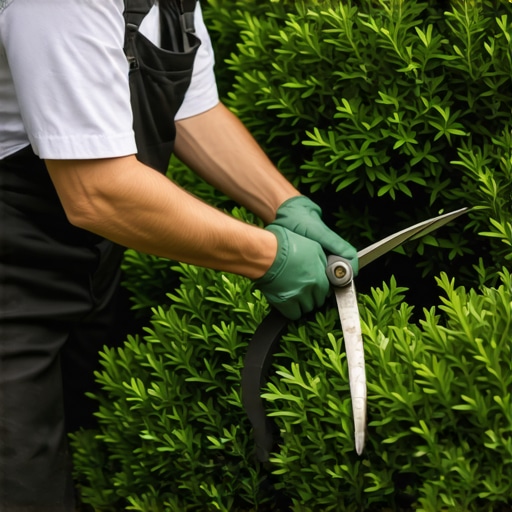
Sanitization and tool hygiene mean disinfecting every blade with 70% isopropyl alcohol or a 10% bleach solution between every single plant to prevent the mechanical spread of sticky fungal spores. Boxwood blight spores are heavy and sticky; they don’t travel far by wind, but they hitchhike on your clothes, your dog, and especially your pruning shears. If you prune an infected plant and move to a healthy one without dipping your tools, you have just signed that plant’s death warrant. This is why yard cleanup crews often spread the disease faster than nature does. Watch your tools. Clean them. No excuses.
Tactic 3: Lower Canopy Clearance and Mulch Management
Lower canopy clearance is the practice of removing any branches within 4 to 6 inches of the soil surface to prevent spores from splashing up during heavy rain or irrigation cycles. When water hits the soil, it kicks up fungal inoculum. If your branches are dragging in the dirt, the infection starts at the bottom and moves up like a ladder. Combine this with a yard cleanup that removes every single fallen leaf. The fungus overwinter in the leaf litter. If you leave that debris, you are maintaining a spore bank for next spring. Replace old mulch with a fresh 1-inch layer of hardwood mulch to act as a physical barrier.
Comparison of Boxwood Varieties and Blight Resistance
| Variety Name | Resistance Level | Growth Rate | Soil pH Preference |
|---|---|---|---|
| English Boxwood (Suffruticosa) | Very Low | Slow | 6.5 – 7.2 |
| American Boxwood | Low | Moderate | 6.8 – 7.5 |
| NewGen Independence | High | Moderate | 6.5 – 7.0 |
| Little Missy | High | Slow | 6.5 – 7.2 |
“Calonectria pseudonaviculata produces sticky spores that can persist in the soil for several years, making sanitation of landscaping equipment paramount.” – University of Maryland Extension
How much modified gravel do I need for a patio base?
While not directly related to pruning, drainage affects boxwood health. For a standard patio near a hedge, you need 6 inches of compacted 21A or 57 stone to ensure water moves away from the root zones. Poorly drained hardscapes create ‘wet feet’ for boxwoods, making them prime targets for blight and root rot.
Can I save a boxwood already infected with blight?
If the infection is less than 20% of the canopy, aggressive pruning, chemical fungicides containing chlorothalonil, and a total yard cleanup of debris can save the plant. However, if the stems show black cankers all the way to the base, the plant is a loss. Pull it. Do not compost it. Burn it or bag it for the landfill.
Essential Boxwood Maintenance Checklist
- Check irrigation timing: Water only in the pre-dawn hours (4 AM – 7 AM) to allow the sun to dry the leaves quickly.
- Verify soil pH: Boxwoods struggle in acidic soil; keep it between 6.5 and 7.2.
- Never shear in the rain: Wet weather is the express lane for fungal infection.
- Apply a pre-emergent in early spring: Prevent weeds from competing for airflow at the base of the hedge.
- Monitor for Boxwood Leafminer: Weakened plants are more susceptible to blight.