
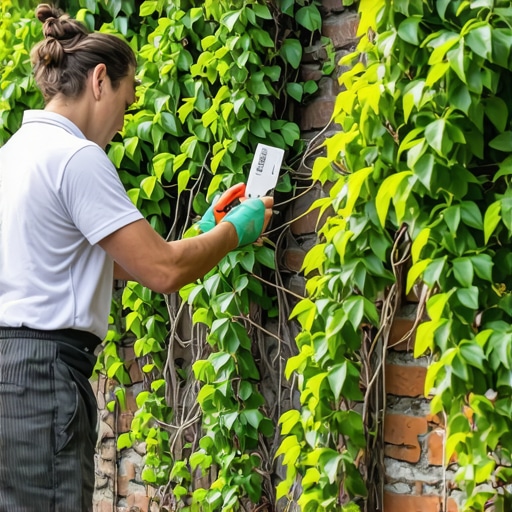
The Slow-Motion Demolition of Your Home’s Exterior
I always drill into my new crew members: if you don’t fix the soil grading first, every plant you put in the ground is just expensive compost. The same logic applies to your brickwork. When you see an invasive vine crawling up a chimney or a retaining wall, you aren’t looking at a charming landscape feature; you are looking at a biological wrecking ball. I’ve spent twenty years digging out English Ivy and Trumpet Creeper that had literally sucked the lime right out of the mortar joints. If you approach this with a ‘mow-and-blow’ mentality, you’re going to end up with a pile of expensive rubble instead of a wall. This is a technical excavation, not a yard cleanup.
The Structural Impact of Invasive Vines on Brick
Invasive vines destroy brick by inserting adventitious roots into mortar joints and secreting organic acids that dissolve calcium carbonate. This process leads to spalling, moisture entrapment, and structural failure of the masonry wall if not remediated with professional-grade mechanical and chemical protocols. You cannot simply rip these plants off the surface. If you do, the root disks stay embedded, and you’ll pull the face of the brick right off with it. It is a slow-motion car crash for your architecture.
“English ivy (Hedera helix) is a woody evergreen perennial that can climb up to 90 feet, using adventitious rootlets to cling to surfaces, leading to significant moisture retention against structures.” – Penn State Extension
The Biology of the Attack
Vines like Hedera helix or Campsis radicans don’t just lean against your house. They use thousands of microscopic ‘fingers’ to find any crack or pore. Once inside, they expand. As the plant grows, the root thickens, exerting hundreds of pounds of pressure per square inch (PSI) against the internal structure of the mortar. This is why you see brick ‘spalling’—where the front of the brick flakes off. It’s not the weather; it’s the plant. Furthermore, the foliage creates a micro-climate against the wall. In a proper landscaping setup, your house needs to breathe. Vines trap humidity, leading to rot and mold that can eventually penetrate the interior sheathing.
The Professional Remediation Protocol
Clearing invasive vines from brick requires a multi-phase chemical and mechanical strategy to ensure the root system is neutralized before physical removal. This process involves severing the main trunk, applying systemic herbicide, and allowing for a ‘die-back’ period to minimize mechanical damage to the masonry. This is not a weekend DIY project if you want the wall to survive for another fifty years.
| Method | Cost Efficiency | Risk to Masonry | Long-term Success |
|---|---|---|---|
| Manual Ripping | High | Extreme | 10% |
| Chemical Die-back | Medium | Low | 85% |
| Thermal Scorch | Low | High | 50% |
| Integrated Removal | Medium | Very Low | 95% |
Step 1: The Base Cut and Kill
Don’t touch the wall yet. Go to the base. Find the primary stems—some of these will be as thick as a man’s wrist. Use a pair of bypass pruners or a reciprocating saw to cut a 12-inch gap in the vine. This disconnects the upper foliage from its water source. Immediately paint the fresh cut on the ground-side with a 41% glyphosate concentrate. This isn’t your grocery store weed killer; this is professional-grade stuff. You want the plant to pull the chemical down into the root ball. If you have a nearby irrigation system, turn it off in this zone. You want the vine thirsty so it drinks the poison.
Step 2: The Waiting Game
You must wait at least 14 to 21 days. The leaves will turn brown, and the vine will go brittle. This is critical. When the vine is alive, it is flexible and ‘glued’ to the brick. When it dies, the rootlets shrink and lose their grip. It’s the difference between pulling wet tape off a box versus pulling dry, old tape. One takes the cardboard with it; the other snaps off.
Essential Tools for Vine Excavation
- Bypass pruners and loppers for primary stem severance.
- Stiff nylon brushes (Never use steel brushes on brick).
- 41% Glyphosate or Triclopyr concentrate for stump treatment.
- Personal Protective Equipment (PPE) including chemical-resistant gloves and goggles.
- Pressure washer with a wide-angle tip (Set to low PSI).
How much vinegar do I need to kill invasive vines?
Vinegar, even at 30% industrial strength, is ineffective for deep-rooted invasive vines because it only burns the foliage and does not kill the root system. For permanent removal from brick, you must use systemic herbicides like Glyphosate or Triclopyr that translocate to the root tip. Don’t waste your time with home remedies when your home’s structural integrity is on the line.
Can I pull vines off brick without breaking the mortar?
You can only pull vines safely if they are completely dead and brittle. Even then, you must pull them sideways or downwards, never straight away from the wall. If the mortar is already soft or sandy, any mechanical pulling will likely necessitate a re-pointing of the masonry joints. If you see the vine has entered the mortar, stop immediately. You’ll need to cut it flush and let it rot out naturally over years.
The Post-Removal Landscape Reset
Once the vines are gone, the area at the base of the wall is usually a disaster. The vines have sucked the nitrogen out of the soil and probably ruined the grading. This is where a sod install or a fresh yard cleanup comes in. You need to ensure the soil slopes away from the foundation at a minimum of 2% grade. If you don’t fix the drainage, the moisture that the vines used to thrive on will now just sit against your foundation, leading to hydrostatic pressure issues.
“A retaining wall doesn’t fail because of the stone; it fails because of the water trapped behind it or the biological forcing agents on its face.” – Hardscape Engineering Axiom
If you’re planning on a new sod install near the wall, keep the grass at least 12 inches away from the brick. Use a stone drip edge instead. This prevents your irrigation heads from constantly hitting the brick, which would otherwise encourage the next generation of invasive seeds to take hold. It’s about creating a sterile perimeter. Brick is for shelter, not for gardening. Keep your biology in the beds and your engineering in the walls. Don’t skip the details. It will rot if you do. Just do it right the first time.