
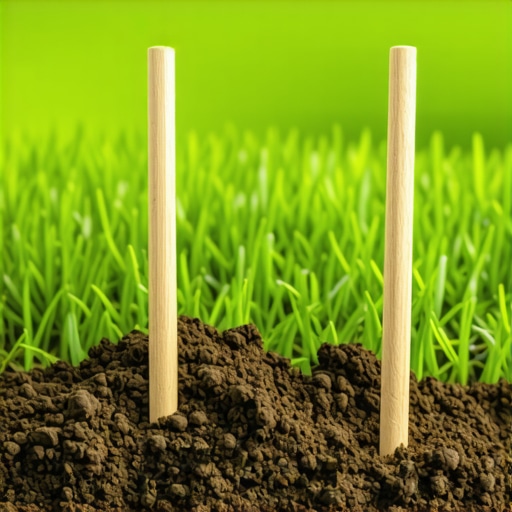
The Hard Truth About Turf Anchoring
Installing a new lawn isn’t about the green side; it’s about the brown side. I always drill into my new crew members: if you don’t fix the soil grading first, every plant you put in the ground is just expensive compost. Most homeowners and ‘mow-and-blow’ outfits think they can just throw a pallet of sod on a 30-degree incline and walk away. That is a recipe for a $5,000 mudslide. I remember a job back in ’08 where we were called to fix a site where 4,000 square feet of high-end Tall Fescue had literally slid six feet down a hill during a midnight thunderstorm because the previous guy used 4-inch metal staples on uncompacted fill. It was a mess of tangled roots and silt. We don’t do that here. We use engineering. If you are dealing with a slope or high-traffic area, sod displacement is your primary enemy. Gravity and water work together to break the friction between the sod mat and the subgrade. To prevent this, you need a mechanical bond that lasts exactly long enough for the roots to take over, which is why the 2026 biodegradable stake standards are a game-changer for the industry. This is not just about putting a nail in the ground; it is about managing soil shear strength and ensuring the rhizosphere remains undisturbed during the critical first twenty-one days of establishment.
The Mechanics of Sod Displacement
Sod displacement occurs when the force of gravity or hydraulic pressure exceeds the friction between the sod’s root mat and the prepared subgrade. To stop this, contractors must use biodegradable stakes to mechanically anchor the turf into the parent soil, preventing sliding, ‘tucking,’ or gaps that lead to root desiccation and eventual lawn failure.
When you lay a piece of sod, you are essentially placing a heavy, wet blanket on top of a slick surface. If that surface is sloped, the weight of the water from your first irrigation cycle increases the downward force. Without anchoring, the sod rolls will buckle. This creates ‘lips’ that catch the mower blade or, worse, air pockets that dry out the tender white feeder roots before they can penetrate the soil. We measure this in terms of shear resistance. A standard 6-inch stake provides enough vertical and lateral resistance to counteract the weight of a water-saturated sod roll on a 2:1 slope. It is basic civil engineering applied to your backyard. You need to understand the ‘angle of repose’ for your specific soil type. Sandy loam has much less natural ‘grip’ than a heavy clay-based soil. If you’re working with sand, you better be using a longer stake with deeper serrations to grab the subgrade. Don’t eyeball it. Measure the pitch. If it’s over 15 degrees, stakes are not optional.
“The success of any turfgrass establishment is contingent upon the intimate contact between the soil and the sod’s root system. Any air gap or movement during the first 14 days will result in localized dry spots and eventual mortality.” – Penn State Center for Turfgrass Science
How do I keep new sod from sliding on a hill?
Keeping sod in place on a hill requires a combination of staggered joint placement and mechanical anchoring using biodegradable stakes. You must install the rolls perpendicular to the slope and drive stakes at a 45-degree angle upslope to create a ‘hooking’ effect that resists gravity and hydrostatic pressure from irrigation runoff.
Biodegradable 2026 Stakes vs. Metal Staples
The 2026 biodegradable stakes are engineered from Polyhydroxyalkanoates (PHA) or high-grade cornstarch resins that maintain structural integrity for 8-12 weeks before breaking down into water and CO2. Unlike metal staples, these stakes do not rust, won’t damage mower blades, and provide superior lateral holding power due to their thicker, barbed shafts.
Metal staples are the old way, and they are a liability. I have seen metal staples work their way out of the ground after a freeze-thaw cycle, only to be sucked up by a $10,000 zero-turn mower. That’s a projectile waiting to happen. The 2026 standard for bioplastics ensures that the stake remains rigid while the grass is in its ‘knitting’ phase. Once the primary roots (rhizomes) have penetrated 3 to 4 inches into the subgrade, the stake is no longer needed. The microbial activity in a healthy soil profile—bacteria, fungi, and actinomycetes—begins to consume the PHA material. By the time you need your third or fourth mow, the stake has softened. By the following season, it is gone. It becomes part of the soil’s organic matter. This is why we avoid the cheap plastic stakes from the big-box stores. Those are often just PVC or low-density polyethylene that stays in the ground for decades. That is trash, not landscaping.
| Feature | Metal Staples | 2026 Bio-Stakes | Wooden Pegs |
|---|---|---|---|
| Degradation Time | 5-10 Years (Rust) | 8-12 Weeks | 1-2 Years |
| Holding Power | Low (Smooth sides) | High (Barbed) | Medium |
| Mower Safety | Dangerous | 100% Safe | Safe |
| Soil Health | Neutral/Rusting | Positive (Organic) | Neutral |
| Cost per 100 | $12.00 | $22.00 | $15.00 |
The cost difference is negligible when you consider the cost of a mower spindle or a trip to the emergency room. We choose the 2026 stakes because the ‘Information Gain’ here is simple: they provide a superior mechanical lock during the most vulnerable window of the sod’s life. We are looking for stakes with a minimum length of 6 inches. Anything shorter won’t get deep enough into the compacted subgrade to hold against a heavy rain.
Preparing the Grade for Maximum Adhesion
Optimal soil preparation involves tilling the top 4-6 inches of soil and amending it with organic matter to achieve a soil pH between 6.0 and 7.0. The surface must be fine-graded and slightly compacted to 85% Proctor density to ensure the sod makes 100% capillary contact with the earth without sinking or shifting.
You can’t lay sod on concrete-hard dirt. I see guys do it all the time. They skip the yard cleanup and just lay grass over old weeds and rocks. That is a failure before you even start. You need to clear the site of all debris. Use a power rake or a Harley rake to create a ‘seedbed’ that is loose enough for roots to penetrate but firm enough that you don’t leave deep footprints. We call this the ‘Goldilocks’ zone of compaction. If the soil is too loose, the stakes won’t hold. If it’s too hard, the stakes will snap when you try to hammer them in. We also look at irrigation head placement. You need to ensure your heads are set to the finished grade of the sod, not the subgrade. If they are too low, they will create a ‘washout’ zone that will undermine your stakes and send your sod down the hill.
“Soil erosion on slopes can exceed 100 tons per acre per year without proper stabilization. Mechanical anchoring of turfgrass is a primary BMP (Best Management Practice) for urban erosion control.” – USDA Natural Resources Conservation Service
How long do biodegradable sod staples take to decompose?
Standard 2026-compliant biodegradable sod staples take approximately 3 to 6 months to fully decompose depending on soil moisture and microbial activity. In warm, moist environments with high organic matter, the process is faster, whereas dry, clay-heavy soils may see the stakes persist for up to a year.
The Installation Protocol: Staking for Success
The staking protocol requires 3-5 stakes per sod roll, placed in a ‘W’ or ‘Z’ pattern to distribute the load across the entire mat. You must drive the stakes flush with the soil surface so they do not catch on maintenance equipment or create tripping hazards while the lawn is being established.
Don’t just put one stake in the middle. That creates a pivot point. The sod will just spin around it like a weather vane. You need to hit the corners. I tell my crew to place a stake 2 inches from each corner and one in the dead center. On extreme slopes, we use a ‘staggered brick’ pattern for the sod rolls themselves. Never align the seams. If you align the seams, you are creating a ‘slip lane’ for water to gain velocity and wash out the soil underneath. It’s like building a brick wall. Stagger the joints. Then, pin those joints down. You want the teeth of the stake to bite into the subgrade. If you hit a rock, move the stake. Don’t just leave it halfway in. A stake that isn’t flush is a liability. It will rot, but not before it ruins someone’s day. [image_placeholder_1] This is the precision that separates a professional landscape from a DIY disaster. You are building a living ecosystem, and the stakes are the rebar that holds it together while the ‘concrete’ (the roots) sets.
- Step 1: Clear all debris and old vegetation from the site.
- Step 2: Amend soil with 1 inch of compost and till to a 6-inch depth.
- Step 3: Fine-grade the area, ensuring a 2% slope away from the home foundation.
- Step 4: Lay sod rolls perpendicular to the slope, staggering all vertical seams.
- Step 5: Drive 3-5 biodegradable stakes into each roll in a ‘W’ pattern.
- Step 6: Use a water-filled lawn roller to press the sod into the soil and remove air pockets.
- Step 7: Set irrigation for 20 minutes, three times daily for the first 14 days.
Irrigation Cycles and Soil Moisture Management
Proper irrigation for new sod requires ‘frequent and light’ watering cycles to keep the root mat and the top 1 inch of soil consistently moist without causing saturation. Over-watering can lead to anaerobic conditions and fungal pathogens like Pythium, which will rot the roots and cause the sod to ‘hydroplane’ off the stakes.
Water is the lifeblood, but it’s also a lubricant. If you put too much water on a staked slope, you turn the soil into grease. The stakes have a lot of friction, but they aren’t magic. We use ‘smart’ irrigation controllers that adjust for evapotranspiration (ET) rates. You want to keep the sod ‘tacky’ but not ‘soupy.’ After the first two weeks, you start the ‘weaning’ process. You move to deeper, less frequent watering. This forces the roots to go deep into the subgrade, following the receding moisture line. This is where the 2026 stakes really shine. Because they are porous, they actually hold a tiny bit of moisture in the stake-hole, which encourages the roots to grow right down the side of the stake. It’s like a guide-wire for the root system. Once those roots are deep, your lawn is drought-resistant. Until then, you are on a knife-edge. Don’t skip the rolling step either. If you don’t roll the sod after staking, you have 30% less root-to-soil contact. That is 30% less chance of survival. Do the work. Use the right stakes. Keep the grass where it belongs.