
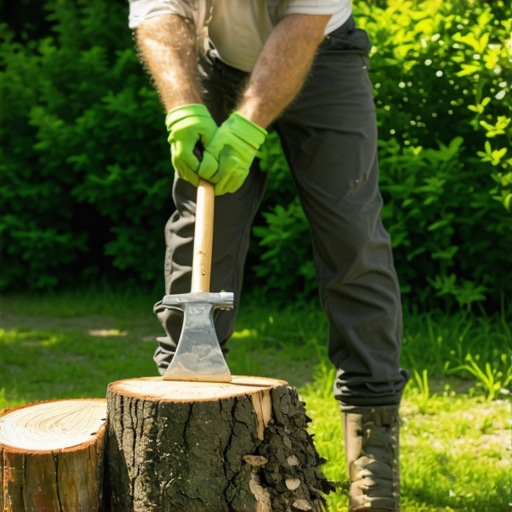
Professional Manual Stump Removal and Soil Preparation
Removing tree stumps without a grinder involves utilizing chemical acceleration or mechanical leverage to break down the wood structure and sever the root system. Professional landscapers prioritize this method when site access is limited or when protecting existing irrigation lines and sod installations from the heavy impact of 600-pound machinery.
I always drill into my new crew members: if you don’t fix the soil grading first, every plant you put in the ground is just expensive compost. I saw a rookie try to lay $2,000 worth of premium fescue sod over a site where he’d merely cut the stumps flush with the dirt. Six months later, the homeowner had a series of literal sinkholes. As the wood rots, it creates voids. More importantly, the fungi breaking down that carbon-heavy wood will rob your soil of every scrap of nitrogen, leaving your expensive lawn yellow and stunted. You don’t just ‘hide’ a stump; you excise it like a tumor or you manage its decay with scientific precision.
The Biological Reality of Stump Decay
To remove a stump without a grinder, you must understand the relationship between lignin and cellulose. When a tree is alive, its root system is a pressurized hydraulic network. Once dead, it becomes a massive carbon sink. If you choose the chemical route, you are essentially trying to spike the Carbon-to-Nitrogen (C:N) ratio. By introducing high-nitrogen compounds, you fuel the Basidiomycota—the wood-decay fungi—to work at ten times their natural speed. We typically use potassium nitrate (KNO3). This is not a ‘shortcut’; it is a controlled chemical burn of the cellular structure. You drill 1-inch diameter holes 12 inches deep into the heartwood, spaced 3 inches apart, and pack them with the granules. You aren’t just ‘waiting’; you are managing a microscopic demolition site.
“The rate of wood decomposition is primarily governed by the moisture content, temperature, and the availability of nitrogen within the soil matrix.” – Penn State Department of Plant Science
Mechanical Extraction: The Lever and the Jack
When chemical timelines don’t fit the project schedule—especially during a yard cleanup meant for immediate sod install—we turn to physics. We use the ‘High-Lift’ method. This involves digging a trench 24 inches wide around the root flare to expose the lateral roots. You don’t use a shovel for the fine work; you use a pressurized air spade or a high-pressure water jet to clear the soil from the undersides of the roots without damaging nearby irrigation pipes. Once the laterals are exposed, we cut them with a reciprocating saw equipped with a 12-inch carbide-tipped pruning blade. Dirt will ruin a chainsaw chain in seconds. Don’t do it. After the laterals are severed, a 20-ton bottle jack or a heavy-duty tripod winch is used to pull the core vertically. It is brutal, mechanical work that requires understanding the tensile strength of the specific species, whether it’s the deep taproot of an Oak or the wide-spreading laterals of a Maple.
| Method | Estimated Time | Tools Required | Best For |
|---|---|---|---|
| Chemical (KNO3) | 4-6 Months | 1″ Auger, Potassium Nitrate | Hardwoods, Low-impact sites |
| High-Lift Jack | 4-6 Hours | 20-ton Jack, Shovel, Recip Saw | Small/Medium stumps, Immediate replanting |
| Manual Digging | 8-12 Hours | Mattock, Digging Bar, Axe | Small stumps (<10″ diameter) |
How long does it take for a tree stump to rot naturally?
In most temperate climates, a standard 20-inch hardwood stump takes 7 to 10 years to rot naturally until it no longer interferes with landscaping. This timeline is unacceptable for managed properties. Softwoods like pine may decay in 3 to 5 years, but they leave behind resinous ‘fatwood’ that can persist even longer, creating localized soil acidity that kills new sod. Accelerating this process through nitrogen spiking or physical removal is the only way to ensure a stable grade for future construction or planting.
Can I bury a tree stump under a new lawn?
Never bury a stump if you intend to maintain a level, healthy lawn. Aside from the eventual collapse of the soil as the wood disappears, the decaying process creates a massive ‘nitrogen pull.’ The microbes will prioritize breaking down the wood over feeding your grass roots. Furthermore, decaying wood is a magnet for Reticulitermes flavipes (Eastern subterranean termites) and carpenter ants. If that stump is within 20 feet of your foundation, you are inviting a structural infestation. Proper yard cleanup means total extraction of the root crown.
The Post-Extraction Checklist for Sod and Irrigation
- Excavate all wood chips: Excess carbon in the hole will starve new grass of nitrogen.
- Backfill with structural fill: Use a mix of 70% screened topsoil and 30% coarse sand.
- Compaction: Use a jumping jack or plate compactor in 4-inch ‘lifts’ to prevent future sinking.
- Grade Adjustment: Ensure the site is 1 inch higher than the surrounding lawn to allow for natural settling.
- Irrigation Check: Pressure test any lines within a 10-foot radius of the extraction to check for root-crush or saw damage.
“Failure to achieve 95% Proctor density in backfilled landscape excavations results in hydrostatic pooling and subsequent turf failure.” – ICPI Hardscape Standards
Integrating Irrigation and New Turf
Once the stump is gone, the void must be treated as a construction site. We often find that old tree roots have grown around irrigation lines, essentially ‘throttling’ the PVC. When you remove the stump, these pipes often crack due to the sudden shift in soil pressure. Always run a 15-minute zone test after extraction. When laying new sod, do not just throw it over the hole. You must knit the new pieces into the existing turf using a sharp sod knife, ensuring the edges are tucked tightly to prevent the roots from drying out. The first 14 days are critical; that patch will need localized hand-watering twice a day, even if your irrigation system is running, because the disturbed soil will drain faster than the surrounding undisturbed earth. It’s about managing the microscopic moisture levels until the mycelium and the grass roots reach a state of equilibrium.