
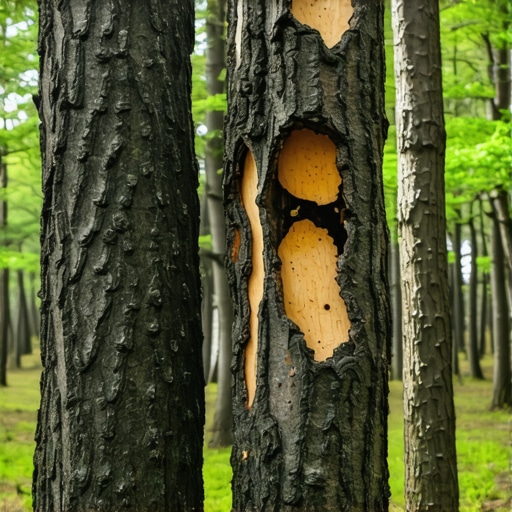
The Epidemic of Bark Loss: Why Your Specimen Trees Are Falling Apart
Bark shedding is rarely the primary disease; it is the final scream of a tree that has been dying for three to five years. When you see large plates of cambium pulling away from the trunk of an Oak or Maple in 2026, you aren’t looking at a recent accident, but a systemic failure of the landscape’s engineering. I always drill into my new crew members: if you don’t fix the soil grading first, every plant you put in the ground is just expensive compost. I’ve seen $5,000 specimen trees rot from the base up because a ‘mow-and-blow’ crew piled mulch against the trunk or a sod install team buried the root flare. This forensic autopsy examines why trees fail at the structural and biological level.
The Mechanical and Biological Causes of Bark Shedding
Bark loss in 2026 is primarily caused by environmental stressors including sunscald from erratic temperature swings, mechanical damage from improper maintenance, and secondary fungal infections that exploit weakened vascular systems. These factors often work in tandem, beginning with a microscopic breach in the protective outer bark and ending in total vascular collapse. To understand bark loss, you must understand the 1/16th of an inch known as the cambium layer. This is the tree’s lifeblood. If it freezes, dries out, or is crushed, the tree cannot transport nutrients. It dies. Don’t ignore the signs.
1. Sunscald and Cryogenic Cambium Failure
Sunscald occurs when intense winter sunlight warms the tree’s bark, tricking the cells into breaking dormancy, only for a rapid temperature drop to freeze and kill the active tissue. This leads to long, vertical lesions on the southwest side of the trunk where the bark eventually dries, cracks, and falls away in large strips. We see this most often in thin-skinned species like Maples or Cherries. In our high-end landscaping projects, we monitor soil moisture levels throughout the fall because a dehydrated tree is 40% more likely to suffer from sunscald. When the water in the cells is insufficient, the freeze-thaw cycle becomes even more destructive.
“Sunscald is often the result of the ‘southwest injury’ phenomenon, where the sudden drop in temperature after a sunny winter day causes the bark to split as the cells expand and contract violently.” – Agricultural Extension Agronomy Manual
The solution isn’t just a wrap; it’s hydration and proper positioning. If your irrigation system was shut off too early in the previous season, the tree entered winter in a state of stress. We use tensiometers to measure soil suction at the 12-inch and 24-inch marks. If the soil is dry at the root zone, the tree can’t maintain the osmotic pressure needed to resist cellular rupture during a freeze. It’s physics, not magic.
2. The ‘Mulch Volcano’ and Root Flare Suffocation
Suffocation of the root flare occurs when mulch or soil is piled against the trunk, trapping moisture and heat against the bark and encouraging the growth of adventitious roots. These roots eventually wrap around the trunk, known as root girdling, which literally strangles the tree’s vascular system. Bark loss at the base of the tree is the hallmark of this amateur mistake. Most crews think they are helping by adding 4 inches of mulch, but they are actually creating a petri dish for pathogens. I’ve excavated thousands of trees where the bark was soft and pulpy because it was buried under a ‘mulch volcano.’
How much mulch is too much?
A proper mulch ring should be 2-3 inches deep, but it must never touch the bark. We call this the ‘donut’ method. The root flare—the area where the trunk expands into the roots—must be visible. If your tree looks like a telephone pole sticking straight out of the ground, it’s buried too deep. During a professional yard cleanup, we use air spades to blow back excess soil and expose the flare. This is a non-negotiable step for any tree’s longevity. If the flare is buried, the bark will rot. It’s that simple.
| Symptom | Likely Cause | Remediation Step |
|---|---|---|
| Vertical cracks (Southwest side) | Sunscald / Frost Cracking | White tree wrap or strategic shading |
| Bark sloughing at the soil line | Root Flare Rot / Girdling | Air spade excavation and flare exposure |
| Shot-holes or sawdust (Frass) | Borer Infestation | Systemic insecticide and soil health audit |
| Loose bark with white fungal mats | Armillaria (Root Rot) | Improve drainage; often terminal |
3. Soil Grading and Hydrostatic Stress
Improper soil grading and poor drainage create anaerobic conditions where roots cannot breathe, leading to root dieback that manifests as bark loss in the upper canopy. When a landscape lacks proper 2% minimum grading away from the tree, water pools at the base, increasing hydrostatic pressure and drowning the fine feeder roots. Without these roots, the tree cannot support its own bark. We see this often after a new sod install where the grade was raised by several inches without considering the existing tree’s oxygen requirements. It takes very little to kill a mature root system.
“A retaining wall doesn’t fail because of the stone; it fails because of the water trapped behind it, and a tree doesn’t die from the bark down, but from the roots up due to drainage failure.” – Hardscape Engineering Axiom
How do you tell if a tree is dying under the bark?
Use the ‘scratch test.’ Take a pocketknife and lightly scratch a small area of a twig or a section of the trunk where the bark is loose. If you see bright green tissue underneath, that’s the cambium, and the tree is still fighting. If it’s brown, brittle, or dry, that section is dead. If this brown tissue extends more than 50% around the circumference of the trunk, the tree is ‘girdled’ and will likely need removal. Don’t wait for the whole tree to turn gray. Once the vascular connection is severed, the tree is a standing hazard.
Can bark grow back on a damaged tree?
Trees do not ‘heal’ in the way humans do; they ‘compartmentalize.’ If a tree loses a patch of bark, it will attempt to grow a callus layer around the wound to seal it off from further infection. This is known as CODIT (Compartmentalization of Decay in Trees). If the tree is healthy and has access to deep irrigation and proper NPK (Nitrogen, Phosphorus, Potassium) ratios, it can survive. However, if the damage is structural or caused by boring insects, the tree will simply rot from the inside out while trying to seal the wound. You cannot ‘glue’ bark back on. You must support the tree’s internal energy reserves.
Critical Tree Health Checklist
- Expose the root flare: Ensure the trunk flare is visible above the soil line.
- Monitor soil pH: Maintain a pH between 6.0 and 7.0 for most hardwoods to ensure nutrient uptake.
- Irrigate deeply: Water should reach 12-18 inches deep, once a week, rather than daily shallow sprays.
- Sterilize tools: Never prune a tree with bark issues using unsterilized shears; you will spread the pathogens.
- Check for frass: Look for tiny holes and ‘sawdust’ which indicate borer beetles are exploiting the weak bark.
The reality is that 2026 will be a year of reckoning for trees planted during the ‘mow-and-blow’ boom of the early 2020s. If your contractor didn’t talk about soil compaction, drainage, or root flare exposure, your trees are on a countdown. Proper landscaping is an investment in biology. If you treat your trees like outdoor furniture, don’t be surprised when the upholstery starts falling off. Get a soil test. Check your irrigation. Save the cambium before it’s too late.