
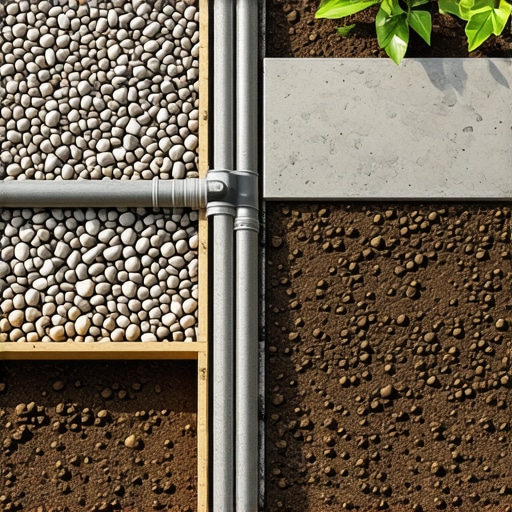
The Forensic Autopsy of a Sinking $30,000 Patio
I recently got called out to tear up a $30,000 bluestone patio that was sinking because the previous contractor failed to respect the physics of clay soil. The homeowner was distraught; the stones were heaving, and water was pooling inches deep against the foundation. When we excavated, we found the ‘compacted’ base had turned into a slurry of grey muck. The contractor had used a standard gravel mix without a geotextile separator, allowing the heavy clay to migrate upward and swallow the base whole. This wasn’t just a landscaping mistake; it was a structural failure caused by ignoring hydrostatic pressure. Clay is not your friend. It is a dense, microscopic lattice of flat platelets that trap water and expand with enough force to crack concrete. If you don’t manage the hydrology first, your expensive backyard renovation is just a countdown to a demolition day.
Why Clay Soil Destroys Backyards in 2026
Clay soil creates a drainage nightmare because its high bulk density and flat particle structure prevent percolation, leading to standing water and anaerobic root zones. Without intervention, hydrostatic pressure builds against structures, causing foundation cracks, turf death, and hardscape settlement. Remediation requires professional-grade soil amendments and subsurface engineering.
“A retaining wall doesn’t fail because of the stone; it fails because of the water trapped behind it.” – Hardscape Engineering Axiom
How much modified gravel do I need for a patio base?
For clay-heavy regions, you need a minimum of 6 to 8 inches of compacted #21A or #57 stone. Do not guess. Calculate your square footage and multiply by the depth in feet, then divide by 27 to get your cubic yardage. Add a 20% margin for compaction. In clay, this base MUST be separated by a non-woven geotextile fabric. If you skip the fabric, the clay will eventually pump into the gravel, destroying the structural integrity of the installation. It is a physical certainty. It will fail.
Fix 1: Chemical Flocculation and Structural Soil Amendments
Soil flocculation involves applying gypsum (calcium sulfate) to heavy clay to replace sodium ions with calcium, which causes tiny clay particles to clump into larger aggregates. This process increases macropore space, allowing irrigation and rainwater to move vertically rather than pooling on the surface. Combined with core aeration, this is the first step in a permanent yard cleanup.
Clay particles are negatively charged. When they are saturated with sodium, they repel each other and stay flat, like a stack of wet playing cards. This is why water sits on top. By introducing gypsum at a rate of 40 lbs per 1,000 square feet, you start a chemical reaction. The calcium ions bridge the gap between clay platelets. We call this ‘opening up the soil.’ But don’t expect a miracle overnight. Chemical remediation takes time. You need to combine this with a deep core aeration, pulling 3-inch plugs to let the gypsum reach the root zone. Stop using cheap big-box fertilizers that add more salt to the soil. You are just making the problem worse.
| Material | Drainage Speed | Primary Function | Lifespan |
|---|---|---|---|
| Gypsum (Pelletized) | Slow/Chemical | Soil Flocculation | 12-24 Months |
| #57 Clean Stone | Rapid/Mechanical | Subsurface Void Space | 30+ Years |
| River Jack Stone | Moderate/Surface | Decorative Runoff Path | Permanent |
| Non-woven Geotextile | N/A | Separation/Filtration | 50+ Years |
Fix 2: Subsurface Engineering with French Drains and Dry Wells
Subsurface drainage systems, specifically French drains, utilize perforated PVC piping and clean stone to create a path of least resistance for groundwater. By intercepting hydrostatic pressure before it reaches the surface, these systems prevent sod install failure and protect the home’s foundation from water intrusion. A properly engineered drain is the only permanent solution for heavy clay.
“Soil structure is the arrangement of soil particles into stable units called peds. In heavy clay, these units are often non-existent, leading to massive, impermeable layers.” – Agronomy Manual for Soil Conservation
Do not use the black corrugated flexible pipe you see at the hardware store. It is garbage. The ridges catch silt, and within three years, the pipe is 50% full of mud. We use 4-inch Schedule 40 perforated PVC. It’s rigid, it’s smooth, and it can be cleaned out with a jetter if needed. The trench must be wrapped in a ‘burrito’ of non-woven geotextile fabric. This lets water in but keeps the clay out. If you don’t wrap the stone, the clay will infiltrate the voids in the gravel, and your drain will become a solid bar of concrete-like mud. Use #57 clean washed stone. No ‘fines’ or sand allowed. Your trench needs a minimum 1% slope. Water doesn’t run uphill, no matter how much you wish it did.
How deep should a French drain be in clay soil?
In clay environments, the pipe should sit at least 18 to 24 inches deep to intercept the lateral movement of water through the soil profile. The trench should extend into the ‘B’ horizon of the soil where the clay is densest. This ensures you are capturing the water that is saturating the root zone of your lawn. Shallow drains only catch surface water; they don’t fix a soggy yard.
Fix 3: Topographic Grading and Sod Stabilization
Surface grading involves reshaping the topography of a property to ensure a minimum 2% slope away from structures, directing runoff toward designated drainage swales. Once the grade is established, a professional sod install provides immediate erosion control and a biological filter that manages surface tension. This is critical for preventing muddy yard conditions after a yard cleanup.
[image placeholder] I’ve seen ‘contractors’ throw sod down on top of hard-packed clay without even tilling. It’s a death sentence for the grass. The roots hit that clay and turn sideways because they can’t penetrate. We call it ‘root girdling.’ You need to rough up the top 4 inches of clay, incorporate organic compost to break the density, and then lay your sod. The sod acts as a stabilizer. Without it, the first heavy rain will wash your newly graded topsoil into the neighbor’s pool. Use a heavy lawn roller after the install. The goal is 100% soil-to-root contact. Air pockets are the enemy. If there is a gap, the root will dry out and die. It’s that simple.
- Check 811 utility markings before any excavation.
- Verify municipal drainage codes for runoff discharge.
- Use a transit or laser level to confirm a 2% minimum slope.
- Ensure the discharge point is clear of debris and has a pop-up emitter.
- Inspect the system after the first 2-inch rain event for settling.
- Maintain a 3-inch height on new sod to encourage deep rooting.
- Never discharge drainage water directly onto a neighbor’s property.
Landscaping in clay is a battle against physics. If you try to cut corners by skipping the gravel base or using cheap materials, the clay will win. It always does. You have to over-engineer. You have to move the water. You have to change the chemistry. Only then will your yard be more than a high-maintenance swamp. Stop listening to the influencers who say a bag of fertilizer will fix your drainage. It won’t. Get a shovel, get the right stone, and do it right the first time.