
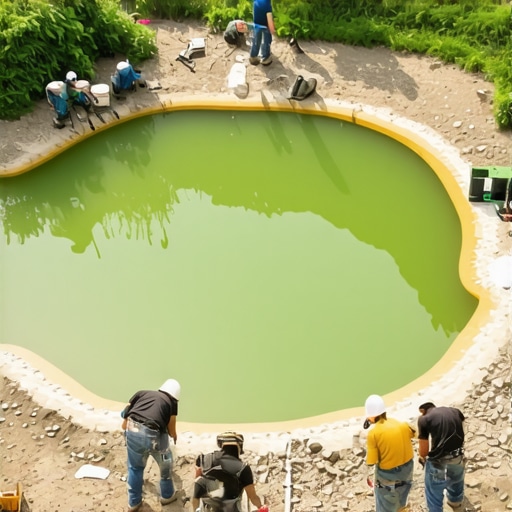
The Mechanics of a Pond Leak
Sodium bentonite fixes pond leaks by creating a high-swelling, impermeable clay barrier that expands upon contact with water, filling voids in the soil structure. This volcanic ash derivative acts as a geological sealant, effectively self-healing cracks in the pond bed without the need for synthetic EPDM or PVC liners. It is the gold standard for earthen dam repair and watershed management.
The sound of a pond pump sucking air at 3:00 AM is the heartbeat of a failed landscape. Last summer, I got called out to a job site in the hills where a homeowner had spent $45,000 on a custom trout pond. Within six months, the water level was dropping four inches every twenty-four hours. I performed a forensic autopsy on the basin. The previous contractor had skipped the soil test and tried to seal a gravel-heavy subgrade with a thin layer of cheap clay they hauled in from a local construction site. It was a disaster. The hydrostatic pressure had pushed the water straight through the porous aggregate. We had to crane out two tons of boulders just to get to the failure point. I told the owner: if you do not respect the physics of water, water will disrespect your wallet. We ended up stripping it to the base and using a high-grade sodium bentonite blanket. It has not leaked a drop since.
“Sodium bentonite can swell up to 15 to 20 times its dry volume, creating an impermeable seal that is ideal for sealing earthen ponds and lagoons.” – Wyoming Mining Association Handbook
The Forensic Diagnosis: Seepage vs. Evaporation
Before you dump a single bag of clay, you must determine if you actually have a leak. Every pond loses water to evaporation. In mid-July, you can lose half an inch a day to the sun alone. You perform the bucket test. Fill a five-gallon bucket with pond water and set it on a pond step so the water levels match. Mark both levels. If the pond level drops faster than the bucket level over 48 hours, you have a structural failure. It is that simple. Most leaks occur at the waterline or where the plumbing pierces the basin. Check your skimmers. Check your waterfall transitions. If those are dry, the problem is the floor of the pond. You are dealing with soil porosity or structural cracking.
How much sodium bentonite do I need for a leaking pond?
Calculating bentonite requirements depends on your soil texture, as sandy soils require 3 to 5 pounds per square foot, while silty soils may only need 2 pounds. For a 1,000 square foot pond area with porous soil, you will need approximately 4,000 pounds of material to ensure a permanent seal. Do not skimp on the application rate or the water will find the weak point.
| Soil Type | Bentonite Per Sq Ft | Application Method | Longevity | |
|---|---|---|---|---|
| Heavy Clay | 1.5 – 2.0 lbs | Sprinkle / Tilled | 25+ Years | |
| Silty Loam | 2.0 – 3.0 lbs | Blanket / Mixed | 20+ Years | |
| Sandy Soil | 3.0 – 5.0 lbs | Blanket Method | 15+ Years | |
| Gravel/Rock | 5.0+ lbs | Slurry / Membrane | 10+ Years |
The Science of Swell: Why Bentonite Works
Sodium bentonite is a three-layer clay mineral known as montmorillonite. At a microscopic level, these clay platelets carry a negative charge. When water molecules enter the space between the layers, they are attracted to the negative charge and the clay expands. It does not just get wet; it physically grows. This expansion creates a dense, gel-like mass that is virtually waterproof. If a small crack forms later due to ground settling, the bentonite nearby absorbs more moisture and expands to fill the void. It is a living, reacting barrier. It is superior to concrete because concrete is brittle. It is superior to plastic liners because plastic eventually degrades under UV light or gets punctured by a stray heron beak or a sharp rock. You are essentially creating a synthetic geological layer that mimics the bottom of a natural lake.
“A retaining wall or pond basin does not fail because of the material; it fails because of the hydrostatic pressure and water management behind the structure.” – Hardscape Engineering Axiom
Can you apply sodium bentonite while the pond is full?
Applying sodium bentonite to a full pond is possible using the sprinkle method, but it is significantly less effective than a dry application. To do this, you broadcast granular bentonite over the surface, allowing it to sink and clog the leaks, though this rarely achieves a 100 percent seal compared to a compacted blanket. If you have a major leak, you must drain the pond to apply the material correctly to the subgrade.
The Blanket Method: Step-by-Step Remediation
The blanket method is the only way I guarantee a seal for my clients. It is labor-intensive. It is dirty. But it works. If you are doing this in 2026, follow this protocol exactly. Do not skip the compaction phase. That is where the hacks fail. A manual tamper is fine for a small hole, but for a pond, you need a vibratory plate compactor or a sheep’s foot roller. The soil density must be high enough to resist the weight of the water column.
- Excavation: Remove at least 6 inches of the existing bottom soil. Store this on a tarp; you will need it later.
- Surface Prep: Remove all large rocks, roots, and debris. The surface must be as smooth as possible.
- Application: Spread the sodium bentonite at the calculated rate (e.g., 3 lbs per sq ft). Ensure even coverage. No bald spots.
- Backfilling: Carefully return the 6 inches of soil you removed. Do not drag the soil, as this will disturb the bentonite layer. Lift and drop.
- Compaction: Compact the soil in 2-inch lifts. You want the soil to feel like concrete under your boots.
- Hydration: Fill the pond slowly. Rapid filling can cause erosion of the newly placed soil layer before it has a chance to set.
Common Pitfalls in Pond Repair
I see it every year. Homeowners think they can just throw a handful of clay into a hole and be done. It does not work that way. If your pond is built on a slope or has high groundwater, the water pressure from the outside can actually lift a liner or blow out a bentonite seal from underneath. This is why drainage is part of any serious landscaping project. You need to manage the water you see and the water you don’t see. In regions with heavy frost-thaw cycles, like the Northeast or Midwest, the ground moves. Bentonite handles this movement better than most materials, but if the compaction was poor, the frost will heave the soil and create new channels for water to escape. Use 811 to mark your lines before you start digging. Nothing ruins a pond project faster than hitting a gas main. It happens more than you think.