
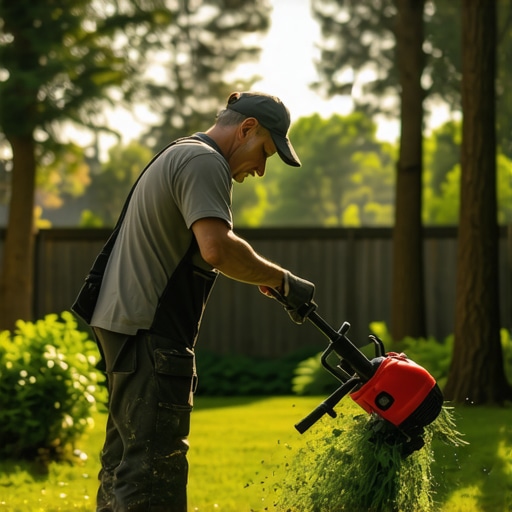
The Forensic Reality of Pine Needle Neglect
Pine needle accumulation is not a cosmetic inconvenience; it is a structural and biological threat to your property that requires a specialized yard cleanup protocol. Left unchecked, the 2026 needle drop will create a thick, acidic mat that chokes out turf grass through light deprivation and oxygen exclusion. I always drill into my new crew members: if you don’t fix the soil grading and clear the organic debris first, every plant you put in the ground is just expensive compost. I’ve seen $15,000 sod install jobs fail within six months because the contractor simply laid the rolls over a half-inch of decomposing pine straw. The roots couldn’t penetrate the hydrophobic layer, and the entire lawn literally slid off the grade during the first heavy rain. You cannot shortcut the biology of the yard.
The Gutter Engineering Problem: Hydrostatic Pressure and Foundation Failures
Clearing pine needles from gutters is a critical engineering task that prevents hydrostatic pressure from building against your foundation walls and causing structural cracks. When needles bridge across the gutter mouth, they create a ‘wicking’ effect, pulling water back toward the fascia board and into the soffits.
“A retaining wall doesn’t fail because of the stone; it fails because of the water trapped behind it.” – Hardscape Engineering Axiom
This same principle applies to your home’s perimeter. If your gutters are choked with needles, the overflow saturates the soil at the base of your house. This saturation leads to soil expansion and eventual basement wall failure. We use high-velocity air systems to clear the runs and then perform a flow-rate test on every downspout to ensure the irrigation and drainage system can handle a 2-inch-per-hour rain event. Don’t skip this.
How often should pine needles be removed from gutters?
For properties with heavy pine canopy, gutters require a minimum of three cleanings per year to prevent the organic material from fermenting into a heavy, sludge-like compost that stresses gutter hangers. We measure the weight of wet pine sludge; it can reach 15 pounds per linear foot. That is enough to pull the spikes right out of the wood. You need a clear path for water to reach the 4-inch corrugated pipe or PVC drain lines.
The Biological Impact: Soil pH and Turf Suffocation
Pine needles dropping onto your turf trigger a chemical shift that makes landscaping success impossible without immediate intervention. While many believe needles acidify the soil instantly, the real danger is the physical barrier they create, which prevents irrigation water from reaching the root zone.
“Successful turf management in acidic environments requires a precise balance of calcium carbonate to offset the organic acids produced by decomposing coniferous litter.” – Agricultural Extension Soil Manual
When we perform a yard cleanup, we don’t just rake; we analyze the soil pH. Most turf grass thrives at a 6.5 to 7.0 pH. Pine-heavy areas often dip to 5.0, which locks out essential nutrients like phosphorus and nitrogen. We must mechanically remove the needles, core aerate the soil to a depth of 3 inches, and apply pelletized lime to stabilize the chemistry before any sod install can be considered. It will rot if the pH is off.
Does pine straw kill grass?
Yes, pine straw kills grass by creating an anaerobic environment where the lack of airflow encourages Rhizoctonia and other fungal pathogens to thrive. The needles also contain terpenes—chemical compounds that can inhibit the germination of certain seeds. If you leave a 2-inch layer of needles on your lawn for more than three weeks, the blades will yellow due to chlorosis, a direct result of being unable to perform photosynthesis. It is a slow death by suffocation.
Material and Equipment Matrix for Pine Management
| Tool Type | Application | Engineering Advantage |
|---|---|---|
| Power Rake / Dethatcher | Surface Mat Removal | Breaks the hydrophobic layer of needles to allow oxygen exchange. |
| Backpack Blower (700+ CFM) | Gutter and Hardscape Clearing | Moves needles without damaging the granular surface of roof shingles. |
| Core Aerator | Post-Cleanup Soil Recovery | Relieves compaction caused by needle decomposition and foot traffic. |
| Top-Dressing Spreader | Soil Remediation | Uniformly distributes sand/compost mix to level the grade after cleanup. |
The Professional Sod Install Recovery Protocol
Executing a sod install after a heavy pine needle clearing requires a ‘ground-up’ build approach to ensure the new turf takes root. Once the yard is cleared, we excavate the top 2 inches of degraded soil. This ‘muck’ is usually full of fungal spores and acidic residue. We then backfill with a sandy-loam mix, compacting it with a 200-pound water roller to ensure there are no air pockets. We then integrate the irrigation heads, ensuring they are set at the exactly 0.5 inches above the soil line so they sit flush with the new sod. We use a ‘running bond’ pattern for the sod rolls, staggering the seams to prevent erosion. Every roll must have 100% soil-to-soil contact. If you see a gap, you’ve failed.
- Step 1: Complete mechanical removal of all coniferous debris from the turf and beds.
- Step 2: Technical gutter flush and downspout snaking to ensure 100% drainage capacity.
- Step 3: Soil testing for pH, NPK levels, and organic matter percentage.
- Step 4: Irrigation system pressure test and nozzle adjustment for head-to-head coverage.
- Step 5: Precision grading to move water away from the foundation at a 2% slope.
Irrigation Logistics in Pine-Dense Environments
Maintaining a landscape under pine trees requires a high-efficiency irrigation strategy because the pine roots will actively compete for water. We install MP Rotator nozzles that deliver water at a slower rate, allowing the soil to absorb moisture without runoff. We also install rain sensors to prevent over-watering, which, when combined with pine needles, creates a breeding ground for wood roaches and termites. Deep, infrequent watering—exactly 1 inch per week—is the rule. This forces the turf roots to chase the water down, making them more resilient to the heat and the chemical stress of the pines. Don’t be a hack; measure your output with a rain gauge. Precision is the only way to win against the needles. [{“@context”:”https://schema.org”,”@type”:”FAQPage”,”mainEntity”:[{“@type”:”Question”,”name”:”How often should pine needles be removed from gutters?”,”acceptedAnswer”:{“@type”:”Answer”,”text”:”Pine needles should be removed at least three times per year in properties with heavy pine canopy to prevent structural damage and clogging of the drainage system.”}},{“@type”:”Question”,”name”:”Does pine straw kill grass?”,”acceptedAnswer”:{“@type”:”Answer”,”text”:”Yes, pine straw kills grass by blocking sunlight, preventing oxygen exchange, and creating an acidic, fungal-prone environment that leads to turf suffocation.”}}]}]