
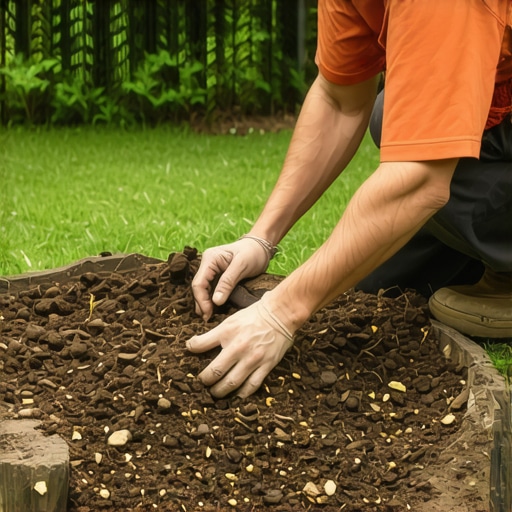
The Forensic Autopsy: Why Your Tree is Suffocating
I always drill into my new crew members: if you don’t fix the soil grading and root exposure first, every plant you put in the ground is just expensive compost. I have walked onto countless job sites for yard cleanup only to find hundred-year-old oaks being slowly strangled by what I call ‘the mulch volcano.’ It is a slow, silent killer. You see the yellowing leaves or the early leaf drop in August and think it is a water issue. You turn up the irrigation, but you are actually just accelerating the rot. The bark at the base of a tree is not meant to be wet. It is not a root. It is an organ that needs to breathe. When you pile 6 inches of dyed hardwood mulch against that bark, you create a dark, damp petri dish for pathogens.
“The root flare is the critical transition zone between stem and root tissues. Burying this area inhibits gas exchange and encourages the development of stem-girdling roots that eventually choke the tree’s vascular system.” – International Society of Arboriculture (ISA) Best Management Practices
What is a Mulch Volcano?
A mulch volcano is a destructive landscaping error where mulch is piled high against the trunk of a tree, creating a conical shape that covers the root flare and suffocates the tree. This practice leads to secondary root growth, moisture-induced bark rot, and increased susceptibility to pests like borers and wood-rotting fungi. It is a common mistake made by ‘mow-and-blow’ contractors who prioritize a specific aesthetic over the biological reality of the plant. If you cannot see the flare where the trunk widens into the soil, your tree is in trouble.
The Biology of Bark Failure
Tree bark is the first line of defense against the environment. Below the bark is the phloem, the tissue responsible for transporting sugars from the leaves to the roots. When you bury the trunk in mulch, you create an environment where the bark remains constantly saturated. This leads to hypoxia. The cells die. Once the bark is compromised, opportunistic fungi like Armillaria move in. They feed on the decaying tissue, eventually girdling the tree. It will rot. It is not a matter of if, but when. I have seen 20-inch diameter maples snap at the base during a moderate storm because the internal structure was turned to mush by a 10-year-old mulch volcano.
How much mulch should be in a tree ring?
For most residential landscaping applications, a depth of 2 to 3 inches of mulch is the biological limit, ensuring the root flare remains completely exposed. Applying more than this depth leads to soil compaction and prevents 1 inch of weekly water from reaching the actual root zone, often causing the mulch itself to become hydrophobic.
The 5-Minute Fix: Remediating Your Tree Ring
Fixing a mulch volcano does not require heavy machinery or a degree in forestry. It requires a hand rake and a willingness to get your hands dirty. First, pull the mulch away from the trunk. Use your fingers to feel for the trunk flare. You want to see the ‘shoulders’ of the tree. If you find small, circular roots wrapping around the trunk under the mulch, these are girdling roots. Snip them with clean bypass pruners. Do not skip this. If left alone, they will thicken and cut off the sap flow like a tourniquet. Once the flare is clear, spread the excess mulch outward to create a flat, donut-shaped ring. The mulch should taper to nothing as it reaches the trunk. This is the only way to ensure the tree survives the next decade.
| Feature | Mulch Volcano (Wrong) | Mulch Donut (Right) |
|---|---|---|
| Trunk Contact | High (3-8 inches) | None (0 inches) |
| Root Flare Visibility | Hidden/Buried | Fully Exposed |
| Moisture Level | Saturated/Rotting | Balanced/Aerated |
| Girdling Risk | Extreme | Minimal |
| Gas Exchange | Inhibited | Optimal |
Checklist for a Healthy Tree Ring
- Locate the root flare (where the trunk widens).
- Remove all mulch within 3 inches of the bark.
- Maintain a maximum mulch depth of 2-3 inches in the outer ring.
- Check for girdling roots and prune if necessary.
- Ensure irrigation emitters are placed at the drip line, not the trunk.
- Verify the mulch is not matted or hydrophobic.
Can a tree survive a mulch volcano?
Trees can survive a mulch volcano if the damage is caught early and the root flare is remediated before pathogenic fungi or deep girdling roots have compromised more than 30% of the vascular circumference. Long-term burial usually results in irreversible structural instability and eventual decline. If you are doing a sod install nearby, ensure the new grade does not bury the tree even further.
Engineering the Perimeter: Soil and Drainage
In my 20 years, I have seen homeowners spend thousands on landscaping only to ignore the fundamental engineering of their yard. When we do a yard cleanup, we look at the hydrostatic pressure and soil compaction. If your soil is heavy clay, that mulch volcano acts like a sponge, holding water against the trunk indefinitely. This is why we advocate for coarse, organic mulches that allow for airflow. Avoid the finely ground ‘mulch dust’ sold at big-box stores. It mats down and prevents water from penetrating. You want a material that breaks down slowly, feeding the soil microbiology without choking it. Stop the madness. Save your trees. Pull back the mulch today. It only takes five minutes to stop a slow-motion disaster.