
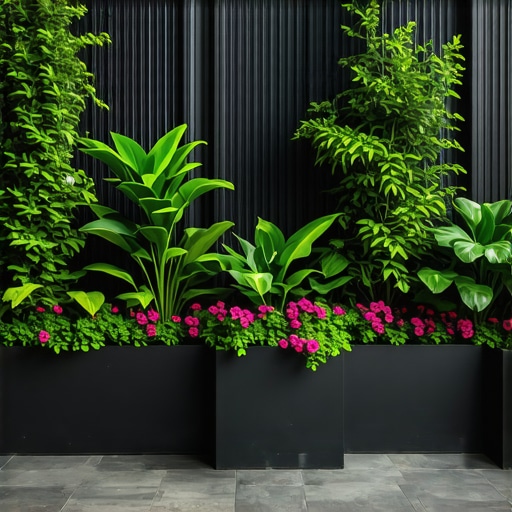
Planning the Vertical Privacy Barrier
Vertical planters for patio privacy require a rigorous engineering approach that prioritizes structural load-bearing capacity and hydrologic management over mere aesthetics. You must calculate the saturated weight of the soil medium and the wind-load pressure against the vertical surface area before selecting any hardware. I always drill into my new crew members: if you don’t fix the soil grading first, every plant you put in the ground is just expensive compost. This applies to vertical systems too. If the base isn’t level and the drainage isn’t planned, you’re just building a vertical swamp that will eventually rot your deck or crack your pavers. Most people think they can just hang a few pots and call it privacy. They are wrong. You need a system that handles 250 pounds of wet soil and resists a 40 mph gust. Anything less is a liability.
Selecting the Right Structural Materials for Vertical Privacy
Vertical privacy planters require structural integrity to resist wind-loading and substrate weight. Select materials like powder-coated steel, cedar, or high-density polyethylene. These systems must be anchored directly into patio footings or heavy-duty bases to prevent tipping during high-velocity wind events. Don’t buy the cheap plastic kits from the big-box store. They degrade under UV exposure within two seasons. I’ve seen those thin-walled plastic pockets tear and dump five gallons of mud onto a client’s outdoor rug. It’s a mess. Use 14-gauge steel frames or 4×4 cedar posts for the skeleton. If you’re building on a concrete patio, use wedge anchors to secure the base. If it’s on a deck, you better make sure you’re hitting joists. A fully watered vertical wall can weigh more than a hot tub. Do the math. [image placeholder]
| Material Type | Structural Lifespan | Max Load Capacity (PSI) | Drainage Rating |
|---|---|---|---|
| Powder-Coated Steel | 15 to 20 Years | High (500+) | Excellent |
| Western Red Cedar | 8 to 12 Years | Medium (250) | Good |
| High-Density Polyethylene | 5 to 7 Years | Low (100) | Moderate |
| Treated Pine | 5 to 10 Years | Medium (200) | Poor (Rot Prone) |
The Physics of Soil and Water in Vertical Columns
Soil physics in vertical planters differs from traditional gardening because gravity causes rapid nutrient leaching and bottom-heavy moisture distribution. Use a specialized growing medium consisting of 60 percent peat moss or coconut coir, 20 percent perlite for aeration, and 20 percent vermiculite for moisture retention to balance the hydrologic cycle.
“A retaining wall doesn’t fail because of the stone; it fails because of the water trapped behind it.” – Hardscape Engineering Axiom
This rule applies to vertical planters. If you don’t have a clear exit path for excess water, the hydrostatic pressure at the bottom of the planter will cause root rot. The bottom six inches of any vertical unit should be filled with a non-compacting drainage aggregate like expanded shale or coarse gravel. This prevents the potting mix from clogging the weep holes. You also need to consider the cation exchange capacity of your mix. Because you’re watering frequently to combat the vertical drainage, you’re flushing out nitrogen and potassium at an accelerated rate. You need a slow-release granular fertilizer, NPK 14-14-14, applied every six weeks during the growing season.
How deep do vertical planters need to be?
For effective privacy screening, your vertical planter needs a minimum depth of 8 to 10 inches to accommodate the root balls of screening plants like arborvitae, clumping bamboo, or tall grasses. Shallow 4-inch pockets are only suitable for succulents or small herbs and will fail as privacy barriers within one season.
“Planting depth and root volume are the primary predictors of long-term survivability in restricted-growth environments.” – Penn State Agricultural Extension
Without sufficient depth, the plants become root-bound. Once they are root-bound, they can’t take up water fast enough to keep the foliage dense. Dense foliage is the only thing providing your privacy. If the leaves go thin, your neighbors can see right through your expensive wall.
Irrigation Integration and Yard Cleanup
Irrigation systems for vertical walls must utilize pressure-compensating drip emitters to ensure the plants at the top of the wall receive the same volume of water as those at the bottom. Without pressure compensation, gravity will cause the lower levels to flood while the top levels desiccate and die. Install a 1/2 inch poly-tubing main line with 1/4 inch distribution lines to each planter cell. Each emitter should be rated for 0.5 or 1.0 gallon per hour. Connect this to a smart timer. If you’re already doing a yard cleanup or a sod install, this is the time to trench in a dedicated line for your vertical wall. Don’t be the guy dragging a hose across the yard every night. It’s inefficient. If you have an existing irrigation system, tap into a zone with similar water requirements. Don’t mix your lawn’s high-flow spray heads with your vertical wall’s low-flow drip. You’ll either blow the emitters off or starve the grass. It’s basic hydraulics.
What plants grow best in vertical privacy screens?
The best landscaping plants for vertical privacy are those with upward growth habits and high leaf density, such as ‘Sky Rocket’ Junipers, Star Jasmine, or even tall varieties of ornamental grasses like Miscanthus. Choose species that match your USDA Hardiness Zone and the specific light exposure of your patio. If your patio faces west, your plants will bake in the afternoon sun. You need heat-tolerant species with thick cuticles to prevent transpiration loss. If it’s a north-facing wall, look for shade-tolerant evergreens like Taxus (Yew). Avoid invasive vines like English Ivy unless you want it to eat your house. Stick to clumping varieties or plants that can be easily pruned to maintain the screen’s shape. Regular pruning is not optional. It forces the plant to push out lateral growth, which fills in the gaps in your privacy screen.
The Vertical Privacy Installation Checklist
- Verify the structural load capacity of the patio surface or deck joists.
- Install a moisture barrier between the planter and any wooden or siding surfaces.
- Select a non-compacting, lightweight potting medium with high CEC.
- Install pressure-compensating drip irrigation with a dedicated shut-off valve.
- Anchor the vertical frame using stainless steel hardware to prevent corrosion.
- Choose plants based on solar orientation and mature root volume requirements.
- Apply a pre-emergent to the soil surface to prevent airborne weed seeds from taking hold.
Remember, a vertical garden is a living machine. It needs fuel (nutrients), water (automated irrigation), and maintenance (pruning). If you ignore it for a month, it will die. If you build it out of cheap wood, it will rot. Do it right the first time or don’t do it at all. Professional landscaping isn’t about the day it’s finished; it’s about how it looks five years later. That’s the difference between a contractor and a hack. Pay attention to the details. Check your PSI. Test your pH. Secure your anchors. That’s how you get privacy that actually lasts.