
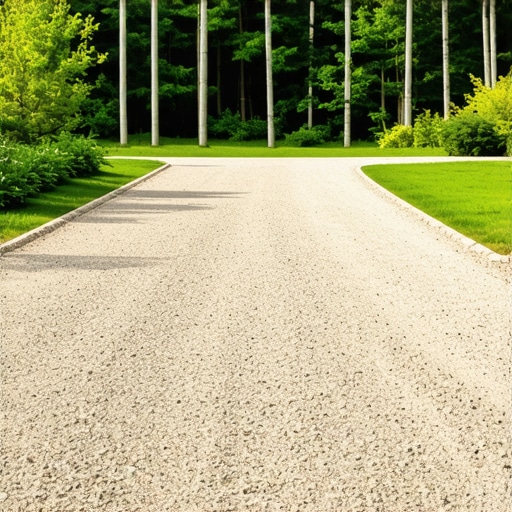
The Engineering of a Permanent Driveway
Building a 2026 gravel driveway that won’t sink requires a fundamental shift from aesthetics to structural engineering and soil mechanics. Most residential driveways fail because homeowners treat gravel as a decorative mulch rather than a structural load-bearing surface. To prevent sinking, you must establish a stable subgrade, utilize non-woven geotextiles for soil separation, and manage hydrostatic pressure through precision grading and multi-layered aggregate compaction. This is not about aesthetics; it is about civil engineering on a domestic scale.
The Hardscape Autopsy: Why Your Neighbor’s Driveway Failed
I recently got called out to tear up a $30,000 driveway that was sinking because the previous contractor thought they could skip the sub-base excavation. The homeowner was staring at eight-inch ruts where their truck parked. When I brought the excavator in, I found that the gravel had simply migrated into the native clay soil. Without a separation layer, the heavy aggregate was literally swallowed by the earth during the spring thaw. The contractor had ignored the California Bearing Ratio (CBR) of the soil, and the result was a muddy, expensive grave for three tons of #57 stone. It was a total failure of fundamentals. Don’t be that guy.
How much modified gravel do I need for a driveway base?
Calculating gravel volume requires measuring the total square footage, multiplying by the intended depth (usually 8 to 12 inches for a stable driveway), and dividing by 324 to convert to cubic yards. For a standard 20×40 foot driveway with a 10-inch total depth, you will need approximately 25 to 30 cubic yards of various aggregate sizes. Always factor in a 20 percent compaction rate for Dense Graded Aggregate (DGA) or modified stone, as the volume will shrink significantly once the vibratory roller hits it. If you don’t account for compaction, you will run short before you even reach the surface layer.
“A driveway’s longevity is inversely proportional to the amount of water trapped within its base layers; drainage is the only variable that truly matters.” – Hardscape Engineering Axiom
The Science of Soil Subgrade and Compaction
Before you buy a single stone, you have to look at the dirt. Native soil is the ultimate foundation. If you are dealing with heavy clay, your driveway is essentially sitting on a sponge. In these environments, the “mow-and-blow” hacks will just scrape the grass off and dump rock. That is a recipe for disaster. You must excavate down to the B-horizon of the soil. We are looking for structural integrity. I tell my crew that if the soil feels soft under a boot, it will fail under a Ford F-150. We use a vibratory plate compactor or a 5-ton roller to reach 95 percent Proctor density before the first stone touches the ground. If you skip the subgrade compaction, the entire project is built on a lie. You cannot fix a soft bottom with more rock.
What is the best gravel for a driveway that won’t wash away?
The best gravel for a permanent driveway is a three-tier system consisting of #3 large stone for the base, #57 crushed stone for the sub-base, and a Dense Graded Aggregate (DGA) or #411 screenings for the top binding layer. This combination allows for mechanical interlocking, where the smaller angular pieces lock the larger stones into place. Avoid rounded river rocks or pea gravel for driving surfaces, as these act like ball bearings and will never stabilize under the weight of a vehicle. Angular, crushed limestone or granite is mandatory for friction and stability.
| Layer | Material Type | Recommended Depth | Core Function |
|---|---|---|---|
| Surface Layer | #411 or DGA (Crushed stone with fines) | 2 – 3 inches | Binding, traction, and shedding water. |
| Sub-Base | #57 Crushed Stone (1-inch angular) | 4 inches | Structural support and lateral stability. |
| Base Layer | #2 or #3 Large Stone (2-3 inch) | 4 – 6 inches | Deep drainage and weight distribution. |
| Foundation | Non-woven Geotextile Fabric | N/A | Prevents stone from sinking into the soil. |
The Geotextile Mandate: Your Invisible Insurance Policy
If you take nothing else away from this, remember this: use non-woven geotextile fabric. This is not the cheap weed barrier you buy at a big-box store. This is industrial-grade fabric designed to keep the soil and the stone separate. When heavy tires roll over gravel, they push the stone down. Without fabric, the soil pushes up into the voids between the stones. Eventually, you have more dirt than stone, and your driveway turns into a mud pit. The fabric distributes the load across a wider surface area. It is the difference between a driveway that lasts 2 years and one that lasts 25. It will not rot. It will not tear. It is the most important $500 you will spend on the entire project.
Integrating Drainage, Irrigation, and Landscaping
A driveway is part of a larger ecosystem. If your irrigation system is spraying the edge of your gravel, you are actively eroding your foundation. I often see sod install jobs where the grass is laid higher than the driveway, creating a lip that traps water. You want your driveway to have a 1 to 2 percent cross-slope so water runs off the sides. If you have a yard cleanup scheduled, make sure the crew isn’t blowing organic debris into your gravel. Leaves and mulch decompose into soil, which fills the gaps in your stone and invites weed growth. Weeds don’t grow from the bottom up; they grow from the top down in the dirt that builds up between your rocks. Keep it clean, or you are just building a very expensive garden bed.
“Effective pavement design must account for the frost-heave cycle of the specific geographic region to prevent vertical displacement of the subgrade.” – Agricultural Extension Engineering Manual
The Step-by-Step Installation Checklist
- Mark all utilities via 811 before excavation begins.
- Excavate to a depth of 12 inches for heavy-duty applications.
- Crown the subgrade to ensure water moves toward the edges, not the center.
- Lay heavy-duty non-woven geotextile fabric across the entire footprint.
- Install the base layer of #3 stone and compact until the machine bounces.
- Apply the #57 stone sub-base and check for level.
- Spread the final DGA layer and use a water hose to lightly mist it during compaction to activate the “fines” for a concrete-like finish.
- Edge the driveway with Belgian block or heavy timber to prevent lateral stone migration.
Maintenance and Year-One Settling
Your driveway will settle. This is a fact of physics. In the first year, the stones will find their final resting places. You might see minor depressions in the high-traffic tire tracks. Do not just dump more rock on top. Use a rake to pull stone from the center crown back into the tracks and re-compact. A well-built gravel driveway is a living structure. It requires a fresh top-dressing of DGA every 3 to 5 years to maintain the sacrificial wearing course. Ignore the “handyman” who says you can just throw some gravel on the grass. That is how you end up with a sinking mess. Do it right, do it once, and let the physics do the work for you.