
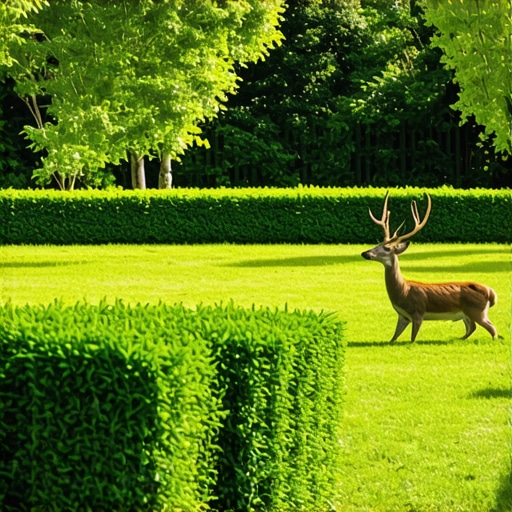
The Reality of Deterring White-Tailed Deer in 2026
Effective deer management for new hedges requires a multi-layered biological and physical defense strategy that accounts for local population density, seasonal caloric needs, and the specific USDA Hardiness Zone of your landscape. I always drill into my new crew members: if you do not fix the soil grading and establish a proper root environment first, every plant you put in the ground is just expensive compost. I have seen too many rookies drop twenty Green Giant Arborvitaes into a hole with no drainage, only to watch them die from root rot before the deer even got a chance to strip the foliage. You have to understand the biology of the plant and the psychology of the animal. If you plant ‘deer candy’ like Taxus in a high-traffic corridor, you are asking for a 100 percent loss. We do things differently. We build for the long term. It starts with the dirt. It ends with a hedge that is physically and chemically unappealing to the local herd. No fluff. Just engineering and botany.
The Apprentice Lesson: Soil First, Foliage Second
Last year, I had an apprentice who thought he could skip the compaction test on a hedge line. He planted thirty Laurels into loose, un-amended clay. Three weeks later, after a heavy rain, the plants were sitting in a bathtub of stagnant water. The root flares were suffocated. When a plant is stressed, its chemical defenses drop. Deer can sense that. They will target a stressed, nutrient-deficient plant over a healthy one every single time. We had to rip the whole line out, install a French drain to manage the hydrostatic pressure, and start over. It was a $5,000 mistake that could have been avoided with a simple perk test. Don’t be that guy.
“The survival of ornamental shrubbery in high-pressure cervid environments is directly correlated to the plant’s secondary metabolite production, which is hindered by poor soil aeration and improper NPK ratios.” – Agricultural Extension Agronomy Manual
Which hedge plants do deer hate the most?
To stop deer from eating your hedges, you must select species with high alkaloid content, prickly textures, or strong aromatic oils such as Buxus (Boxwood), Ilex (Holly), or Myrica (Bayberry). These plants provide a natural chemical deterrent that makes them unpalatable compared to softer, nitrogen-rich alternatives.
Biological Selection and Zoning
When we talk about yard cleanup and site prep, we are looking at the 2026 landscape through a lens of resistance. You need to know your soil pH. If your soil is too alkaline, your Ilex (Holly) will yellow out, lose its vigor, and the deer will move in. I recommend a pH of 5.5 to 6.5 for most evergreen hedges. If you are doing a sod install nearby, make sure your irrigation system doesn’t over-saturate the hedge line. Wet feet lead to Phytophthora. That is a death sentence. We use 1-inch diameter drip line with 0.9 GPH emitters spaced every 12 inches. This keeps the water at the roots, not on the leaves where it can encourage fungal pathogens. Keep it precise.
Physical Barriers and Jumping Physics
A deer can clear a six-foot fence if they have a clear landing zone. However, they hate jumping into tight spaces. If you are installing a new hedge, consider a double-row planting or a staggered ‘zig-zag’ pattern. This creates visual depth that confuses their depth perception. It works. Use 14-gauge welded wire cages for the first two years. This is the ‘settling in’ period. Once the root flare is established and the plant reaches a height of five feet, you can usually remove the cages, provided you have used a species they find disgusting.
| Hedge Species | Deer Resistance Level | Growth Rate (Annual) | Best Soil Type |
|---|---|---|---|
| Buxus sempervirens | Very High | 4-6 inches | Well-drained Loam |
| Ilex opaca (American Holly) | High | 12 inches | Acidic Clay/Loam |
| Thuja occidentalis ‘Green Giant’ | Moderate | 36 inches | Moist/Well-drained |
| Juniperus virginiana | Very High | 12-18 inches | Poor/Rocky Soil |
The 10-Step Deer-Proof Installation Checklist
- Conduct a soil drainage test (dig a 12-inch hole, fill with water, must drain in 4 hours).
- Verify utility lines via 811 before any excavation or irrigation trenching.
- Amend soil with organic compost to achieve 5 percent organic matter.
- Set the root flare 1-2 inches above the finished grade to allow for settling.
- Install a dedicated irrigation zone for hedges with a pressure regulator set to 25 PSI.
- Apply a 3-inch layer of triple-ground hardwood mulch (no mulch volcanoes).
- Spray a systemic repellent containing putrescent egg solids immediately after planting.
- Install physical 5-foot wire mesh cages for all ‘at-risk’ species.
- Monitor NPK levels; avoid high-nitrogen fertilizers that create ‘soft’ growth.
- Schedule a yard cleanup to remove fallen fruit or acorns that attract herds.
“A retaining wall doesn’t fail because of the stone; it fails because of the water trapped behind it, and a hedge fails for the same reason: lack of drainage.” – Hardscape Engineering Axiom
How much irrigation do new hedges actually need?
New hedges require deep, infrequent watering to force root systems to grow downward into the subsoil, specifically 1 to 1.5 inches of water per week delivered via low-flow emitters. Shallow daily watering creates weak surface roots that make the plant vulnerable to both drought and deer-related uprooting.
The Problem with ‘Mow-and-Blow’ Maintenance
Most ‘landscaping’ companies just want to blow the leaves into your hedge line and leave. This is a disaster. Decomposing leaf litter against the trunk of a hedge creates a bridge for moisture and insects. It hides the root flare. I tell my clients: if you can’t see where the trunk meets the roots, your plant is too deep. It will rot. Proper yard cleanup means hand-raking the interior of the hedge line to ensure airflow. Airflow is the best fungicide. Don’t skip this. If you want your 2026 project to survive until 2036, you have to do the manual labor. It is not glamorous. It is necessary.
2026 Deer Trends: Habituation and Persistence
Deer are getting smarter and more habituated to human scents. The old tricks like soap bars or human hair don’t work anymore. You need ‘Information Gain’ strategies. Use a rotating schedule of repellents. Switch between taste-based (capsaicin) and smell-based (dried blood) every 30 days. This prevents the herd from getting used to one scent. Also, watch your lighting. Motion-activated lights are only a temporary fix. They will eventually ignore them. The only permanent solution is a plant they physically cannot digest or a fence they cannot see a way over.