
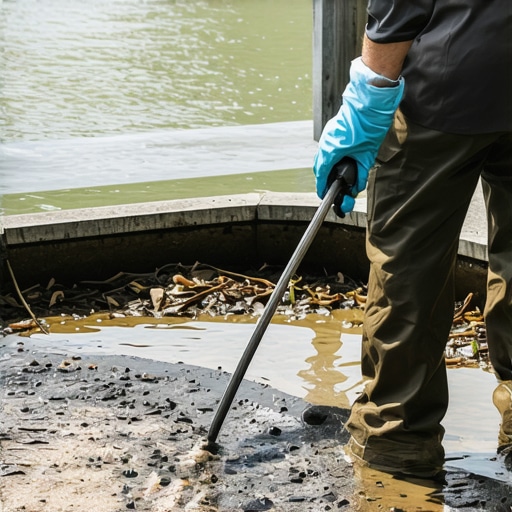
Why Your Pond Filter is Choking on Sludge
Pond sludge, or benthic detritus, accumulates when organic matter like leaf litter, fish waste, and uneaten food exceeds the capacity of the biological filtration system. This buildup creates an anaerobic environment that kills beneficial bacteria and triggers dangerous ammonia spikes that can wipe out your koi in hours.
I always drill into my new crew members: if you don’t fix the soil grading first, every plant you put in the ground is just expensive compost. The same logic applies to ponds. If your filtration is overwhelmed by sludge, the entire nitrogen cycle collapses. Last year, I walked onto a property where the homeowner had installed a high-end $5,000 pond system, but they ignored the hydrostatic pressure and drainage around the basin. Every time it rained, nitrogen-heavy runoff from the lawn washed into the pond. Within three months, the filter was a solid block of black, anaerobic muck. It didn’t just smell like rotten eggs; it was a biological hazard. We had to do a full forensic teardown, adjusting the soil grading to divert water before we even touched the filter mats. If you don’t address the source of the sediment, you’re just a hamster on a wheel.
“A filtration system is not a trash can; it is a living bioreactor that requires specific dissolved oxygen levels to maintain bacterial colonies.” – International Association of Professional Pond Builders Manual
The Mechanical vs. Biological Filtration Reality
Mechanical filtration removes physical debris via pads or brushes, while biological filtration uses porous media to house Nitrosomonas and Nitrobacter bacteria. You must clean mechanical components aggressively but treat biological media with extreme care to avoid sterilizing the pond’s nitrogen-processing engine. Most amateurs make the mistake of using a high-pressure garden hose connected to city water. The chlorine and chloramine in municipal water are designed to kill bacteria. If you spray your bio-media with tap water, you are effectively nuking your pond’s immune system. Use bucketed pond water only. It is messy. It is gross. Do it anyway.
| Filter Component | Function | Cleaning Frequency | Cleaning Method |
|---|---|---|---|
| Filter Mat (Mechanical) | Traps large solids | Weekly in summer | Aggressive rinse (pond water) |
| Bio-Balls/Lava Rock | Houses nitrifying bacteria | Twice per season | Gentle swirl in pond water |
| UV Sterilizer | Kills suspended algae | Annual bulb change | Wipe quartz sleeve with vinegar |
| Pump Pre-filter | Protects motor | Bi-weekly | Remove and shake out debris |
How to Clean Your Pond Filter Fast Without Killing the Ecosystem
The fastest way to clean a pressurized pond filter is to utilize the backwash setting while the pump is running, but for gravity-fed or waterfall boxes, you need a manual intervention. Start by unplugging the pump to prevent dry-running. Pull the mechanical pads first. If they are sagging under the weight of the muck, they are likely bypass-clogged. This means the water is just flowing over the top instead of through the media. Rinse these pads in a tub of pond water until the water coming off them is grey, not black. Next, inspect the biological media. If it is coated in slime, it cannot ‘breathe.’ A quick, gentle dunking in pond water is all you need. Do not scrub. Do not use soap. Soap is death in a pond environment.
How much modified gravel do I need for a pond edge?
To stabilize a pond edge and prevent soil erosion from entering the filter, you need a 4-to-6-inch layer of ASTM D448 No. 57 stone over a heavy-duty non-woven geotextile fabric. This prevents the soil from migrating into the water column during heavy rains. Landscaping around water features requires understanding riprap principles to manage kinetic energy from splashing water.
Can I use a pressure washer on filter pads?
Never use a pressure washer on any pond filter component unless you intend to replace it immediately. The PSI (pounds per square inch) from a pressure washer will tear the fibers of mechanical mats, rendering them useless for trapping fine particles, and it will completely strip the biofilm from your biological media. Stick to manual rinsing. It takes longer but saves the fish.
“Proper pond maintenance begins with the management of the watershed; any sediment allowed to enter the basin will eventually manifest as filter sludge.” – Penn State Agricultural Extension
The Maintenance Checklist for a Clean System
- Test Water Chemistry: Check ammonia and nitrite levels 24 hours after cleaning.
- Inspect Seals: Apply silicone-based lubricant to O-rings on pressurized canisters.
- Clear Intake Screens: Ensure the pump isn’t working against a vacuum.
- Dose Beneficial Bacteria: Add a concentrated liquid bacteria boost to jumpstart the colony.
- Check Soil Grading: Ensure no mulch or turf fertilizer can wash into the basin.
Clean it fast, but don’t clean it sterile. A pond is a living thing. If you treat it like a swimming pool, you will fail. The sludge is the byproduct of life, but left unchecked, it becomes the agent of death. Keep your hands dirty and your water moving. Don’t skip the details. Your irrigation and sod install projects nearby will thank you for the stable water table and lack of runoff issues. Landscaping is an ecosystem, not a set of isolated tasks. Treat it as such.