
The Forensic Autopsy of Failed Shade Turf
Growing thick grass under an oak tree requires managing the biological competition for nitrogen, water, and sunlight through soil remediation, selective pruning, and shade-tolerant cultivar selection. Most homeowners fail because they treat the area under a canopy the same as an open field, ignoring the localized soil acidification and root-zone resource depletion.
I always drill into my new crew members: if you don’t fix the soil grading and chemistry first, every plant you put in the ground is just expensive compost. I remember a job last spring where a client had spent four thousand dollars on premium sod every year for three years, only to watch it rot by July. They thought it was a lack of water. It wasn’t. It was a combination of hydrostatic pressure from a poorly graded slope and a soil pH of 4.5 caused by decades of decomposing oak leaf litter. The roots were literally suffocating in an acidic bog. We had to strip it to the dirt, incorporate three tons of pelletized lime, and rebuild the microbial colony from scratch before a single blade of grass could survive.
“Turfgrass and trees are in constant competition for moisture and nutrients, with the tree usually winning due to its massive root system and canopy dominance.” – Penn State Center for Turfgrass Science
The Science of the Oak Canopy Microclimate
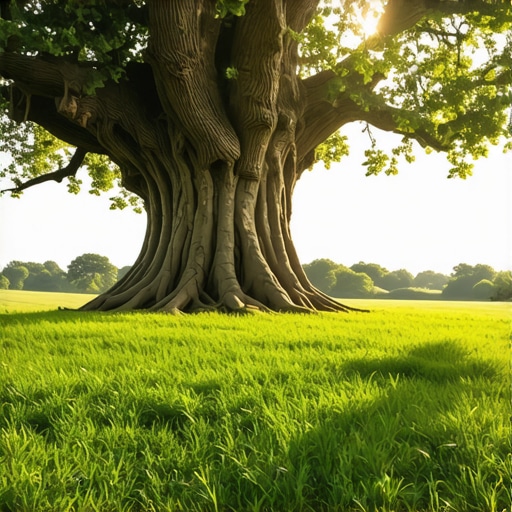
Oak trees are notorious for creating a hostile environment for turf. It is not just the shade. It is the physics of the root system. An established oak has a root flare that extends far beyond the drip line. These roots are primarily located in the top 12 to 18 inches of soil, exactly where your grass is trying to feed. This creates a zero-sum game for nitrogen and phosphorus. Furthermore, the canopy acts as an umbrella, preventing light rain from reaching the ground, while the leaves contain high concentrations of tannins. When these leaves decompose, they drive the soil pH down into a range where most turfgrass cannot metabolize nutrients. You are not just fighting shade; you are fighting a chemical and structural blockade.
[IMAGE_PLACEHOLDER]
Professional Soil Remediation and pH Balancing
To remediate soil under an oak tree, you must first conduct a professional soil test to measure CEC (Cation Exchange Capacity) and base saturation levels. Stop guessing. If your pH is below 6.0, your grass is starving regardless of how much fertilizer you dump on it. Most lawn care hacks will tell you to just throw down some 10-10-10 fertilizer. That is a waste of money. You need to address the structural compaction first. Use a core aerator to pull three-inch plugs. This allows oxygen to reach the rhizomes and breaks the surface tension of the soil, which often becomes hydrophobic under old oaks.
How do I fix patchy grass under a tree?
Fixing patchy grass under a tree requires mechanical core aeration, top-dressing with organic compost, and overseeding with fine fescue or Palmetto St. Augustine. You must clear all leaf debris weekly to prevent the buildup of growth-inhibiting tannins and allow for maximum gas exchange in the soil profile.
| Turf Variety | Light Requirement | Drought Tolerance | Mowing Height |
|---|---|---|---|
| St. Augustine Palmetto | 4 to 5 Hours | Moderate | 3.5 to 4 Inches |
| Fine Fescue | 4 Hours | High | 3.0 Inches |
| Tall Fescue | 6 Hours | High | 3.5 Inches |
| Zoysia Zeon | 5 Hours | High | 1.5 to 2 Inches |
Irrigation and Hydration Strategies
Irrigation under oak trees must be deep and infrequent to force turf roots to grow deeper than the tree feeder roots. While the internet tells you to water every day, turf grass actually needs deep, infrequent watering, exactly 1 inch per week, to force roots to chase the water down. If you water for ten minutes every morning, you are only hydrating the top half inch of soil. This encourages the tree roots to stay near the surface, where they will eventually choke out the grass and create a matted mess of roots and dead thatch.
“A retaining wall doesn’t fail because of the stone; it fails because of the water trapped behind it.” – Hardscape Engineering Axiom
While that axiom refers to walls, the logic applies to your yard cleanup and grading. If water sits at the base of the oak, the soil becomes anaerobic. You need a 2 percent slope away from the trunk. If you have a low spot, do not just fill it with dirt. You will bury the root flare and kill the tree. You need a strategic yard cleanup that involves thinning the interior canopy of the oak, known as crown thinning, to allow dappled sunlight to hit the forest floor. Do not lion tail the tree by removing all the interior growth; just thin it enough to increase the Light Compensation Point for the grass below.
Can you put sod over tree roots?
You should never install more than 2 inches of topsoil or sod over existing oak tree roots, as this can cause root suffocation and tree decline. Use a thin-cut sod and ensure the root flare remains exposed to prevent girdling roots and fungal pathogens from destroying the tree’s vascular system.
The Professional Installation Checklist
If you are serious about a sod install under a massive oak, follow this protocol. Don’t skip these steps. It will rot.
- Conduct a soil test to determine pH and nutrient deficiencies.
- Perform crown thinning on the tree to increase light penetration to at least 30 percent.
- Core aerate the entire area to a depth of 3 to 4 inches.
- Apply pelletized lime to raise pH to 6.5 if necessary.
- Top-dress with 1/4 inch of screened leaf mold compost.
- Install shade-tolerant sod like Palmetto St. Augustine or Sapphire.
- Roll the sod with a water-filled roller to ensure soil-to-root contact.
- Water deeply, reaching a 6-inch soil moisture depth.
Maintenance is the final pillar. You cannot let leaves sit on shade-stressed grass for more than three days. They block what little light is available and trap moisture, leading to Large Patch or Brown Patch fungus. Set your mower to the highest possible setting. For St. Augustine, that is 4 inches. The longer the blade of grass, the more surface area it has for photosynthesis. In a low-light environment, every millimeter of green tissue is a solar panel. If you scalp the lawn, you are cutting off its ability to feed itself. It is that simple.