
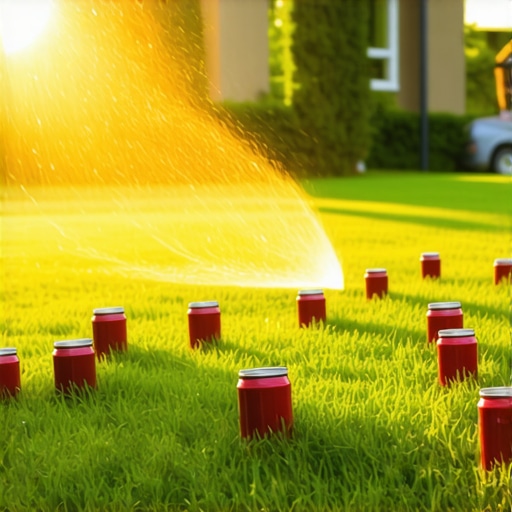
Checking your sprinkler coverage with the tuna can test involves placing flat-sided containers across your lawn to measure the depth of water delivered by your irrigation system over a specific timeframe. This landscaping diagnostic tool identifies distribution uniformity issues, allowing you to prevent turf stress and water waste caused by uneven sprinkler head performance.
The Forensic Autopsy of a Dying Lawn
When a client calls me to look at a brown patch in their yard, they usually expect me to find a pest or a fungus. Most of the time, they have already dumped three different types of fungicide on the grass, wasting a couple of hundred bucks in the process. I walk out there, stick a soil probe into the ground, and find it is bone dry six inches down. The lawn is not sick; it is thirsty. I always drill into my new crew members: if you don’t fix the soil grading and irrigation first, every plant you put in the ground is just expensive compost. You can have the most expensive sod install in the county, but if your irrigation system has a 20 percent distribution variance, that sod is going to look like a checkerboard of death by August. We call this the Forensic Autopsy because we are looking at the structural failure of the water delivery system. It is usually a combination of nozzle clogging, low pressure, or improper head spacing. If your heads are not spaced for head-to-head coverage, you have failed before you even turned the timer on. The water from one sprinkler must reach the base of the next one. Anything less is negligence.
“Distribution uniformity is the measure of how evenly water is applied to a given area. A system with low uniformity will result in some areas receiving excess water while others remain in a state of permanent moisture deficit.” – Irrigation Association Technical Manual
The Science of the Catch-Can Test
The catch-can test is the industry standard for measuring how much water your landscaping actually receives. We use tuna cans because they have straight, vertical sides. This is critical. If you use a tapered bowl or a coffee mug, the math is useless because the surface area at the top does not match the bottom. To perform a professional-grade audit, you need at least 12 to 20 cans depending on the size of the irrigation zone. You are looking for distribution uniformity (DU). In a perfect world, every can would have the exact same depth. In the real world, if you are hitting 70 percent uniformity, you are doing better than most. Most residential systems I see are operating at a pathetic 40 percent DU. This means to get enough water to the dry spots, you have to over-water the wet spots by double, leading to root rot and anaerobic soil conditions. You are literally drowning your sod install in one corner just to keep it alive in another. It is a waste of resources and a recipe for dollar spot fungus.
How many tuna cans do I need for a sprinkler test?
For a standard residential irrigation zone, you should use a minimum of 12 tuna cans spaced five to ten feet apart in a grid pattern. This density allows you to capture the variations in nozzle spray patterns and wind drift, providing a statistically significant sample of your total water application rate.
Step-by-Step Irrigation Audit Process
Start with a clean slate. This means a full yard cleanup to ensure no tall weeds or overgrown landscaping are blocking the sprinkler heads. If a blade of tall fescue is leaning over a pop-up spray head, it will deflect the water and ruin your data. Once the site is prepped, follow this protocol. First, map out your zones. Do not test multiple zones at once. You need to know exactly what Zone 1 is doing before you move to Zone 2. Place your cans in a grid. Do not just put them in the middle of the lawn. Put them near the heads, in the center of the spray pattern, and at the furthest reach of the nozzle. Run the system for exactly 20 minutes. Not 15, not 30. Twenty minutes makes the math easy because you just multiply by three to get your inches per hour rate. Use a ruler to measure the depth in each can to the nearest sixteenth of an inch. Record every single measurement. Do not round up because you want the lawn to look good on paper. The grass does not care about your feelings; it cares about hydrostatic pressure and soil moisture tension.
| Soil Type | Infiltration Rate (Inches/Hour) | Irrigation Strategy |
|---|---|---|
| Heavy Clay | 0.05 to 0.20 | Cycle and Soak (Short bursts) |
| Silt Loam | 0.30 to 0.60 | Standard Cycles |
| Sandy Soil | 0.80 to 2.00 | Deep and Infrequent |
Diagnosing the Results: Why Your Coverage Fails
If you find that the cans near the sprinkler head are full while the cans ten feet away are nearly empty, you have a pressure problem. Most landscaping professionals ignore PSI (pounds per square inch). If your pressure is too high, the water atomizes into a mist and blows away. If it is too low, the nozzle cannot throw the water to its intended distance. This creates a donut effect where the area around the head gets soaked and the perimeter dies. Another common failure we see during a sod install is mismatched precipitation rates. If you have a high-flow rotor head on the same zone as a low-flow mist head, you will never get even coverage. It is physically impossible. You must ensure all heads on a single valve have the same gallons per minute (GPM) output relative to their arc. If a 360-degree head is putting out the same GPM as a 90-degree head, the 90-degree corner is getting four times as much water. It is a disaster. Don’t skip the math here. It matters.
Why is my sprinkler coverage uneven?
Uneven coverage is typically caused by clogged nozzles, sunken heads, or low water pressure. Over time, sprinkler heads can settle into the soil, causing the spray to be blocked by the surrounding turf, which necessitates a riser extension or head adjustment during your seasonal yard cleanup.
The Critical Importance of Soil Infiltration
Water on the surface means nothing if it cannot reach the root zone. This is where soil compaction becomes the enemy. During a yard cleanup, we often find that the soil is so compacted that water just runs off into the street. If your catch-can test shows you are putting down one inch of water, but your soil probe shows the moisture only went down two inches, you have a compaction problem. You need to core aerate. You need to break up that thatch layer. In heavy clay soils, you cannot dump an inch of water at once. The infiltration rate of clay is often less than 0.1 inches per hour. If you run your sprinklers for an hour, 90 percent of that water is wasted runoff. You must use a cycle and soak method. Run the zone for 10 minutes, let it soak for an hour, and repeat. This forces the water deep into the macropores of the soil, encouraging roots to grow deeper. Deep roots are the only thing that will save your landscaping during a drought. Shallow roots are for amateurs.
“A retaining wall doesn’t fail because of the stone; it fails because of the water trapped behind it.” – Hardscape Engineering Axiom
The same logic applies to your lawn. Too much water in the wrong place creates hydrostatic pressure that displaces soil and kills oxygen levels. You need oxygen in the soil for nitrifying bacteria to function. Without those bacteria, your fertilizer is just salt sitting in the dirt. When we do a sod install, we prep the soil with organic matter to ensure that capillary action can pull the water through the profile. If you just slap sod on top of hard-packed clay, you are building a graveyard. Check your coverage. Fix your soil. Stop being a hack.
- Inspect every sprinkler head for physical damage or debris.
- Verify that nozzle filters are clean and unobstructed.
- Check that all pop-up heads are vertical and not leaning.
- Ensure the controller is set for the specific needs of your grass type.
- Perform a pressure test at the furthest head in the zone.
Maintaining the System for the Long Haul
Once you have calibrated your system using the tuna can method, don’t think you are done for the decade. Landscaping is dynamic. Plants grow, heads shift, and nozzles wear out. Every spring, as part of your yard cleanup, you should run a quick five-minute test on every zone. Look for the misting that indicates a broken seal. Look for the bubbling that indicates a cracked pipe. Irrigation is the lifeblood of your property. If you ignore it, the sod install you spent five grand on will be gone in two seasons. It is cheaper to buy a dozen cans of tuna and spend an afternoon in the yard than it is to replace an entire lawn. Do the work. Measure the water. Grow something worth looking at. It will rot if you don’t. Don’t skip this. Every drop counts when you are trying to maintain a professional-grade landscape in a changing climate. Precise irrigation is the difference between a foreman and a mower-operator.