
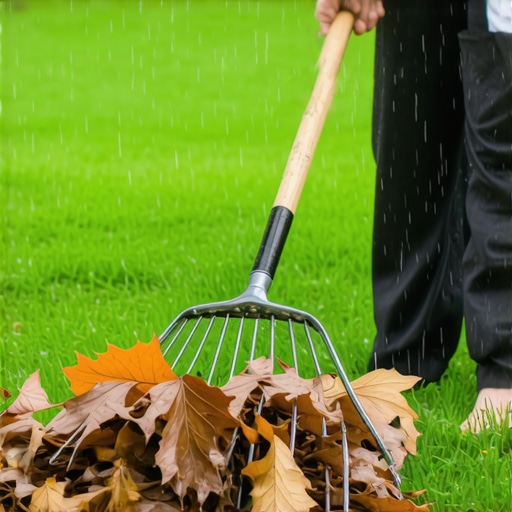
How to Clean Wet Leaves Off Your Lawn Using a Pitchfork
Most homeowners assume a rake is the only tool for yard cleanup, but when you are dealing with a heavy, sodden mat of oak or maple leaves, a rake is often the wrong tool for the job. Cleaning wet leaves with a pitchfork is a specialized technique used by professionals to lift anaerobic mats without tearing the crown of the turf grass or compacting the soil. It is about aeration and weight management, not just movement.
The Anatomy of a Failed Yard Cleanup: A Forensic Autopsy
I always drill into my new crew members: if you don’t fix the soil grading and air circulation first, every plant you put in the ground is just expensive compost. I remember a call last November where a client had left a three-inch layer of wet maple leaves on their high-end fescue for just three weeks. When we arrived, the smell of fermentation was overpowering. We peeled back the leaf mat to find the grass had turned a sickly yellow-white; the lack of oxygen had triggered anaerobic respiration, and the localized soil pH had plummeted due to the organic acids leaching out of the decaying matter. The homeowner tried to use a leaf blower, but the leaves were so heavy they didn’t budge. They tried a rake and ended up pulling up the actual sod because the wet leaves had essentially glued themselves to the grass blades. This is where the pitchfork becomes a precision instrument rather than an agricultural relic.
“Leaves left in a dense mat on turfgrass during wet conditions block sunlight and trap moisture, creating a primary environment for fungal pathogens such as Microdochium nivale (Pink Snow Mold).” – University of Minnesota Extension
Why Use a Pitchfork Instead of a Rake?
A pitchfork is superior for wet leaf removal because its tines penetrate the heavy, interlocking leaf mat to provide leverage without creating the friction that a wide-tined rake does. When leaves are saturated, they lose their individual surface area and become a single, heavy mass. A rake drags this mass, putting immense stress on the root system of your lawn. A pitchfork allows you to lift sections of the mat, breaking the surface tension and allowing air to enter the lower layers. It is a surgical approach to yard cleanup. Do not skip the lifting phase. It saves the crown of the grass.
How do you use a pitchfork for leaves without damaging the grass?
To use a pitchfork for wet leaves, you must insert the tines at a 45-degree angle into the edge of the leaf mat, lift vertically to break the suction, and then toss the clump into a wheelbarrow. Avoid dragging the tines across the soil surface, which can lead to scarring or mechanical damage to the irrigation heads or the sod install integrity. Focus on the heaviest piles where the leaves have settled into depressions in the yard. This prevents the grass underneath from suffocating. It is tedious. It works.
| Tool Type | Ideal Condition | Risk Factor | Efficiency Rating (Wet Leaves) |
|---|---|---|---|
| Poly Rake | Dry, loose debris | High turf stripping | Low |
| Leaf Blower | Dry, light coverage | Zero effect on mats | Very Low |
| Garden Pitchfork | Saturated, matted piles | Soil compaction if misused | High |
| Mulching Mower | Light dampness | Blade dulling/Clumping | Medium |
The Physics of Soil Compaction and Moisture
When you walk across a lawn covered in wet leaves, you are dealing with a high-moisture environment where the soil is at its most vulnerable to compaction. Landscaping longevity depends on pore space in the soil. If you use heavy machinery or even heavy raking on a wet, leaf-covered lawn, you collapse the macro-pores that allow for gas exchange. This is why we use a pitchfork to ‘chunk’ the leaves out. By lifting the weight off the grass, you allow the soil to breathe. You must monitor the moisture level. If the ground squishes under your boot, stay off it.
Will wet leaves kill my grass?
Yes, wet leaves will kill grass by creating a light-blocking barrier that stops photosynthesis and traps moisture against the leaf blade, leading to crown rot and fungal outbreaks. Within 14 days, a thick mat of wet leaves can cause significant turf dieback that will require a full sod install or extensive overseeding in the spring. Removing them is not an aesthetic choice; it is a biological necessity for turf survival. Don’t wait for a dry day that might not come.
“Effective turf management requires maintaining a balance between organic matter accumulation and decomposition; excessive leaf litter disrupts the carbon-to-nitrogen ratio of the surface soil.” – Agronomy Manual of Standards
Step-by-Step Professional Pitchfork Cleanup Protocol
- Assess the Mat: Locate areas where leaves are deeper than two inches and saturated.
- The Insertion: Use a long-handled garden fork with thin, forged steel tines. Do not use a wide-tine compost fork.
- The Break: Slide the tines under the mat and lift. You will hear a ‘sucking’ sound as the air breaks the moisture seal.
- The Transport: Move the lifted clumps directly into a yard waste bag or wheelbarrow. Do not make larger piles on the lawn.
- The Finish: Once the heavy mats are gone, use a leaf rake very lightly to pick up the remaining scattered debris.
Maintaining the Ecosystem Post-Cleanup
After the leaves are cleared, check your irrigation system’s rain sensor. Often, homeowners leave their systems running during the fall, which exacerbates the leaf-rot problem. Turn off the water. Your lawn needs to harden off for the winter, not sit in a swamp. If you find bare patches where the leaves have already killed the grass, do not throw seed down in the mud. Wait until the soil temperature is correct for your specific cultivar. High-quality landscaping is about timing, not just effort. You cannot rush biology.
How much modified gravel do I need for a patio base?
While not directly related to leaves, yard cleanups often reveal issues with landscaping structures. For a standard paver patio, you need a minimum of 6 inches of compacted 21A or 3/4-inch modified gravel. This base prevents the frost heave that shifts your stones when the ground freezes and thaws. Always calculate for a 20 percent compaction rate when ordering your tonnage. Get the base right or the stones will move.