
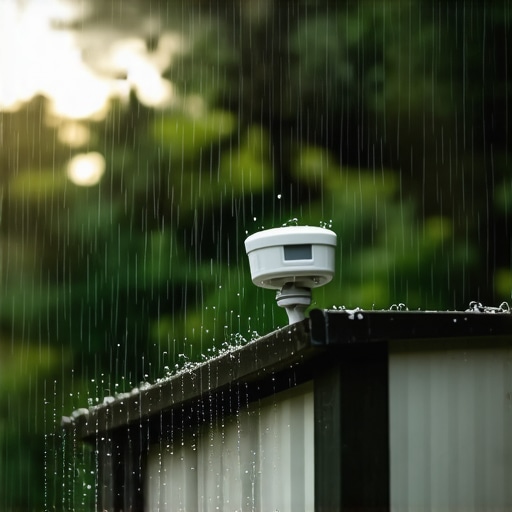
The Engineering Gap in Modern Irrigation Control
The sight of irrigation heads popping up during a torrential downpour is the mark of a poorly engineered system. Smart rain sensors often fail because of mechanical latency, improper placement, and a fundamental misunderstanding of soil hygroscopy. While homeowners expect these devices to act as a fail-safe, the reality is that most entry-level sensors rely on expanding cork disks that do not mirror the infiltration rate of your specific soil profile. When these sensors fail, your sod install is at risk of nitrogen leaching and root rot, turning a high-end landscape into a stagnant marsh. You are not just wasting water; you are actively destroying the soil microbiology you worked so hard to build during your last yard cleanup.
I always drill into my new crew members: if you don’t fix the soil grading first, every plant you put in the ground is just expensive compost. I remember a project three years ago where a client insisted on a top-of-the-line wireless sensor system. We installed it, but the site had a 3 percent grade sloping toward the house. During a heavy storm, the sensor correctly shut off the valves, but because the previous contractor ignored the hydrostatic pressure and grading, the water pooled at the foundation anyway. The sensor did its job, but the engineering failed. This is why we look at the yard as a complete hydraulic system, not a collection of gadgets. If the soil is compacted to a high bulk density, even the smartest sensor won’t prevent the runoff that carries away your expensive pre-emergent fertilizers.
The Mechanical Reality of Sensor Latency
Irrigation sensors typically utilize a stack of hygroscopic disks that expand when they absorb moisture. This mechanical expansion triggers a switch that breaks the circuit to the solenoid valves. The problem is that cork dries at a rate that rarely matches the evapotranspiration (ET) of your turf. If you have sandy soil, your lawn dries out much faster than the cork in the sensor. Conversely, in heavy clay, the soil remains saturated long after the sensor has dried out and signaled the controller to resume watering. This discrepancy creates a dangerous cycle of over-saturation or drought stress. It is a biological mismatch that no simple bypass switch can fix. To truly manage a landscape, you must calibrate the sensor to the infiltration rate of the soil, measured in inches per hour.
“A retaining wall doesn’t fail because of the stone; it fails because of the water trapped behind it.” – Hardscape Engineering Axiom
How much modified gravel do I need for a patio base?
Calculating the base for a landscaping project requires understanding volume and compaction; generally, you need 1 ton of modified gravel (2A or 3/4-inch minus) for every 50 square feet at a 4-inch depth. This base is critical for drainage, ensuring that even if your irrigation system over-runs due to a sensor failure, the water has a clear path to move through the sub-base rather than destabilizing your pavers or stone. We use plate compactors to reach 95 percent Proctor density, ensuring the base can handle the weight of the hardscape without shifting during freeze-thaw cycles. Never skimp on the stone; it is the only thing keeping your patio from becoming a series of trip hazards.
Sod Installation and the Perched Water Table
When performing a sod install, the first 14 days are critical for root establishment. A failing rain sensor during this window can be catastrophic. If the sensor fails to trigger a shut-off during a storm, the new sod becomes buoyant. This lift separates the roots from the soil interface, stalling the knitting process. Furthermore, many contractors fail to account for the “perched water table” effect, where water builds up at the interface between the organic sod peat and the native mineral soil. If your smart system keeps dumping water on top of a heavy rain, you create an anaerobic environment where Pythium and other fungal pathogens thrive. You need deep, infrequent watering cycles to force those roots to chase moisture down into the profile, not a sensor that keeps the surface in a constant state of mush.
| Sensor Type | Detection Method | Reliability Rate | Best Use Case |
|---|---|---|---|
| Hygroscopic Disk | Expanding Cork | 65% | Residential Budget Systems |
| Tipping Bucket | Mechanical Volume | 85% | Agricultural Monitoring |
| Soil Moisture Probe | Capillary Tension | 98% | High-End Commercial/Sod Care |
| ET Controller | Weather Data Stream | 90% | Large Managed Estates |
Why do smart rain sensors stop working after a year?
The primary reason for sensor failure is environmental degradation and lack of maintenance. Over time, the hygroscopic disks become clogged with dust, pollen, and debris from yard cleanup activities, which prevents them from expanding or contracting properly. Furthermore, insects like spiders often build webs inside the collector, blocking the path of water or interfering with the mechanical switch. Batteries also lose voltage in extreme heat, leading to signal drops between the sensor and the controller. We recommend an annual audit: clean the collector, test the battery, and ensure the mounting bracket hasn’t shifted toward a tree canopy or roof eave that blocks rainfall.
“Effective irrigation management requires an understanding of the Soil-Plant-Atmosphere Continuum (SPAC) to prevent nutrient leaching.” – USDA NRCS Agronomy Manual
The Physics of Soil Saturation
Understanding the field capacity of your soil is the only way to master landscaping. Field capacity is the amount of water soil can hold after excess water has drained away. When a storm hits, the soil quickly reaches the saturation point. A smart sensor is supposed to act as a governor, but it doesn’t know the pore space of your soil. If you have 50 percent pore space in a loamy soil, you have a massive reservoir. If you have compacted clay, you have almost none. In compacted areas, the rain sensor might register half an inch of rain and think it’s safe to resume watering tomorrow, but the clay is still at 100 percent saturation. You are essentially pouring water into a full cup. This leads to runoff, which carries phosphorus and nitrogen into the local watershed, a major failure in environmental stewardship.
- Inspect the sensor location: It must have a 360-degree clear view of the sky.
- Verify the rain threshold: Most systems should be set to 1/8 or 1/4 inch of rain.
- Calibrate for soil type: Clay needs longer shut-off times than sandy loam.
- Check for signal interference: Metal siding or thick masonry can block wireless signals.
- Conduct a bucket test: Measure actual output of your irrigation heads to match sensor data.
Proper drainage is the silent partner of irrigation. If you don’t have a French drain or a clear exit strategy for water, no sensor in the world will save your yard from a 2-inch downpour. We often see homeowners spend thousands on tech but zero on grading. It is a backwards approach. You build the foundation of the land first, then you add the controls. Every time we do a yard cleanup, we check the grade and the sensor. It’s a standard operating procedure. A sensor is a tool, not a brain. You still need to walk the grass, feel the soil, and understand the biology of what is happening under the surface. If it’s squishy, turn the clock off. Don’t wait for a cork disk to tell you what your feet already know.