
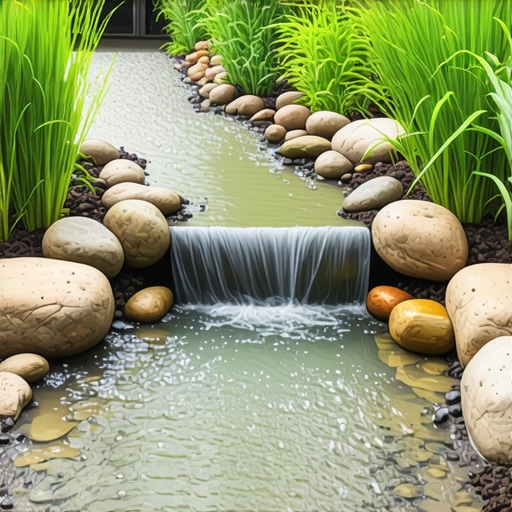
The Engineering Reality of Dry Creek Bed Construction
Building a dry creek bed requires more than just dumping river rock in a ditch; it is a calculated engineering solution designed to manage surface water runoff and prevent soil erosion during high-velocity rain events. To function correctly, these structures must account for hydrostatic pressure, soil permeability, and the critical slope necessary to ensure water moves away from foundations and toward designated catchment areas.
I recently got called out to tear up a $30,000 patio that was sinking because the previous contractor thought a ‘dry creek’ was just a decorative stripe of pebbles. It wasn’t. They didn’t calculate the gallons per minute (GPM) of runoff coming off the roof, and the water eventually back-flowed, saturating the subgrade of the patio until the entire limestone base turned into a slurry. We had to excavate three feet down, install a 4-inch perforated ADS pipe underneath a new creek bed, and rebuild the drainage profile from the ground up. If you do not respect the volume of water your property moves, the water will eventually move your property. I have spent twenty years fixing ‘landscaping’ that didn’t take civil engineering into account. Most homeowners see a pretty pile of stones; I see a riparian management system that needs to handle 4 inches of rain in an hour without blowing out the downstream banks.
The Hydrology of Dry Creek Beds and Slope Calculation
A functional dry creek bed must have a minimum slope of 2 percent (a 2-inch drop for every 10 feet of length) to maintain the velocity required to prevent sediment buildup while avoiding scouring. Proper irrigation management and landscaping design require understanding the watershed of your specific lot, including the coefficient of runoff for different surfaces like turf and concrete.
“A retaining wall or drainage swale doesn’t fail because of the stone; it fails because of the water trapped behind or beneath it.” – Hardscape Engineering Axiom
How deep should a dry creek bed be for drainage?
To effectively move water, the center of the swale should be at least 12 to 18 inches deep before the addition of stone. This depth allows for a 2-inch layer of compacted subgrade, a non-woven geotextile fabric, and 6 to 10 inches of graded river rock. A shallow bed will simply overflow during a heavy storm, leading to sod install failure and foundation saturation. Don’t eyeball it. Use a transit level or a laser level. If you are off by half an inch over twenty feet, you create a stagnant pool that breeds mosquitoes and rots plant roots.
| Material Type | Permeability Rating | Primary Function |
|---|---|---|
| Non-Woven Geotextile | High | Soil separation and weed suppression |
| 3-5 Inch River Rock | Moderate | Energy dissipation and aesthetics |
| #57 Clean Stone | High | Base drainage and pipe bedding |
| Boulders (12″+) | N/A | Structural banking and flow redirection |
What is the best liner for a dry creek bed?
Avoid plastic liners at all costs. You need a 4-ounce or 6-ounce non-woven geotextile fabric. Unlike plastic, which traps water and creates a slip-plane for the rocks to slide down the slope, geotextile allows soil microbiology to breathe while preventing the rock from sinking into the native clay. If you use cheap weed barrier from a big-box store, it will tear within two seasons. Professional grade fabric is non-negotiable. It keeps the fines (small soil particles) from clogging the voids between your stones. This ensures the void ratio remains high enough to store and transport water effectively.
Excavation and the Science of Subgrade Preparation
Before you even think about yard cleanup or stone delivery, you must address the subgrade. The shape of the trench should be a ‘V’ or ‘U’ profile with flared sides to mimic a natural floodplain. This shape is critical for energy dissipation. When water hits a bend in your creek, it exerts force on the outer bank. If that bank isn’t reinforced with larger rip-rap or boulders, the water will carve a path right through your lawn. We call this bank migration. It is the enemy of a stable landscaping project.
“Surface drainage systems must be designed to accommodate the peak flow rate of a 10-year, 24-hour storm event to prevent localized flooding and structural erosion.” – USDA Natural Resources Conservation Service
- Mark Utility Lines: Always call 811. Hitting a gas line or an irrigation main will turn a weekend project into a disaster.
- Calculate Volume: Measure the square footage of the roof and hardscape areas feeding into the creek. 1,000 square feet of roof sheds 625 gallons of water for every inch of rain.
- Remove Vegetation: Strip all grass and roots. Decaying organic matter creates voids that lead to settling.
- Compaction: Use a plate compactor or a hand tamper on the raw earth. The ground should be hard enough that a boot heel doesn’t leave an impression.
Material Selection: Beyond Aesthetics
Selecting stone is a matter of hydraulics. You need D50 sizing, which refers to the median diameter of the stones. For a standard residential dry creek, a mix of 3-to-8-inch round river rock provides the best balance of water movement and stability. Small pebbles (pea gravel) will wash away in the first storm. Larger boulders should be used at the ‘bends’ and ‘drops’ to act as check dams. These boulders break the water’s momentum. This prevents the water from reaching a critical velocity that would rip up your new sod install at the end of the run. I see ‘pros’ use 1-inch stones in a high-flow area all the time. It is lazy. The water will treat those stones like marbles.
How much modified gravel do I need for a creek bed base?
If you are installing a French drain underneath the creek (highly recommended for clay soils), you need 1 ton of #57 clean stone for every 20 linear feet of 4-inch pipe. This stone surrounds the pipe and acts as a filter medium. Do not use ‘modified’ gravel (which contains dust/fines) for drainage; it will pack down and stop water flow. You need clean-washed stone only. The porosity of the stone layer is what allows the system to ‘hide’ water during the initial stages of a storm.
The Maintenance Lifecycle
A dry creek bed is not ‘zero maintenance.’ Yard cleanup is essential every autumn. Leaves and organic debris will settle between the rocks, decompose, and turn into compost. Once that happens, weed seeds will blow in and take root in the rocks. This is why many creek beds look like overgrown weed patches after three years. You must use a high-powered leaf blower to clear the stones annually. Also, check for undermining after the first major rain. If you see soil washing out from under a boulder, you have a piping issue where water is finding a path under the fabric. Fix it immediately with hydraulic cement or additional fabric layers. This isn’t just gardening; it’s infrastructure management. Treat it as such, and your basement will stay dry for decades.