
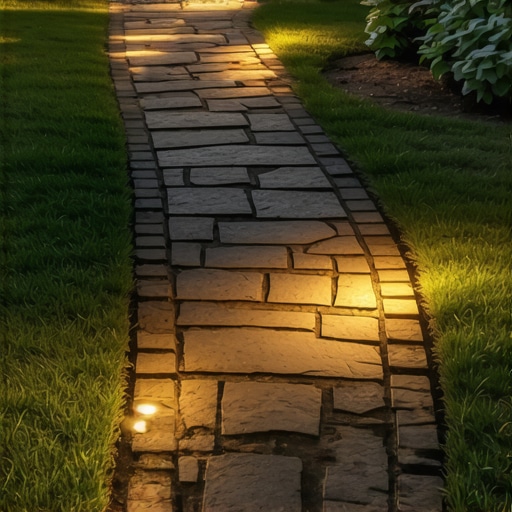
Why Planning Your Stone Walkway Lighting Starts with the Subsurface Environment
Proper stone walkway lighting requires an integrated approach where conduit placement happens before the modified gravel base is compacted. This prevents later excavation that compromises the structural integrity of the pavers and ensures a low-voltage system remains protected from hydrostatic pressure and soil movement. If you treat lighting as an afterthought, you are asking for a structural failure that will cost thousands to remediate. Landscape lighting is not just about aesthetics; it is a critical component of site engineering and safety.
I recently got called out to tear up a $30,000 travertine patio and walkway that was sinking because the previous contractor decided to retro-fit lighting by digging under the edge of the pavers. They compromised the 1 inch sand setting bed and didn’t realize they were creating a channel for water to undermine the entire 6 inch base of 2A modified gravel. Within six months, the walkway had a two inch dip where the water had washed away the fines. This is what happens when you treat hardscaping like a DIY project instead of a civil engineering task. You cannot simply shove wires into the dirt and expect the earth to remain stable. Every time you penetrate the subgrade, you must understand how that void will affect load-bearing capacity and drainage.
“A retaining wall or stone walkway does not fail because of the stone; it fails because of the water trapped behind it or the lack of a compacted base.” Hardscape Engineering Axiom (ICPI Standards)
When we talk about landscaping and hardscape integration, we are talking about layers. Your soil has a specific pH level and moisture content that can corrode cheap fixtures. Your yard cleanup routine needs to account for these fixtures, meaning they must be positioned where a leaf blower or mower won’t catch them. If you are doing a sod install, the irrigation lines and lighting lines need to be mapped on a site plan to avoid the dreaded shovel-through-the-wire scenario during future yard maintenance.
Mistake #1: The Over-Illumination Trap and Ignoring Photometric Spread
Most homeowners over-light their paths, creating a harsh glare that ruins scotopic vision. The goal of landscape lighting is to illuminate the walking surface using 3000K LEDs with a crossover pattern to eliminate shadows without blinding the pedestrian or washing out the natural stone color. When you blast a walkway with too many lumens, you create ‘hot spots.’ These are areas of intense light followed by deep shadows. This is statistically more dangerous than no light at all, as the human eye cannot adjust quickly enough between the two zones.
Consider the beam angle. A professional grade fixture will have an adjustable shroud. You want the light directed at a 45 degree angle toward the ground. We measure this in foot-candles. For a standard residential stone walkway, you only need about 0.5 to 1.0 foot-candles of light on the path. Anything more is light pollution. If you are using travertine or light colored flagstone, the reflectance value is high. You need fewer lumens because the stone itself acts as a secondary light source. Conversely, dark slate or basalt absorbs light, requiring a slightly higher output or closer spacing of fixtures.
How many lumens do I need for a stone walkway?
For most residential paths, fixtures should output between 100 and 300 lumens. This provides enough visibility for safe passage without causing glare. We typically space these fixtures 6 to 8 feet apart, staggered on both sides of the path. This creates a rhythmic, balanced wash of light that guides the eye. Don’t line them up like a runway; it looks amateur and narrows the perceived width of the landscaping.
Mistake #2: Failure to Sync with Irrigation and Grading Logic
Integrating lighting wires with existing irrigation lines and yard drainage is non-negotiable for long-term system health. If wires are laid in areas of high hydrostatic pressure or poor grading, moisture ingress will eventually short the transformer, leading to a total system failure within two seasons. Water is the enemy of every hardscape project. When we install a stone walkway, we are usually dealing with a 2 percent grade to ensure water sheds off the surface. If your lighting conduit runs perpendicular to this grade without proper trenching and backfilling, you have created a miniature dam.
This is where yard cleanup and sod install knowledge comes into play. If you are laying sod over a recently trenched lighting line, the soil will settle. This creates a low spot where water will pool. This water then sits on your 12/2 direct-burial wire. While the wire is rated for moisture, the connectors are the weak point. We use silicone-filled wire nuts or heat-shrink tubing. Even then, constant immersion in a poorly drained yard will eventually lead to copper oxidation and voltage drop. You must ensure your landscaping plan includes French drains or catch basins if the walkway sits in a low point of the property.
“Excessive night lighting can disrupt the phenology of woody plants and the behavior of nocturnal pollinators, leading to localized ecological imbalances.” Agricultural Extension Research on Urban Horticulture
| Feature | Pro-Grade LED | Big-Box Halogen | Solar ‘Stakes’ |
|---|---|---|---|
| Lifespan | 50,000+ Hours | 2,000 Hours | 6-12 Months |
| Durability | Cast Brass/Aluminum | Thin Plastic | Flimsy Plastic |
| Light Quality | 3000K (Warm White) | Yellow/Muddy | Blue/Cold |
| Voltage Stability | Regulated Driver | Fluctuating | Highly Variable |
Mistake #3: Neglecting Voltage Drop and Wire Gauge Selection
Calculating voltage drop is critical for long runs of stone walkway lights. Using thin 16-gauge wire for a 100-foot run results in dim fixtures at the end of the line. Professional installers use 12/2 or 10/2 direct-burial wire and multi-tap transformers to maintain consistent output across the entire circuit. If the first light is getting 12 volts and the last light is getting 9 volts, the color temperature will shift. On a LED, it might not even fire. On a halogen, it will look orange and weak.
The math is simple: Watts x Length / Constant. For 12-gauge wire, that constant is 7500. If your total wattage on a run is 60 watts and the run is 100 feet, your voltage drop is 0.8 volts. This is acceptable. If you use 16-gauge wire, that constant drops significantly, and your voltage loss doubles or triples. We also recommend never loading a transformer beyond 80 percent of its rated capacity. If you have a 300-watt transformer, do not exceed 240 watts. This headroom accounts for the inrush current when the system first kicks on at dusk.
How deep should landscape lighting wire be buried?
Code usually requires 6 inches for low-voltage (12V-15V) lighting, but I tell my crews to go 8 to 10 inches. Why? Because homeowners love to aerate their lawns. A standard core aerator pulls 3 to 4 inch plugs. If your wire is only 4 inches deep, you will have twenty different breaks in your line after one yard maintenance session. If you are running wire under a stone walkway, it must be in Schedule 40 PVC conduit. Period. No exceptions. The weight of the stone and the compaction of the base will crush or pinch a bare wire over time.
- Verify Soil Compaction: Ensure the subgrade is at 95 percent Proctor density before laying conduit.
- Check Polarity: Always maintain consistent lead identification to prevent phase issues.
- Voltage Test: Measure voltage at the furthest fixture under load. It should be between 11.5V and 12.5V.
- Fixture Placement: Set fixtures 2 inches back from the edge of the stone to prevent damage from string trimmers.
- Transformer Location: Mount the transformer at least 12 inches above the finished grade to avoid snow or mulch accumulation.
Once the install is complete, the ‘settling in’ period begins. In the first year, keep an eye on the polymeric sand in the joints near your fixtures. If you see cracking, it means the fixture was not seated properly or the soil is shifting. Correct it immediately. A stone walkway is a living structure in a sense; it moves with the freeze-thaw cycles. Your lighting system must be flexible enough to move with it without snapping a connection or losing its aim. This is the difference between a contractor who knows the dirt and a hack who just knows how to plug in a cord.