
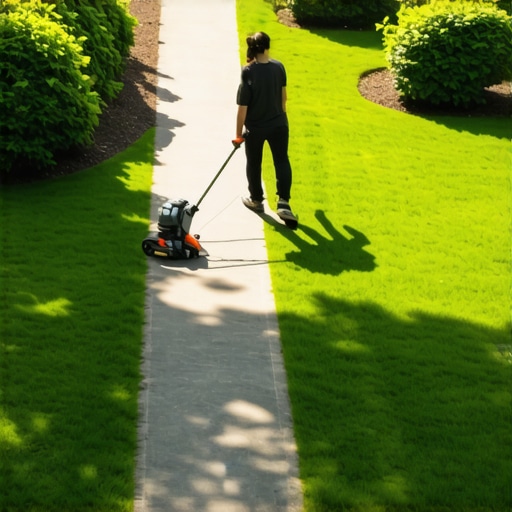
The Mechanics of a Perfect Vertical Cut
To edge a walkway like a pro with a string trimmer, you must flip the trimmer head 180 degrees to a vertical orientation and walk backward while maintaining a steady 90-degree angle against the concrete edge. This process creates a V-trench that serves as a physical barrier against sod encroachment, improves surface drainage, and defines the structural limits of your landscaping beds. Don’t be a hack. A clean edge is the difference between a high-end estate and a neglected rental property.
I always drill into my new crew members: if you don’t fix the soil grading first, every plant you put in the ground is just expensive compost. I remember an apprentice years ago who thought he could hide a 3-inch height variance in a sod install just by trimming the grass tall. Within a month, the irrigation runoff pooled at the low point, the roots rotted, and we had to rip out 400 square feet of turf. The edge is where your engineering meets the eye. If the edge is crooked, the whole yard cleanup was a waste of time. You have to understand the soil. You are not just cutting grass; you are managing a living biological system that is constantly trying to reclaim your hardscape. The concrete walkway is a heat sink that dries out the soil at the margin. Trimming it improperly exposes the meristematic tissue of the grass to desiccation. You need a clean, sharp shear, not a blunt-force trauma impact from a weak trimmer line.
“Proper lawn edging prevents the lateral spread of rhizomatous grasses into ornamental beds and hardscapes, reducing long-term maintenance costs.” – Agricultural Extension Service Bulletin
The Physics of Trimmer Line and Centrifugal Force
The average homeowner buys the cheapest .080-inch round line they can find. That is a mistake. Professional landscaping requires at least a .095-inch or .105-inch twisted or square line. Why? Aerodynamics and mass. A square line has sharp edges that act like a saw blade, while a round line acts like a whip. At 8,000 RPM, the tip speed of that line is incredible. You need that mass to slice through the thick thatch layer of a neglected edge. When the line hits the dirt, it loses velocity. A thicker line maintains its moment of inertia, allowing you to maintain a consistent depth in the soil trench. If you skip this, your edge will look ragged and uneven. It will rot. Don’t skip this. You also need to consider the displacement of the engine. A 25cc engine might struggle with a .105 line in heavy clay. I prefer a 30cc plus unit for any serious yard cleanup. The torque is what keeps the line spinning when you’re 2 inches deep in the dirt.
How much modified gravel do I need for a patio base?
For a standard hardscape installation, you need a minimum of 6 inches of compacted 2A modified gravel (also known as CR6 or 3/4-inch minus) to ensure structural integrity and proper hydrostatic pressure management. This equates to approximately 1 ton of gravel for every 50 square feet at a 4-inch depth, though 6 inches is the professional standard for frost-thaw climates. If your sod install borders this base, your edging depth must be carefully calibrated to avoid disturbing the compacted sub-base of the walkway. If you hit the gravel with your trimmer line, you’ll chew through the spool in seconds and destabilize the polymeric sand in the joints. Precision is everything.
| Line Diameter | Application Type | Durability Rating | Material Density |
|---|---|---|---|
| .080 inch | Light grass trimming | Low | Standard Nylon |
| .095 inch | Commercial Edging | High | Reinforced Co-polymer |
| .105 inch | Heavy Sod/Brushes | Extreme | Multi-sided Star/Square |
Step-by-Step Professional Edging Protocol
- Clear the Line: Use a leaf blower to remove all stones and debris from the walkway. A single pebble hit by a trimmer line at high speed is a projectile that can shatter a sliding glass door or blind a crew member.
- Establish the Plane: Rest the trimmer’s guard (if you still use one) or the motor housing against your forearm to create a stable fulcrum.
- The Vertical Flip: Rotate the machine so the string is spinning in a vertical plane, perpendicular to the ground.
- Direction of Travel: Always walk backward. This allows you to see the “cut line” as it develops against the concrete. Walking forward hides your work behind the trimmer head.
- Depth Control: Sink the line approximately 1 to 1.5 inches into the soil. This severs the rhizomes and creates a clean air gap.
“A retaining wall doesn’t fail because of the stone; it fails because of the water trapped behind it.” – Hardscape Engineering Axiom
Environmental Impact and Soil Health
Edging is not just about aesthetics; it is about water management. A deep edge prevents irrigation water from sheeting off the lawn and onto the sidewalk, where it picks up pollutants and enters the storm drain. By creating a trench, you allow that water to infiltrate the soil at the root zone. Furthermore, the nitrogen cycle in your lawn is highly active at the edges. When you cut, you are leaving organic matter behind. If you don’t blow that debris back onto the lawn during your yard cleanup, you are mining nutrients out of your soil and throwing them away. Professional landscaping is about closed-loop systems. Take the time to calibrate your irrigation system after a heavy edging session. You may find that your edge-line heads need adjustment to account for the new soil level. A professional never leaves a job site without checking the clocks and zones. It’s the difference between a contractor and a technician.