
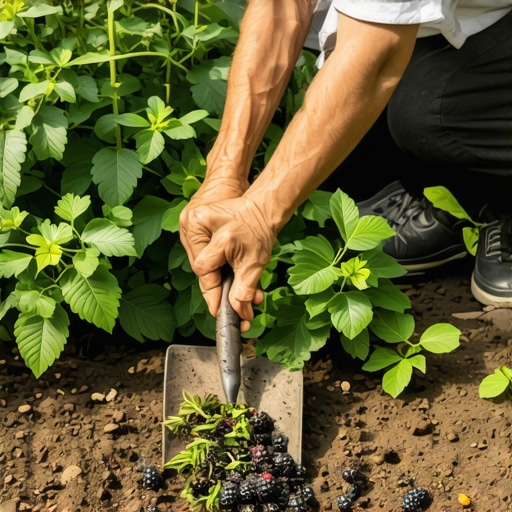
I always drill into my new crew members: if you don’t fix the soil grading first, every plant you put in the ground is just expensive compost. The same logic applies to invasive removal. I recently watched a homeowner spend three weekends hacking at a blackberry thicket with a machete, only to have it return twice as thick. He didn’t understand the anatomy of the beast. Blackberries, specifically Rubus armeniacus or Himalayan Blackberry, are not just bushes; they are a sophisticated biological underground network. If you leave a single two inch piece of rhizome in the dirt, you haven’t won. You have just pruned it. Real yard cleanup requires an engineering mindset where we treat the root system like a structural foundation that must be excavated.
How to Remove Blackberry Bushes Without Using Harsh Sprays
To remove blackberry bushes without chemicals, you must mechanically excavate the root crown and starve the remaining rhizomes of light and oxygen for at least two growing seasons. This involves cutting canes to manageable heights, digging out the central ‘brain’ or root hub, and using heavy-duty silviculture fabrics to prevent photosynthesis in any missed fragments.
The Anatomy of the Infestation: A Forensic Autopsy
When you look at a wall of thorny canes, you are seeing a carbohydrate factory. The leaves capture solar energy, convert it into sugars, and pump those sugars down into a massive, woody root crown. This crown can be the size of a basketball. It serves as a storage battery. You can cut the top off every day, and the battery will just send up a new shoot using stored energy. To kill it, you have to disconnect the battery. I tell my guys to look for the ‘knuckle’ where the canes meet the earth. That is your primary target. If that stays in the ground, your landscaping efforts are doomed from the start. We see it all the time in sod install prep; people lay expensive turf over old blackberry sites and are shocked when the canes punch through the new grass within a month. The pressure these plants exert is immense.
“Management of invasive Rubus species requires a multi-year commitment to depleting the plant’s carbohydrate reserves through repeated mechanical stress or complete root system extraction.” – Penn State Extension Horticultural Manual
The Mechanical Removal Protocol
Don’t reach for the RoundUp. Reach for a pair of geared bypass loppers and a sharpened drain spade. First, you need to clear the ‘aerial biomass.’ Cut the canes down to about 8 inches above the soil. This height is strategic. It gives you a handle to grab when you start digging, but it removes the plant’s ability to photosynthesize. Once the canes are cleared, you need to perform a perimeter search. Blackberries use ‘tip-rooting’ where a cane bends over, touches the ground, and starts a new plant. It is a biological flanking maneuver. You must sever these connections before you move to the main excavation. Use a 14 gauge sharpened spade. Narrower is better. You want to slice through the lateral roots around the crown at a 45 degree angle. Once you have circled the plant, use the spade as a lever. Physics is your friend here. A 48 inch handle gives you the mechanical advantage needed to pop a 50 pound root mass out of compacted clay.
Comparison of Removal Strategies
| Method | Success Rate | Soil Impact | Effort Level |
|---|---|---|---|
| Mowing/Cutting | 15% | Minimal | High (Repeat) |
| Chemical Spray | 65% | High Toxicity | Low |
| Root Excavation | 95% | Soil Disturbance | Extreme |
| Solarization | 80% | Microbe Death | Medium |
How long does it take to kill blackberry roots?
While the initial excavation takes hours, the total eradication of a blackberry seed bank and rhizome network takes 12 to 24 months of active monitoring. You must check the site every 30 days for ‘volunteers’ emerging from dormant seeds or deep lateral roots that were missed during the primary dig. Consistency is the only way to win. One missed month allows the plant to recharge its energy stores. It is a war of attrition. If you are planning a sod install, I recommend waiting at least one full spring cycle after removal to ensure the ground is clean. Nothing ruins the irrigation lines faster than a woody blackberry root growing through a PVC pipe. I have seen 1/2 inch poly tubing crushed by the secondary growth of these plants. It is a slow motion hydraulic press.
The Post-Removal Maintenance Checklist
- Sift the Soil: Use a 1/2 inch hardware cloth screen to sift the top 6 inches of soil in the ‘blast zone’ to catch small root fragments.
- Monitor pH Levels: Blackberries thrive in slightly acidic soil. Adding lime to bring the pH closer to 7.0 can make the environment less hospitable for new seedlings.
- Mulch Deeply: Apply 4 to 6 inches of wood chips. This forces any new growth to work harder to reach the light, making them easier to spot and pull.
- Compaction Check: If you dug deep holes, you must backfill and compact the soil in 3 inch lifts to prevent settling that ruins drainage.
Does vinegar kill blackberry bushes permanently?
Household vinegar is too weak, and even 30% industrial acetic acid only burns the foliage without touching the root system. Using vinegar on a blackberry crown is like trying to put out a forest fire with a squirt gun; it might look like you did something because the leaves turn brown, but the ‘brain’ of the plant is perfectly safe underground. For real results, you need mechanical force.
“Surface treatments that do not penetrate the soil profile are largely ineffective against perennial woody species with established lateral rhizome systems.” – ICPI Hardscape Engineering Standard – Site Prep Section
The Engineering of the Kill Zone
After the physical removal, you have a site that is prone to erosion and nutrient leaching. This is where yard cleanup transitions into landscaping. You have essentially performed surgery on the earth. You need to stabilize it. If the area is sloped, you are looking at potential hydrostatic pressure issues if you don’t replant quickly. I recommend a heavy seeding of a competitive cover crop or moving straight to a professional sod install. The goal is to create a ‘living mulch’ that outcompetes any blackberry seeds left in the soil. A thick mat of turf grass or native groundcover acts as a biological barrier. If you are installing an irrigation system at this stage, ensure your drip lines are buried properly to avoid encouraging shallow weed growth. Deep roots are healthy roots. We want the water to go 6 to 8 inches deep to encourage your new plants to chase the moisture down, leaving the surface dry for potential invasive seeds. It will rot if you over-saturate the top layer. Don’t skip the compaction phase. Use a plate compactor if the area is larger than 100 square feet to ensure your new grade holds. Precision matters. Your yard is a system. Treat it like one.