
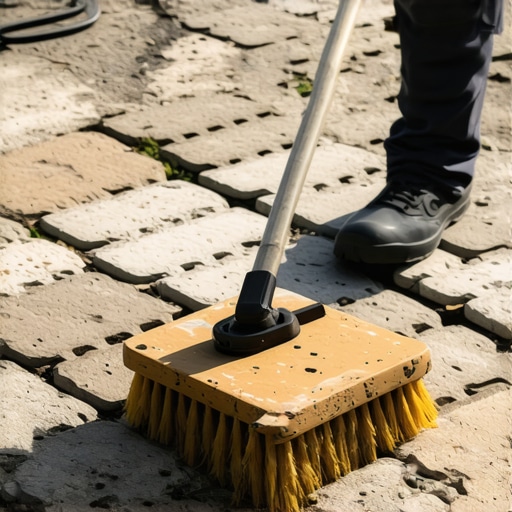
The Hidden Decay of Dirty Hardscapes
To clean paver stones without a power washer, use a pH-neutral surfactant or a specialized oxygenated bleach solution paired with a stiff-bristled nylon brush. Avoid acidic cleaners on limestone or marble. This manual method preserves the paver surface paste and protects the polymeric sand joints from erosion and cavitation damage caused by high-pressure water. Most homeowners assume the grime is just dirt. It is not. It is a biological film. It is a microscopic ecosystem of algae, lichen, and moss that feeds on the minerals in your concrete. If you leave it, it will destroy the stone. It will cost you thousands.
The Hardscape Autopsy: A Lesson in Base Failure
I recently got called out to tear up a $30,000 patio that was sinking because the previous contractor failed to manage the hydrostatic pressure and surface maintenance. The homeowner thought the problem was the stone. They were wrong. When I excavated the site, I found a saturated, muddy mess where a modified gravel base should have been. The stones were covered in a thick layer of black biofilm that had trapped moisture against the surface for years. This moisture didn’t just sit there. It moved through the stones via capillary action, saturating the bedding layer. Because the homeowner had been using a high-pressure power washer every spring, they had blasted out the polymeric sand in the joints. This allowed rain to bypass the surface entirely and dump straight into the base. The base turned to mush. The patio settled four inches in the center. It was a total loss. Don’t be that person. Proper cleaning is about preservation, not just aesthetics.
Why High Pressure is the Enemy of Your Patio
Power washers are the favorite tool of the unskilled laborer. They provide instant gratification but long-term destruction. When you hit a concrete paver with 3000 PSI, you aren’t just removing dirt. You are performing a microscopic excavation of the cementitious matrix. This is known as pitting. Once the surface is pitted, the stone becomes more porous. It absorbs more water. It holds more dirt. You have effectively created more surface area for algae to grow. It is a vicious cycle. Furthermore, high-pressure water causes cavitation in the joints. It rips out the stabilizer. Without that sand, the stones will shift. They will wobble. Eventually, they will crack. Low-impact cleaning is the only way to maintain the tensile strength of your hardscape.
“A retaining wall doesn’t fail because of the stone; it fails because of the water trapped behind it.” – Hardscape Engineering Axiom
The Chemistry of Biofilms and Mineral Stains
We need to understand what we are fighting. Most patio stains fall into three categories: organic, mineral, and petroleum. Organic stains are the greens and blacks. They are alive. You need an oxidizer to kill them. Sodium percarbonate is my go-to choice. It breaks down into hydrogen peroxide and soda ash. It is safe for your grass. It is safe for your pets. Mineral stains, or efflorescence, are white and chalky. This is salt rising to the surface. If you see this, your drainage is failing. You are seeing the evidence of water moving through the stone. Petroleum stains come from grills or cars. They require a high-alkaline degreaser to break the molecular bond between the oil and the concrete aggregate.
The Non-Mechanical Cleaning Protocol
This process takes more sweat, but it saves the stone. You should perform this as part of your regular yard cleanup routine. Before you start, check your irrigation system. If your sprinklers are hitting the patio daily, you are depositing minerals that will cause scaling. Adjust those heads. If you just did a sod install, wait until the turf is rooted before doing a deep clean, as the runoff can affect soil chemistry. Follow this technical table for agent selection:
| Stain Type | Recommended Agent | Chemical Mechanism |
|---|---|---|
| Biofilm (Algae/Moss) | Sodium Percarbonate | Oxidation of cellular walls |
| Efflorescence | Specialized Salt Dissolver | Chelation of calcium carbonate |
| Oil/Grease | Alkaline Degreaser | Saponification of lipids |
| Tannins (Leaves) | Liquid Dish Soap (Dawn) | Micellar encapsulation |
The manual cleaning process is straightforward but requires discipline. Do not skip steps. The dwell time is the most important factor. You must let the chemistry do the heavy lifting. If you scrub while the stone is dry, you are just grinding dirt into the pores. It will not work. You need to keep the surface wet.
- Step 1: Clear all furniture and debris. Use a leaf blower. Do not leave organic matter behind.
- Step 2: Pre-wet the entire surface. The stones should be saturated but not have standing puddles.
- Step 3: Apply your chosen cleaning solution. Use a pump sprayer for even distribution.
- Step 4: Dwell. Let it sit for 15 to 20 minutes. If it starts to dry, mist it with water.
- Step 5: Agitate. Use a stiff nylon brush. Do not use wire brushes. They will leave metal fragments that rust.
- Step 6: Rinse. Use a standard garden hose with a spray nozzle. No high pressure.
How much modified gravel do I need for a patio base?
For a standard pedestrian patio, you need a minimum of 4 to 6 inches of compacted modified gravel (2A or 2B stone). If you are in a freeze-thaw climate, you may need 8 inches to prevent heaving. Calculate your volume by multiplying the square footage by the depth in feet. Then divide by 27 to get cubic yards. Do not skimp on this. If the base fails, the cleaning doesn’t matter. The whole landscaping project is a waste of money.
How do you stop weeds from growing between pavers?
Weeds do not grow from the soil underneath. They grow from seeds that land in the dirt on top of the joints. The only way to stop them is to maintain the polymeric sand. This sand contains a binder that hardens when wet. It creates a physical barrier. If you see weeds, it means your sand has eroded or reached its lifecycle end. Clean the joints, remove the weeds, and sweep in new sand. It is a maintenance task. It is not a one-time fix. Do not use vinegar on your pavers to kill weeds. Vinegar is acetic acid. It will dissolve the calcium in your concrete. It will ruin the finish.
“Ensure the subgrade is compacted to 95 percent of the standard Proctor density to prevent differential settlement.” – Interlocking Concrete Pavement Institute (ICPI) Standards
Protecting Your Investment: Beyond the Scrub
Once your pavers are clean, you need to think about the surrounding environment. If your sod install is too high, it will trap water on the edge of the patio. This is called a “perched water table.” It will cause the edge pavers to sink first. Ensure your soil grading slopes away from the patio at a rate of 2 percent. This is about a 1/4 inch drop for every foot of distance. If you don’t have this, you need to install a French drain or a channel drain. Your landscaping should work with your hardscape, not against it. A beautiful yard is a system. Every part must function correctly. If one part fails, the rest will follow. It is basic engineering. It is not magic. It is just dirt and physics.