
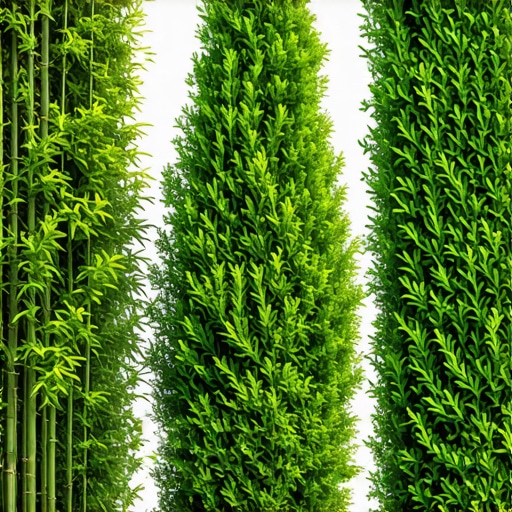
Selecting Fast-Growing Privacy Plants Without the Invasive Headache
Choosing the right privacy plants involves balancing vertical growth rates with root system containment to ensure your screen provides 100% foliage opacity without damaging hardscapes. Cultivars like Green Giant Arborvitae, Skyrocket Juniper, and clumping Fargesia bamboo are the top professional choices for high-density screening that remains manageable within standard residential property lines.
The Engineering of a Privacy Screen: The Planning Blueprint
Before you ever touch a shovel, you have to understand that a privacy screen is a living wall. I always drill into my new crew members: if you don’t fix the soil grading first, every plant you put in the ground is just expensive compost. You cannot ignore the civil engineering side of horticulture. When we are designing a screen, we look at soil compaction levels and hydrostatic pressure. If you plant a row of heavy evergreens at the bottom of a slope without addressing drainage, you are creating a swamp that will induce phytophthora root rot within two seasons. We look at the soil pH and cation exchange capacity. Most of these hacks just dig a hole, throw in some big-box store potting soil, and hope for the best. That is how you get a dead hedge in three years. You need to verify the percolation rate of your soil. Dig a hole 12 inches deep, fill it with water, and see how long it takes to drain. If it’s still full after four hours, you have a drainage crisis that needs a French drain or a sod install with regrading before any privacy plants go in. This is about structural biology. We are building a windbreak, and that requires a solid foundation in the soil horizon.
“Plants should be spaced to allow for their mature width; overcrowding leads to poor air circulation and fungal pathogens that can decimate a privacy screen in months.” – University of Maryland Extension
Plant 1: Thuja Standishii x Plicata ‘Green Giant’
The Green Giant is the workhorse of the industry. It is a hybrid that provides a growth rate of up to 3 feet per year once established. Unlike the Leyland Cypress, which is a structural nightmare prone to seiridium canker, the Green Giant is resilient. It has a pyramidal habit and high salt tolerance. When we install these, we look at the root flare. If you bury that flare, you’re suffocating the tree. We see it all the time with ‘mow-and-blow’ crews who pile mulch up the trunk like a volcano. That moisture against the bark invites boring insects and fungal infections. The Green Giant needs irrigation that is consistent but not saturating. We install a drip line system with 2-gallon-per-hour emitters placed at the drip line of the tree, not against the trunk. This encourages the roots to grow outward, providing better wind resistance. If you are doing a yard cleanup and find your old arborvitae are browning from the inside out, it’s likely a lack of airflow or spider mites. The Green Giant’s open branch structure helps mitigate these risks. It stays where you put it. The root system is fibrous and downward-trending, meaning it won’t lift your patio pavers or crack your irrigation pipes like a Willow or a Poplar would.
How deep should I plant a privacy hedge?
You must dig a hole twice as wide as the root ball but no deeper than the height of the ball itself. The goal is to allow the lateral roots to penetrate the loosened soil while keeping the root flare exactly at the grade line to prevent trunk decay.
Plant 2: Juniperus scopulorum ‘Skyrocket’
For tight spaces where you only have a 3-foot wide strip of dirt, the Skyrocket Juniper is king. It reaches 15 to 20 feet in height but stays only 2 to 3 feet wide. This is a xeriscaping favorite. It thrives in sandy loam and can handle high alkalinity. The engineering challenge here is the root ball weight-to-height ratio. Because they are so narrow and tall, they act like sails in a storm. We don’t just ‘plant’ these; we ensure the soil density around the base is compacted to approximately 85% to 90% of the Proctor density to keep them upright. If your soil is too loose, they will lean after the first heavy rain. We also watch out for cedar-apple rust. This is why you need a professional who understands botany, not just someone with a truck and a mower. The Skyrocket provides a bluish-gray hue that looks professional and clean. It requires almost zero pruning, which is a major win for long-term landscaping maintenance. It doesn’t drop messy fruit or invasive seeds. It is a sterile, structural pillar of privacy.
| Plant Name | Growth Rate (Annual) | Mature Width | Water Needs | Soil Preference |
|---|---|---|---|---|
| Green Giant Arborvitae | 36 Inches | 12-15 Feet | Moderate | Loam/Clay | Skyrocket Juniper | 12-18 Inches | 2-3 Feet | Low | Well-drained/Sandy | Fargesia Robusta | 24-36 Inches | 4-6 Feet | High | Rich/Moist |
Plant 3: Fargesia (Clumping Bamboo)
Stop being afraid of bamboo. The ‘horror stories’ you hear are about running bamboo (Phyllostachys), which uses underground rhizomes to invade your neighbor’s yard. Clumping bamboo, specifically the Fargesia genus, has a pachymorph rhizome system. It grows like a bunch grass, expanding slowly from a central point. It is one of the fastest ways to get 20 feet of vertical privacy screening in a narrow footprint. We often use Fargesia robusta or Fargesia rufa. These plants are evergreen and can handle temperatures down to -10 degrees Fahrenheit. The information gain point here is silica content. Bamboo needs high levels of silica to maintain its structural strength. We often supplement the soil microbiology with specialized fertilizers to ensure the canes don’t bend under snow loads. From an irrigation standpoint, bamboo is thirsty. You need a dedicated zone on your controller for these. If they dry out, the leaves curl as a defense mechanism. It’s a sensory check: if the leaves are curled, your irrigation system is failing or your timer is off. We recommend a 3-inch layer of arborist wood chips to retain moisture and build the humic acid levels bamboo thrives on.
How often do privacy plants need irrigation?
New sod install projects and privacy hedges require daily watering for the first 14 days, followed by a transition to deep, infrequent watering. Aim for 1 inch of water per week, delivered over two sessions to force root systems to grow deeper into the soil profile.
“Proper planting depth is critical; the root flare must remain at or slightly above the soil surface to prevent trunk rot and long-term structural failure.” – ISA Arboriculture Manual
The Installation Mechanics: Beyond Digging a Hole
Installing a privacy screen is a civil engineering project. You have to consider utility marking. Always call 811 before you dig. I’ve seen too many DIYers and cheap contractors slice through irrigation lines or worse, fiber optic cables, because they were too lazy to wait for a mark-out. Once the lines are marked, we look at the compaction. If you are planting in a new construction area, the soil is likely dead clay. We use a mechanical auger to break the glazing on the sides of the hole. If those walls are smooth and shiny, the roots will just circle around like they’re in a plastic pot. This is called root girdling. It will kill the tree in five years. We use a spading fork to scarify the edges, ensuring the capillary action of the soil is maintained. Don’t skip this. It is the difference between a landscape that thrives and one that just survives.
- Step 1: Verify drainage with a 4-hour percolation test.
- Step 2: Call 811 for utility marking.
- Step 3: Excavate holes 2x the width of the root ball.
- Step 4: Scarify hole walls to prevent root girdling.
- Step 5: Position root flare 1-inch above grade.
- Step 6: Backfill with native soil, avoiding air pockets.
- Step 7: Install drip irrigation and 3 inches of mulch.
The Post-Installation Settlement Period
The first year is the ‘settling in’ phase. Your plants are focused on root establishment, not vertical growth. You might see some minor transpiration stress. This is normal. Do not dump high-nitrogen fertilizer on them in the first 90 days. You want the plant to hunt for nutrients, which builds a stronger vascular system. In year two, you will see the growth rate explode. Keep your yard cleanup routine focused on removing any dead interior wood to maximize airflow. If you see bagworms or scale, treat it immediately with horticultural oil. This is a long-term investment. Treat it with the same respect you would a home addition. A well-installed privacy screen adds 10% to 20% to your property value and provides a natural sound barrier that hard fencing can’t match. Don’t be a hack. Do the grading, check the pH, and plant it right the first time.