
Diagnosing the Death of Your Turf: A Forensic Autopsy
The first sign of a failing lawn isn’t just the yellowing of the blades; it is the physical sensation of the ground beneath your boots. When you walk across a lawn that needs remediation, it often feels either like concrete or like a spongy, disconnected mat. This is the visual and tactile evidence of systemic failure. I recently saw a homeowner who had completely torched their front lawn by applying a high-nitrogen ‘weed and feed’ product during a 95-degree heatwave without any supplemental irrigation. The nitrogen salts literally sucked the moisture out of the root zones, creating a chemical burn that left the soil sterile and the grass crispy. This wasn’t a job for a simple sprinkler; it required a total forensic teardown of the soil profile to understand why the grass couldn’t recover on its own. Most people see brown spots and think ‘more water,’ but usually, the problem is deeper, involving soil compaction, anaerobic conditions, or a thatch layer so thick it acts like a thatched roof on a cottage, shedding water away from the roots.
What is the Scratch and Seed Method?
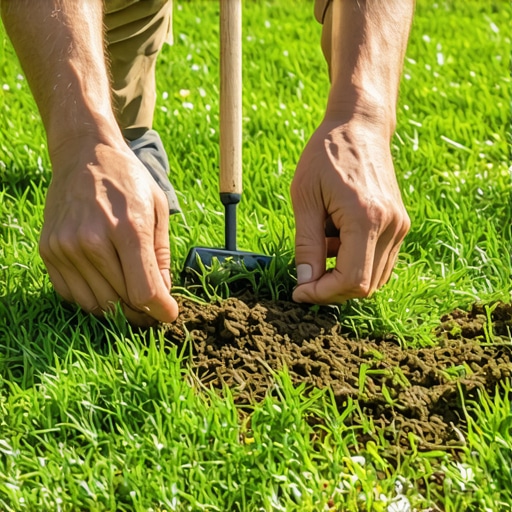
The scratch and seed method is a mechanical turf restoration process where the top 1/4 to 1/2 inch of mineral soil is agitated to create seed-to-soil contact, followed by the application of high-quality grass cultivars. Unlike a full sod install, this method utilizes the existing soil structure while remediating compaction and thatch through aggressive scarification. It is the most cost-effective way to fix patchy grass during yard cleanup phases without excavating the entire site.
“A successful turf stand is not determined by the amount of seed thrown, but by the percentage of seed that achieves intimate contact with the soil and remains moist during the germination window.” – Agronomy Field Manual, Section 4.2
The Physics of Soil Compaction and Thatch
Why does grass become patchy in the first place? In many residential yards, the primary culprit is a high bulk density of soil. When soil particles are squeezed together, the pore spaces that hold oxygen and water disappear. Without oxygen, the aerobic bacteria that drive the nitrogen cycle die off, and the grass roots suffocate. You cannot simply throw seed on top of this hard-packed earth. It will sit there, dry out, and be eaten by birds. You must ‘scratch’ the surface. This means using a power rake or a heavy-duty garden rake to break that surface tension. If your thatch layer (the mat of dead organic matter between the green blades and the soil) is thicker than half an inch, it must be removed. Thatch acts as a sponge for pathogens and a barrier for nutrients. Professional landscaping requires that we strip this back until we see the actual dirt.
How much seed do I need for patchy areas?
For standard turf restoration, you should calculate your seeding rate based on the species: 6 to 8 pounds per 1,000 square feet for Tall Fescue, or 2 to 3 pounds for Kentucky Bluegrass. Applying more than this leads to seedling damping off, where young plants compete for limited resources and succumb to fungal rot. Precision is more important than volume. Use a calibrated drop spreader for small patches to ensure even distribution of the NPK-enhanced starter fertilizer.
[IMAGE_PLACEHOLDER]
The Restoration Material Matrix
| Material/Method | Initial Cost | Labor Intensity | Success Rate (12 Months) | Primary Benefit |
|---|---|---|---|---|
| Sod Install | High | High | 95% | Instant erosion control |
| Scratch and Seed | Moderate | Medium | 80% | Better root integration |
| Hydroseeding | Moderate | Low | 70% | Covers large slopes |
| Dormant Seeding | Low | Very Low | 40% | Minimal equipment needed |
The Step-by-Step Remediation Protocol
Do not skip these steps. If you skip the prep, you are just buying expensive bird food. Professional results require professional discipline.
- Site Clearance: Perform a deep yard cleanup. Mow the existing grass as low as the mower will go (scalping) to allow sunlight to reach the new seedlings. Remove all debris, rocks, and sticks.
- Mechanical Scarification: Use a power rake (vertical mower) set to a depth that actually hits the dirt. You want to see grooves in the soil. This is the ‘scratch’ that creates the bed for your seed.
- Soil Correction: Test your pH. If you are below 6.0, apply pelletized lime. If the soil is heavy clay, top-dress with 1/4 inch of compost to improve the Cation Exchange Capacity (CEC).
- Seeding and Tamping: Spread your seed and then use a water-filled roller or your feet to press the seed into those scratches. Seed-to-soil contact is the only thing that matters right now.
- Hydration Management: Set your irrigation to run three times a day for 5-10 minutes. The goal is to keep the surface damp, not flooded. Once the grass is 2 inches tall, shift to deep, infrequent watering.
“Surface compaction is the silent killer of urban landscapes, often overlooked until the turf biomass has depleted by 50 percent or more.” – Penn State Center for Turfgrass Science
What is the best time to scratch and seed?
The ideal window for this method is late summer to early fall when soil temperatures are between 50 and 65 degrees Fahrenheit. This allows the root system to establish without the intense heat of summer or the competition from spring-germinating weeds like crabgrass. If you must do it in the spring, you must be aggressive with your irrigation and realize that you cannot use most pre-emergent herbicides, as they will kill your new grass just as easily as the weeds.
Nutrient Requirements and Micro-Biology
When you scratch the soil, you are also exposing the soil microbiome. This is the time to add a starter fertilizer high in phosphorus (the middle number in the NPK ratio). Phosphorus is critical for ATP production and root development. Avoid high nitrogen at this stage. Nitrogen forces top-growth (the blades) at the expense of the roots. We want a deep, resilient root system that can survive the coming winter or summer. In heavy clay soils, common in many regions, the addition of humic acid can help flocculate the soil particles, creating more room for those roots to dive deep. Remember: a lawn is an engineered biological system. Treat it like one. If you treat it like a carpet, it will fail. If you treat it like a living organism, it will thrive. It will rot if you over-water it. Don’t skip the rolling step. The seed needs to feel the pressure of the earth to wake up.