The Forensic Autopsy of a Failing Backyard
You can smell it before you see it. That stagnant, metallic scent of anaerobic soil where water has sat too long. You walk out onto your expensive stone patio and feel that tell-tale squish. Or worse, you notice the white, crusty salt deposits—efflorescence—climbing up your pavers. These are not just aesthetic issues; they are the death rattles of a poorly engineered hardscape. Most homeowners wait until the 2026 spring thaws to realize their drainage is a disaster, but by then, the hydrostatic pressure has already shifted the base. I recently got called out to tear up a $30,000 patio that was sinking because the previous contractor used a standard sand base over heavy clay without a single drainage exit point. Within two seasons, the entire 800-square-foot install had tilted four inches toward the home foundation. We had to excavate 20 tons of saturated material just to start the remediation. Don’t be that homeowner. If your patio is holding water, it is not just a puddle; it is a structural threat to your home. Engineering a dry yard requires more than just a shovel; it requires an understanding of soil porosity, compaction rates, and the physics of gravity-fed flow.
“A retaining wall doesn’t fail because of the stone; it fails because of the water trapped behind it.” – Hardscape Engineering Axiom
1. The 2 Percent Rule: Precision Surface Regrading
To fix a flooded patio, you must install sub-surface drainage systems like French drains or regrade the surface to a 2% slope, ensuring water moves away from the foundation toward a designated discharge point or dry well. This prevents pooling and structural settling. This means for every 10 feet of patio, the elevation should drop at least 2.4 inches. Use a laser level or a transit to verify this; your eyes will lie to you. When I see a patio with zero pitch, I know the installer was lazy. We use screed pipes to ensure the bedding layer follows the subgrade pitch perfectly. If your yard cleanup doesn’t include checking the grade against your sod install, you’re just putting a band-aid on a hemorrhage. In heavy clay soils, surface tension can hold water even on a slight slope, which is why the texture of your joint sand matters. Use a high-quality polymeric sand that facilitates runoff rather than absorption.
How much modified gravel do I need for a patio base?
For a stable, well-draining patio base, you need a minimum of 6 inches of compacted #2A modified stone for pedestrian areas and up to 12 inches for driveways. To calculate volume, multiply the square footage by the depth in feet, then divide by 27 to get cubic yards. Do not use pea gravel; it acts like marbles and will never reach 98% Proctor compaction.
2. French Drain Engineering: The Subsurface Muscle
A French drain is a sub-surface trench filled with perforated PVC pipe and washed aggregate that intercepts groundwater before it reaches your patio base. This system relieves hydrostatic pressure by providing a path of least resistance for water to travel to a safe exit. Do not use that cheap, corrugated black pipe from the big-box stores. It collapses under the weight of the soil and clogs with silt within three years. Use Schedule 40 perforated PVC with the holes facing down—not up. This allows the water table to rise into the pipe and be carried away. You must wrap the entire trench in a non-woven geotextile fabric. This fabric acts as a filter, allowing water through while keeping the fines (tiny soil particles) from clogging your stone. Without this, your drain will fail. It is a biological certainty.
| Feature | Corrugated Pipe (DIY) | Schedule 40 PVC (Pro) | |||||||||
|---|---|---|---|---|---|---|---|---|---|---|---|
| Crush Rating | Low (30-50 PSI) | High (200+ PSI) | Flow Velocity | Slow (Turbulent) | Fast (Laminar) | Longevity | 5-7 Years | 50+ Years | Maintenance | Impossible to snake | Easy to clean out |
3. Permeable Interlocking Concrete Pavements (PICP)
Permeable paving systems use specialized stone layers and wider joint gaps filled with #8 washed stone to allow 100% of rainfall to infiltrate the ground instantly. This eliminates surface runoff and prevents the need for complex catch basins or expensive irrigation re-routing. The science here is in the open-graded base. Unlike a traditional patio that uses dense stone dust, a permeable system uses #57 and #2 stone with large voids. These voids act as a massive underground reservoir, holding the water during a heavy storm and letting it slowly dissipate into the subgrade. This is the gold standard for high-water-table areas. If you are doing a new sod install nearby, make sure the grass is slightly lower than the pavers so the silt doesn’t wash over and seal the permeable joints. It requires a different mindset; you aren’t fighting the water, you’re inviting it into the ground where it belongs.
What is the best slope for patio drainage?
The industry standard for patio drainage is a slope of 1/4 inch per foot, or approximately 2%. This provides enough velocity to move water away from the building without creating a noticeable incline for furniture or walking. In areas with extreme rainfall, increasing the slope to 3% may be necessary for textured stones.
4. Catch Basins and Channel Drains: Managing High Velocity
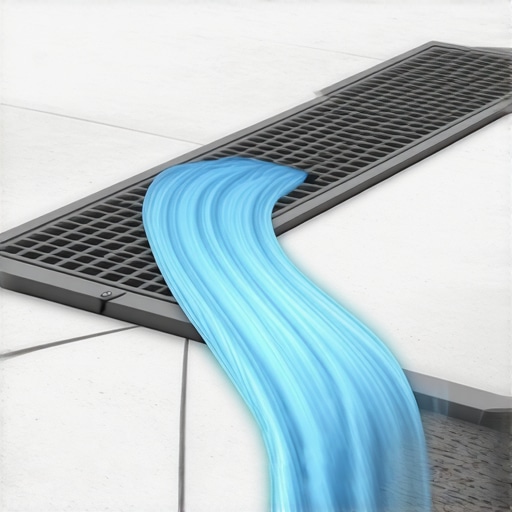
For patios trapped against a house or a rising landscape, channel drains or surface catch basins are required to intercept high-volume sheet flow. These grated drainage systems connect to solid 4-inch piping that carries water to a pop-up emitter or a municipal storm line. I see too many guys install a catch basin and just let it dump into a pile of rocks five feet away. That is not drainage; that is a sinkhole in training. You need to carry that water to a daylight exit. The catch basin should be the lowest point in your hardscape. We often integrate these into the yard cleanup phase, ensuring that gutters and downspouts are also tied into this underground network. Never let your downspouts dump directly onto your patio. One heavy storm can move 1,000 gallons of water off your roof; that volume will undermine your paver base in hours. Use a 12×12 catch basin with a debris basket. Clean it twice a year. No excuses.
“Standard turf grass can only survive submerged for 24 to 48 hours before anaerobic conditions lead to root rot and total loss of the sod install.” – Agronomy Manual
- Inspect: Check for standing water 30 minutes after rain stops.
- Excavate: Remove organic soil until you hit stable subgrade.
- Fabric: Always use non-woven geotextile to separate soil from stone.
- Compact: Use a plate compactor in 2-inch lifts, not all at once.
- Pitch: Maintain a minimum of 2% slope away from all structures.
Proper drainage is the invisible backbone of a quality landscape. While the internet tells you to just dig a hole and fill it with rocks, professional-grade work requires calculating the infiltration rate of your specific soil. If you have heavy red clay, a simple soakaway will fail. You need a discharge point that uses gravity to move the water off-site. Don’t skip the compaction. If the tamper doesn’t literally bounce off the stone, you aren’t done. Fix the water problem now, or prepare to pay for the same patio twice when it starts to heave in 2026.