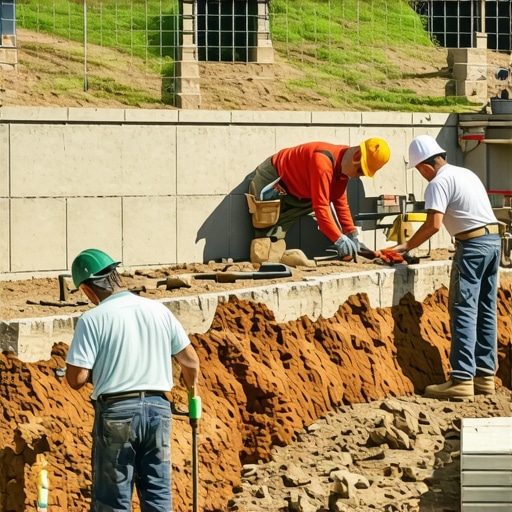
The Forensic Autopsy of a $30,000 Hardscape Failure
I recently got called out to tear up a $30,000 patio and retaining wall system that was sinking and tilting because the previous contractor thought he could cheat the frost line. The homeowner showed me the invoice from 2025; by early 2026, the wall had moved four inches out of plumb. The culprit wasn’t the stone quality. It was a complete failure to understand soil mechanics and hydrostatic pressure. When I dug out the backfill, I found heavy clay sitting directly against the block. No drainage, no clean stone, no hope. It was a graveyard of wasted capital. Most homeowners see a leaning wall and think they need better glue. They don’t. They need a physics lesson. Soil heave is a relentless force that treats poorly engineered walls like toys. If you’re seeing movement in your 2026 installations, you aren’t just looking at a cosmetic flaw; you’re looking at a structural emergency that will only accelerate as the freeze-thaw cycles continue.
Understanding the Physics of 2026 Soil Heave
To fix soil heave around a retaining wall, you must mitigate hydrostatic pressure and frost-susceptible soils by replacing non-porous backfill with angular clean stone and installing a dedicated drainage system. This process eliminates the water that expands when frozen, preventing the lateral force that pushes blocks out of alignment.
Soil heave occurs when water trapped in the soil voids freezes and expands by approximately 9 percent. In heavy clay soils, this expansion creates ice lenses. These lenses exert thousands of pounds of pressure per square foot. If your yard cleanup or landscaping crew didn’t install a 12-inch chimney of clean stone behind the wall, that pressure has nowhere to go but forward. This is why irrigation systems must be pressurized and checked; a slow leak near a wall in the winter is a death sentence for the masonry. We talk about ‘heave’ as a vertical movement, but in hardscaping, it is almost always lateral. You can’t fight the expansion of ice. You can only remove the water before it freezes.
“A retaining wall doesn’t fail because of the stone; it fails because of the water trapped behind it.” – Hardscape Engineering Axiom
How deep should a retaining wall base be to prevent heaving?
The base for a retaining wall must be excavated below the local frost line or, at a minimum, consist of 6 to 12 inches of compacted modified gravel (2A or 411) over a non-woven geotextile fabric. For walls over three feet, the depth must account for the angle of repose of the retained soil. In many northern climates, the frost line can reach 36 to 48 inches. While we don’t always bury the wall that deep, we must ensure the foundation is built on non-frost-susceptible material. A thin layer of sand is not a base. It is a lubricant for failure. Use a plate compactor. The machine should literally bounce off the surface when the 95 percent Standard Proctor density is achieved.
What is the best backfill for a retaining wall?
The only acceptable backfill for a structural retaining wall is #57 clean crushed stone or a similar angular, open-graded aggregate. Do not use ‘clean fill’ or ‘topsoil’ or ‘bank run gravel’ behind the units. Clean stone provides a 40 percent void space, allowing water to drop straight down to the perforated drain tile rather than sitting against the block face. If you see ‘weep holes’ that are dry after a rainstorm, your drainage is clogged or non-existent. This is often where sod install projects go wrong; contractors pile soil and sod right up to the wall, sealing off the drainage chimney and trapping moisture.
| Material Type | Drainage Rating | Frost Susceptibility | Recommended Use |
|---|---|---|---|
| #57 Clean Stone | Excellent | Very Low | Primary Backfill / Drainage Chimney |
| Modified Gravel (CR6/2A) | Moderate | Low | Base Foundation (Compacted) |
| Heavy Clay | None | Extremely High | Never use near walls |
| Sand | Good | Medium | Pipe Bedding only |
The Professional Remediation Process: Step-by-Step
Fixing a heaving wall requires a ‘bottom-up’ approach. You cannot simply push it back. The friction of the soil mass won’t allow it. 1. Site Assessment: Use a laser level to determine the exact degree of lean. 2. Excavation: You must dig out the soil behind the wall to a distance equal to the wall’s height. 3. Drainage Check: Locate the 4-inch perforated pipe. If it is filled with silt, it was installed without a fabric ‘sock’ or the wrong aggregate. 4. Soil Grading: Correct the yard cleanup to ensure the surface water flows away from the wall, not into the backfill. 5. Re-installation: Reset the blocks on a leveled, compacted base, using geogrid reinforcement every two courses if the wall exceeds 36 inches.
- Call 811 before you dig to mark irrigation lines and utilities.
- Use a non-woven geotextile to separate native soil from your clean stone.
- Install a ‘pop-up’ emitter at the end of your drain line to prevent rodent clogs.
- Ensure the first course of block is buried at least 10 percent of the total wall height.
- Check the compaction every 4-inch lift of gravel.
“Soil compaction is the most overlooked phase of hardscape construction, yet it determines the lifespan of the entire structure.” – ICPI Tech Spec No. 2
I tell my crew every day: if you don’t fix the soil grading first, every plant or stone you put in the ground is just expensive compost. Irrigation management is also critical. If your 2026 sod install involves heavy watering schedules, that water will find the path of least resistance. Usually, that path is straight into the backfill of your new wall. You must coordinate your irrigation zones so they don’t saturate the structural footprint of the masonry. Deep, infrequent watering of turf grass is better for the roots and safer for your hardscapes. One inch of water per week is the standard, but it should be delivered in a way that allows the soil to dry between cycles. Saturated soil loses its shear strength, and that’s when the weight of the earth overcomes the gravity of the wall.
Don’t trust a contractor who doesn’t talk about ‘fines’ or ‘hydrostatic load.’ If they just want to ‘beautify’ your yard without discussing the 80 percent of the work that stays underground, show them the door. A wall built in 2026 should still be standing in 2056. Water wins every fight it’s invited to. Your job is to make sure it’s never invited to stay behind your wall.