The Chemical Nightmare: Why Most Sod Fails Before the First Mow
I recently walked onto a job site where a homeowner had effectively nuked their own property. They had applied a high-nitrogen urea fertilizer during a 95-degree heatwave, followed by a shallow 10-minute sprinkle. The result was a total salt burn that sterilized the top two inches of the soil profile. We didn’t just have dead grass; we had a biological wasteland. To fix it, we had to scrape the entire lot, haul away the contaminated silt, and implement what I call the 2026 Deep-Soak Method. This isn’t just about wetting the grass; it is about managing the hydrostatic pressure and capillary action of the soil to force root depth. If you do not understand the bulk density of your soil, your new sod is just expensive compost waiting to happen. It will die.
The Physics of Water Retention in New Turf
To stop new sod from wilting, you must saturate the soil profile to a depth of six inches immediately after sod install to eliminate air pockets. This process, known as hydro-cycling, ensures that the root-to-soil contact is absolute, preventing the delicate root hairs from desiccating in the afternoon heat. Most failures happen because people water the blades, not the dirt. The blades don’t need the water; the rhizomes do.
“Successful turfgrass establishment depends on maintaining a moist environment in the top 4 to 6 inches of the soil profile to support rapid adventitious root development.” – Texas A&M AgriLife Extension
How much water does new sod need daily?
During the first 14 days, new sod requires approximately 0.25 to 0.50 inches of water per day, delivered in split applications to prevent anaerobic soil conditions. This timing prevents the evapotranspiration rate from exceeding the water uptake, which is the primary cause of turf wilting in high-sun exposure areas. You are fighting a clock. Once the edges turn brown, the vascular system of the grass is already collapsing. Don’t wait for the brown.
The 2026 Deep-Soak Method: Operational Blueprint
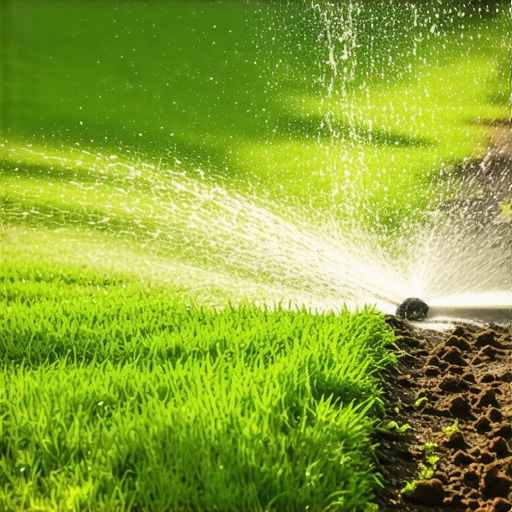
The 2026 method moves away from the old “water three times a day” mantra and focuses on soil moisture tension. We use a soil probe to check the moisture at the 4-inch mark. If the dirt is dry at 4 inches, you are failing. We utilize low-precipitation rate nozzles (like the MP Rotator series) to apply water slowly, allowing it to percolate rather than run off. This is critical if you have heavy clay soils with low infiltration rates.
[image_placeholder_1]
Irrigation Management by Soil Texture
| Soil Type | Infiltration Rate (in/hr) | Deep-Soak Duration | Cycle/Soak Required? |
|---|---|---|---|
| Heavy Clay | 0.05 – 0.10 | 15 mins | Yes (4 cycles) |
| Sandy Loam | 0.50 – 1.00 | 45 mins | No |
| Silt Loam | 0.20 – 0.30 | 25 mins | Yes (2 cycles) |
Notice the clay metrics. If you run your irrigation for an hour straight on clay, you are just washing your money down the storm drain. The water can’t get in. It puddles, the roots suffocate from lack of oxygen, and the sod slides off the grade. You must use cycle-and-soak settings. Period.
Step-by-Step Yard Cleanup and Sod Preparation
Proper yard cleanup is not just raking leaves; it is a structural necessity. You need to remove all thatch layers and organic debris that can create a barrier between the new sod and the mineral soil. If there is a layer of dead grass between the new sod and the dirt, the roots will never dive. They will stay in the sod mat, bake in the sun, and die in three days. I see this every week. It is amateur hour.
- Grade Check: Ensure the soil is 1 inch below the level of hardscapes (sidewalks/patios) to account for sod thickness.
- Soil Test: Check the pH levels. If you are below 6.0 or above 7.5, your NPK uptake will be locked out.
- Pre-Hydration: Wet the bare dirt the night before the install. Never lay sod on bone-dry, 100-degree soil. It’s like putting a steak on a hot griddle.
- Rolling: Use a water-filled sod roller to press the sod into the dirt. If there is air, there is death.
“A retaining wall doesn’t fail because of the stone; it fails because of the water trapped behind it. Similarly, sod doesn’t fail because of the grass; it fails because of the soil interface.” – Hardscape and Agronomy Axiom
Why is my new sod turning yellow?
Yellowing in new sod is typically a sign of nitrogen leaching from over-watering or iron chlorosis caused by high alkalinity in the local water supply. If the soil is muddy but the grass is yellow, stop watering and check the oxygen levels in the root zone. You might be drowning it. New sod needs air just as much as it needs water. Balance the pore space.
Long-Term Turf Stability
By day 21, you should be transitioning to deep, infrequent watering. This forces the roots to chase the moisture downward as the top layer dries out. If you keep the surface wet forever, the roots stay shallow. Shallow roots mean your lawn will die the first time the temperature hits 95 degrees next summer. You are training the grass. Be a tough coach. Use a sharp mower blade for the first cut and never remove more than one-third of the leaf tissue. Scalping is a death sentence for young turf. Follow the 1-inch-per-week rule. Measure it with a tuna can. Don’t guess.