
Why 80% of Sod Installs Fail at the Perimeter
Sod edges die primarily due to desiccation caused by air pockets and the wicking effect of surrounding dry soil. When the perimeter isn’t compressed to match the height of the existing grade, wind and heat penetrate the root zone, leading to rapid moisture loss and root death within 48 hours of installation.
I always drill into my new crew members: if you don’t fix the soil grading first, every plant you put in the ground is just expensive compost. I remember a kid we hired last season who thought he could just lay the rolls down like a carpet and walk away. Three days later, the entire perimeter of that $12,000 install looked like shredded wheat. He didn’t understand that the edge of a sod roll is its most vulnerable point; it is an open wound in the plant’s vascular system. If that wound isn’t pressed firmly into the earth, the capillary action of the soil is broken, and the grass literally breathes its last bit of moisture into the air. We had to rip out 400 linear feet of turf because he skipped the tamping phase. It was an expensive lesson in soil-to-root contact.
Fix 1: Sub-Grade Beveling for Hydraulic Continuity
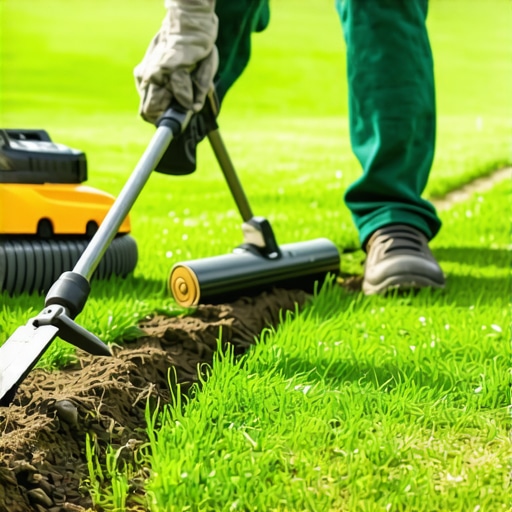
Sub-grade beveling involves excavating a shallow trench 1 to 2 inches deeper at the perimeter of the install area to allow for extra soil-to-root contact. This creates a physical ‘sump’ effect where irrigation water settles at the edge rather than draining away from the exposed seam into the adjacent mulch or dirt.
When you prepare the soil for a yard cleanup or full sod install, the tendency is to make the dirt perfectly level. This is a mistake. You need a ‘bevel’ at any point where the turf meets a hardscape or a mulch bed. By dropping the grade by an extra 1.5 inches at the edge, you ensure the ‘lip’ of the sod roll sits slightly lower than the surrounding terrain. This protects the delicate crown of the grass from the wind. It also forces the roots to grow downward into the moisture-rich subsoil immediately. If you leave the edge high, it will dry out. It will rot. Don’t skip this. We use a specialized power edger or a manual spade to create this bevel. It is the difference between a lawn that survives a July heatwave and one that turns brown by Friday.
“Soil compaction is often seen as an enemy, but in sod installation, uniform soil-to-root contact is the primary determinant of establishment success.” – Penn State Center for Turfgrass Science
Fix 2: High-PSI Perimeter Hand-Tamping
Hand-tamping the edges provides localized compaction that a 1,000lb water roller cannot reach due to its wide surface area and rigid drum. Using a 10×10 steel tamper ensures the edge fibers are pushed firmly into the mud, eliminating the air-gap ‘kill zone’ that ruins most residential installs.
Most hacks will tell you that rolling the lawn is enough. They are wrong. A water roller is great for the center of the lawn, but it can’t get into the corners or tight against a concrete walkway. You need a heavy steel tamper. We look for a compression that leaves no visible seam between rolls. You want to see the soil ‘ooze’ slightly into the thatch layer of the sod. This ensures that the hydrostatic pressure of the soil moisture can move directly into the plant. If you can stick a finger under the edge of the sod after it’s been laid, you haven’t tamped it enough. The tamper should literally bounce off the compacted base when you’ve hit the right density. We aim for a 90% Proctor density on the perimeter to prevent the ‘wicking’ of air into the root zone.
How much modified gravel do I need for a patio base?
While often asked during landscaping projects, for a sod install near a patio, you actually need 0 gravel; you need a 6-inch layer of screened topsoil with a pH between 6.5 and 7.0 to ensure the turf can knit to the hardscape edge without hitting a drainage barrier. [image_placeholder_1]
Fix 3: The Edge-Tuck and Irrigation Calibration
Tucking the sod edge against hardscapes or existing lawn prevents the ‘wicking’ of moisture into the surrounding mulch or soil. Proper irrigation alignment ensures the perimeter spray pattern covers the outer 6 inches of the sod strip, which is the first area to dry during the heat of the day.
The final fix involves the ‘tuck.’ When the sod meets a sidewalk, don’t just lay it flat. You want to slightly ‘over-stuff’ the edge and then tamp it down so it is flush with the concrete. This creates a seal. Think of it like caulking a window. If there is a gap, the air gets in. Once tucked, you must calibrate your irrigation. Most rotors are set to hit the middle of the lawn and ‘mist’ the edges. In a 2026 install, we use high-efficiency MP Rotators that provide a dedicated ‘strip’ spray for the perimeters. You need to ensure the edge gets 15% more water than the center for the first 14 days. This compensates for the heat radiation coming off the concrete or asphalt.
| Tamping Method | Compaction Force | Edge Survival Rate | Labor Intensity |
|---|---|---|---|
| Water Roller | Low (Distributed) | 65% | Low |
| Steel Hand Tamper | High (Localized) | 98% | High |
| Plate Compactor | Extreme (Vibratory) | 40% (Root Damage) | Medium |
Why does my sod die at the edges?
The edge of the sod is cut, meaning the rhizomes and roots are exposed to the air. Without heavy tamping to seal these edges against the soil, the moisture within the plant evaporates faster than the roots can pull it from the ground. This is exacerbated by ‘heat sink’ effects from nearby pavement. Use these steps for a perfect install:
- Clear all debris and ‘mow-and-blow’ waste from the site.
- Apply a 18-24-6 starter fertilizer to the beveled edge.
- Lay sod perpendicular to the slope.
- Tamp edges with 10×10 steel tamper immediately.
- Water to a depth of 4 inches within 30 minutes.
“A retaining wall doesn’t fail because of the stone; it fails because of the water trapped behind it, much like sod fails when air is trapped beneath it.” – Hardscape Engineering Axiom
While the internet tells you to water every day, turf grass actually needs deep, infrequent watering—exactly 1 inch per week after the first 21 days—to force roots to chase the water down into the sub-grade. This creates a drought-tolerant lawn that doesn’t rely on constant surface moisture. By year one, your sod should be so well-knit that you cannot find the seams. If you can still see the grid, you failed the tamping phase. Don’t be that contractor. Do the work. Get the dirt under your fingernails and seal those edges. Your 2026 clients will thank you when their lawn stays green while the neighbor’s ‘cheap’ install turns to dust.
Comments are closed.