
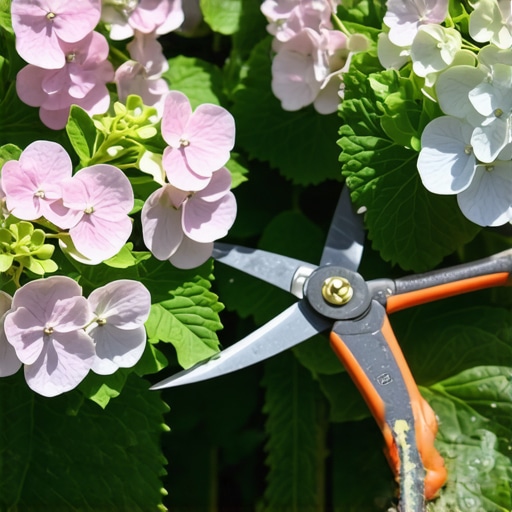
Pruning is Engineering, Not Aesthetics
The first thing I drill into my new crew members is this: if you don’t fix the soil grading and understand the plant’s biological clock first, every plant you put in the ground is just expensive compost. I’ve spent 20 years fixing the mistakes of ‘mow-and-blow’ contractors who treat every shrub like a hedge to be squared off with gas shears. When it comes to hydrangeas, that ‘haircut’ approach is a death sentence for next year’s blooms. You aren’t just cutting stems; you are managing meristematic tissue and hormonal distribution. If you hack away at a Bigleaf hydrangea in March, you’ve just thrown your summer display into the chipper. Precision matters. Soil chemistry matters. Timing is everything.
Identifying Old Wood vs. New Wood Species
To prune hydrangeas correctly, you must first identify if they bloom on old wood (growth from previous seasons) or new wood (current year growth). Pruning a Macrophylla or Quercifolia in late spring will remove all dormant flower buds, resulting in zero blooms for that entire calendar year. Most homeowners fail because they cannot distinguish between a Hydrangea paniculata and a Hydrangea macrophylla. One can be cut to the ground; the other requires a surgical touch. Look at the stems. Are they woody and peeling? Do they have fat, green buds visible in late winter? These are the indicators of where the energy is stored. If you misidentify the wood, you lose the season. It is that simple.
“Proper pruning of hydrangeas requires knowing whether the plant flowers on old wood or new wood to avoid removing next year’s flower buds.” – Penn State Extension
Hydrangea Classification and Pruning Timing
Use the following table to determine your specific species and the required intervention timing. Misidentifying your plant leads to vegetative growth without floral production.
| Species Name | Common Name | Bloom Wood Type | Best Pruning Window |
|---|---|---|---|
| H. macrophylla | Bigleaf / Mophead | Old Wood | Immediately after summer bloom |
| H. paniculata | PeeGee / Limelight | New Wood | Late winter or early spring |
| H. arborescens | Smooth / Annabelle | New Wood | Late winter (can be cut low) |
| H. quercifolia | Oakleaf | Old Wood | Minimal pruning, post-bloom only |
How much irrigation do hydrangeas actually need?
Hydrangeas require approximately 1 inch of water per week, delivered directly to the root zone via drip irrigation to prevent foliar fungal diseases like powdery mildew. Overhead spraying is a rookie mistake that invites Botrytis. When we do a professional sod install near hydrangea beds, we ensure the irrigation zones are separated so the turf gets its high-frequency water while the shrubs get deep, low-frequency soaking. High-pressure sprayers will damage delicate blooms and compact the soil surface, reducing oxygen availability to the fine feeder roots.
Can I prune my hydrangeas to the ground in the winter?
You can only prune Hydrangea arborescens (Smooth) and Hydrangea paniculata to the ground in winter because they develop buds on new growth; doing this to Macrophylla will kill all bloom potential. Cutting a PeeGee hydrangea back to 12-24 inches in late February encourages massive, heavy flower heads, but you must ensure the structural integrity of the remaining ‘scaffold’ branches is strong enough to support the weight of the water-saturated blooms.
The Anatomy of the Perfect Cut
When you make a cut, you aren’t just shortening a branch; you’re redirecting the plant’s auxin flow. Every cut should be made at a 45-degree angle exactly 1/4 inch above a viable node. If you leave a long stub, it will rot. If you cut too close to the bud, you will dehydrate the node and it will die. We use bypass pruners, never anvils. Anvil pruners crush the vascular tissue (xylem and phloem), creating an entry point for pathogens. In a proper landscaping maintenance routine, your tools must be sterilized with 70% isopropyl alcohol between plants to prevent the spread of Cercospora leaf spot.
Soil Mechanics and Nutrient Load
A hydrangea’s bloom is a direct reflection of the soil’s pH levels and cation exchange capacity. For blue blooms in Macrophylla, you need acidic soil (pH 5.2–5.5) to make aluminum ions available to the plant. If your soil is alkaline, you can dump all the aluminum sulfate you want on it, but the plant won’t be able to uptake it. It’s basic chemistry. When we perform a yard cleanup, we don’t just rake leaves; we test the soil. We look for compaction. If the soil is hard-packed, the roots can’t breathe, and the plant will exhibit ‘wilt’ even if the soil is wet. This is often misdiagnosed as underwatering, leading to root rot.
“Macrophylla species specifically require a soil pH below 6.0 to mobilize aluminum ions, which produces the signature blue coloration.” – Agronomy Field Manual
The Professional Pruning Checklist
- Identify the species and wood type (Old vs. New).
- Sterilize bypass pruners with alcohol.
- Remove the ‘Three Ds’: Dead, Damaged, and Diseased wood.
- Thin out 1/3 of the oldest stems to the ground to increase airflow.
- Cut 1/4 inch above an outward-facing bud at a 45-degree angle.
- Apply a slow-release 10-10-10 fertilizer after the last frost.
- Mulch with 2 inches of aged arborist chips (never mulch volcanoes).
Landscaping Synergy: Yard Cleanup and Mulch Integrity
During a thorough yard cleanup, removing dead hydrangea foliage is critical because it’s a primary vector for overwintering pests and fungal spores. However, don’t get over-eager with the leaf blower. High-velocity air can desiccate the tender buds on Oakleaf and Bigleaf varieties. Instead, hand-rake around the drip line. When we finish a sod install or a bed renovation, we apply a coarse-textured mulch. Avoid dyed ‘triple-ground’ mulch; it mats down and prevents irrigation from reaching the soil, effectively creating a waterproof barrier that suffocates the roots. You want a mulch that breathes.
The Lifecycle of a Masterpiece
Patience is the hallmark of a veteran landscaper. You won’t see the results of your pruning for months. In year one, a properly pruned hydrangea might look a bit thin, but you are building the structural ‘bones’ of the plant. By year three, the wood is thick, the airflow is optimal, and the bloom count will be double what any DIY homeowner achieves. Don’t chase instant results with high-nitrogen fertilizers. High nitrogen gives you big green leaves and weak, floppy stems. Focus on the root system and the structural pruning. The blooms will follow. It’s not magic; it’s biology. [{“@context”:”https://schema.org”,”@type”:”Article”,”headline”:”The Right Way to Prune Hydrangeas for Massive Blooms Next Year”,”author”:{“@type”:”Person”,”name”:”Master Landscaper”},”description”:”A guide to pruning hydrangeas based on horticultural engineering and biology.”},{“@context”:”https://schema.org”,”@type”:”FAQPage”,”mainEntity”:[{“@type”:”Question”,”name”:”When is the best time to prune hydrangeas?”,”acceptedAnswer”:{“@type”:”Answer”,”text”:”Timing depends on species. Bigleaf and Oakleaf hydrangeas bloom on old wood and should be pruned immediately after summer flowers fade. Panicle and Smooth hydrangeas bloom on new wood and should be pruned in late winter or early spring.”}},{“@type”:”Question”,”name”:”How much water do hydrangeas need?”,”acceptedAnswer”:{“@type”:”Answer”,”text”:”Hydrangeas typically require 1 inch of water per week. This is best delivered via drip irrigation to avoid wetting the foliage and encouraging fungal growth.”}}]}]