
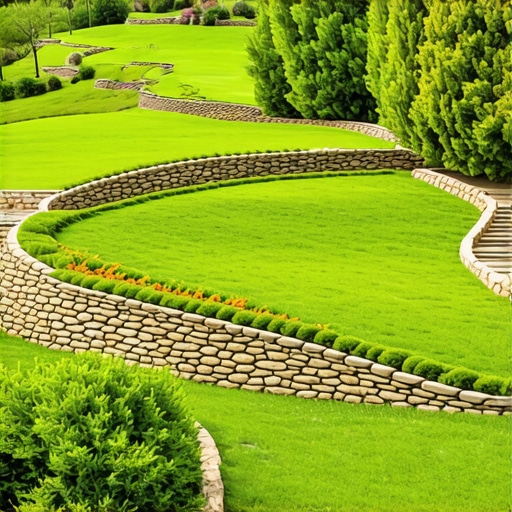
The Engineering Reality of Gravity and Dirt
I always drill into my new crew members: if you don’t fix the soil grading first, every plant you put in the ground is just expensive compost. I’ve spent twenty years watching homeowners throw thousands of dollars at sod install projects on 45-degree inclines, only to watch the entire investment slide into the neighbor’s pool after the first spring rain. Soil isn’t a static object; it’s a fluid mass governed by hydrostatic pressure and the angle of repose. When you’re dealing with a steep backyard hill, you aren’t just gardening; you are performing low-grade civil engineering. If you ignore the physics of water velocity, you will lose every single time. Water wins. It always wins.
What is the fastest way to stop soil erosion on a steep hill?
The most effective way to stop soil erosion on steep backyard hills is the implementation of live stakes and terracing with 57 stone drainage, which breaks the velocity of surface runoff and provides immediate mechanical stabilization through root-system integration and gravity-defying structural barriers. This simple trick involves using dormant woody cuttings that, when driven deep into the subsoil, act as biological rebar, anchoring the topsoil to the more stable horizons beneath it.
“Slope failure occurs when the downward force of gravity exceeds the soil’s internal strength and friction.” – Penn State Agricultural Extension
How much modified gravel do I need for a patio base?
When stabilizing a hill for a hardscape landing, you calculate your DGA (Dense Graded Aggregate) by multiplying the square footage by the depth (minimum 6 inches for stability) and dividing by 27 to get cubic yards. Never skimp on this. Most failures happen because a contractor used 2 inches of sand instead of a compacted modified gravel base. In erosion control, this gravel acts as a French drain, allowing water to pass through without carrying your dirt with it. Compaction is non-negotiable. The tamper should literally bounce off the compacted base when you’ve hit the correct PSI. If it feels soft, your hill is still a moving target.
Can sod installation stop erosion on a 45-degree slope?
Standard sod install is often a recipe for disaster on steep grades unless it is pinned with 12-inch biodegradable stakes every 6 inches. Without pinning, the weight of the water-saturated grass becomes greater than the friction holding it to the clay, causing it to peel away like a wet rug. You need to focus on irrigation timing—short, frequent bursts to prevent runoff—rather than one long soak. A deep yard cleanup that removes all natural leaf litter can actually make erosion worse by exposing bare mineral soil to raindrop impact energy, which shatters soil aggregates and starts the washing process.
[IMAGE_PLACEHOLDER]
The Comparison of Erosion Control Methods
| Method | Maximum Slope Grade | Installation Cost | Technical Difficulty |
|---|---|---|---|
| Live Staking | 60% | Low | Moderate |
| Riprap (Stone) | 50% | High | High |
| Turf Reinforcement Mats | 35% | Medium | Moderate |
| Standard Sodding | 25% | Medium | Low |
Most “landscaping” companies will just suggest more mulch. Mulch is a temporary aesthetic fix that floats away. Real erosion control requires soil anchors. Use the Ground-Up Build approach: start with the sub-grade. You need to identify if you have heavy red clay or sandy loam. Clay has high cohesion but low permeability, leading to massive surface runoff. Sandy soil has high permeability but zero cohesion. On a hill, you need a mix of both, or a mechanical stabilizer like a geogrid.
“A retaining wall doesn’t fail because of the stone; it fails because of the water trapped behind it.” – Hardscape Engineering Axiom
The Professional Erosion Control Checklist
- Analyze Drainage: Identify where the water enters the hill from the roof or driveway.
- Check Soil pH: Acidic soil kills the roots that are supposed to hold your hill together.
- Install 811 Marks: Call before you dig any French drains or terrace footings.
- Select Native Species: Use plants with fibrous root systems like Switchgrass or Deep-rooted Dogwood.
- Compaction Testing: Ensure any fill dirt is compacted in 4-inch lifts, not dumped all at once.
The secret I tell my crew is simple: Break the slope. Never let water run more than 5 feet without hitting a physical obstruction. This could be a dry creek bed, a row of live stakes, or a terraced timber. By breaking the run, you prevent the water from reaching terminal velocity. Once water reaches a certain speed, it gains the energy required to lift soil particles. Keep the water slow, and the soil stays home. It’s not magic; it’s physics. Don’t be the homeowner who spends five figures on a yard cleanup and sod install only to see it in the street after a thunderstorm. Build from the dirt up. Fix the hydrology first. The plants are just the window dressing on a well-engineered foundation.
Comments are closed.