
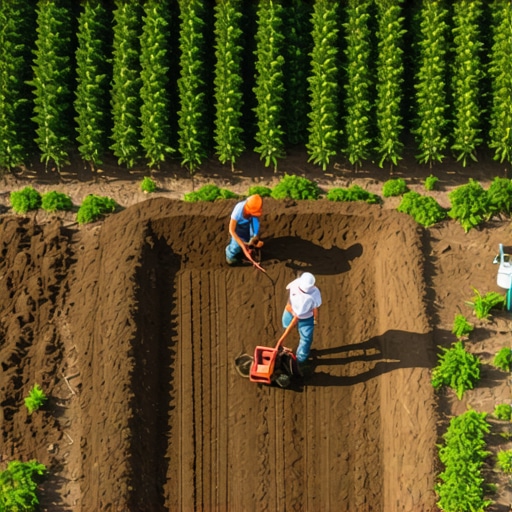
The Forensic Autopsy of a Dead Lawn
I always drill into my new crew members: if you don’t fix the soil grading and structure first, every plant you put in the ground is just expensive compost. I have seen fifty thousand dollar landscapes die in two seasons because the soil was essentially a brick. When you walk across a lawn and it feels like concrete, or you see water pooling for hours after a light rain, you are looking at a structural failure of the earth itself. This is not a matter of needing more fertilizer. It is a matter of physics. Clay soil is composed of microscopic, flat platelets that carry a negative electrical charge. When these plates are compressed by foot traffic or heavy rain, they stack like sheets of paper, squeezing out all the macropores. Without those air pockets, your grass roots cannot breathe, and they eventually drown in an anaerobic grave. This is why your 2026 yard cleanup must start with the soil, not the mower.
Why does clay soil compact so easily?
Clay soil compaction occurs when the pore space between microscopic clay platelets is collapsed, usually by foot traffic or heavy rains. In 2026, we focus on biological aeration and chemical flocculation to restore soil structure without the use of heavy machinery that often causes deeper subsoil compaction through sheer weight. The bulk density of the soil must be lowered to allow for hydraulic conductivity and gas exchange at the root zone.
“Soil compaction is the most overlooked factor in plant health; it limits root elongation and reduces the diffusion of oxygen to the roots, which is critical for nutrient uptake.” – Agricultural Extension Agronomy Manual
How do I test my soil compaction at home?
The simplest method is the screwdriver test. Take a ten inch flathead screwdriver and try to push it into the soil when it is slightly moist. If you cannot push it past two inches without significant effort, your bulk density is too high. You are dealing with a soil structure that is physically blocking your sod install from ever taking hold. [IMAGE_PLACEHOLDER] If the metal bends before the soil gives, you have a serious problem. In my twenty years, I have seen soil so hard it snapped a core aerator tines. You cannot fix that with a bag of 10-10-10. You need to change the chemistry of the dirt.
The Biological Drill: Remediating Clay Without Excavation
Instead of hiring a bobcat to scrape away your yard, we use what I call the biological drill. This involves a multi-pronged approach using liquid aerators, humic acid, and specific cover crops. High-grade liquid aerators contain surfactants that break the surface tension of the water, allowing it to penetrate deeper into the clay layers. But the real secret for 2026 is the use of Daikon radishes or ‘Tillage Radishes.’ These plants are engineered to punch through dense clay, creating channels up to thirty inches deep. When the radishes die off in the winter, they rot in place, leaving behind massive vertical tunnels filled with organic matter. This is landscaping at a cellular level. It turns your yard into a sponge without lifting a single shovel.
| Method | Cost per 1k Sq Ft | Effectiveness | Timeline |
|---|---|---|---|
| Mechanical Core Aeration | $15 – $30 | Moderate (Top 3 inches) | Immediate |
| Liquid Aeration (Humic/Surfactants) | $10 – $20 | High (Long-term structure) | 3-6 Months |
| Biological Drills (Tillage Radish) | $5 – $10 | Extreme (Deep subsoil) | 1 Season |
| Gypsum Application | $15 – $25 | Variable (Depends on Sodium) | 12 Months |
Will liquid aeration fix heavy clay soil?
Liquid aeration works by using ammonium laureth sulfate to open up the soil’s surface tension, allowing water to carry nutrients and oxygen into the clay profile. While it does not remove physical cores like a machine, it provides a more uniform treatment across the entire landscaping area, especially around existing irrigation lines that a mechanical aerator might sever. It is a cleaner, more efficient way to manage 18-inch depths that machines cannot reach. It is the only way to treat a lawn without a total yard cleanup of messy soil plugs.
The Chemical Flocculation Strategy
Many homeowners think they should add sand to clay. Never do this. You are effectively making low-grade concrete. Instead, you need to focus on flocculation. This is the process where small clay particles are chemically clumped together into larger ‘peds.’ This creates the air space we need. If your soil has high sodium levels, gypsum (Calcium Sulfate) is your best friend. The calcium displaces the sodium on the clay particles, which allows the soil to aggregate. However, if your soil is not sodic, gypsum is a waste of money. In those cases, you need high concentrations of organic matter and humic acid to glue the soil particles into a crumbly structure. This is the difference between a hack and a professional. We test the soil first.
“A retaining wall doesn’t fail because of the stone; it fails because of the water trapped behind it.” – Hardscape Engineering Axiom
The same logic applies to your lawn. If the water cannot move through the soil, it builds up hydrostatic pressure, rots the roots, and causes the entire surface to heave during freeze-thaw cycles. This is why proper irrigation timing is vital. You should water deeply but infrequently. One inch of water once a week is the standard. This forces the roots to chase the moisture down into the depths of the clay, naturally breaking up compaction as they grow. Shallow watering keeps roots at the surface, where they are baked by the sun and crushed by foot traffic.
Your Tool-Free Compaction Remediation Checklist
- Conduct a soil test: Determine if you have sodic clay before applying gypsum.
- Apply a high-quality liquid aerator: Focus on products with humic and fulvic acids.
- Top-dress with compost: Apply a quarter-inch layer of fine compost after liquid treatment.
- Overseed with deep-rooting species: Use Turf-Type Tall Fescue or tillage radishes in garden beds.
- Adjust irrigation: Switch to a deep-soak cycle to encourage downward root migration.
- Minimize traffic: Keep all heavy equipment and foot traffic off the area for one full growing season.
The Long-Term Maintenance Cycle
Soil health is not a one-time event. It is a cycle. Once you have broken the initial compaction, you must feed the microbiology. Earthworms are your best employees; they work for free and aerate the soil 24/7. To keep them happy, you need to stop using high-salt synthetic fertilizers that drive them away. Use organic-based fertilizers that provide carbon. When you perform your yard cleanup, leave some mulched grass clippings on the lawn. This is free nitrogen and organic matter that the worms will pull down into the clay, continuing the aeration process you started. By 2027, you will find that the screwdriver slides into the earth like it is butter. That is the mark of a pro-grade landscape. It is not about how it looks on day one; it is about how it performs in year five. Don’t be the guy who buys a fancy sod install only to watch it die on a bed of hard clay. Do the work. Fix the dirt.
How much modified gravel do I need for a patio base?
While this guide focuses on soil, if you are transitioning from lawn to hardscape, you need a minimum of 4 to 6 inches of compacted 21A or 3/4-inch modified gravel. This base prevents the clay from shifting under your pavers. Never lay stone directly on clay. The hydrostatic pressure will pop those stones out of alignment within two seasons. Engineering the base is more important than picking the stone. Ground-up builds require precision, and that starts with understanding the load-bearing capacity of the sub-base. Clay has poor drainage, so a geotextile fabric between the clay and your gravel is a non-negotiable step to prevent the materials from mixing and failing.