
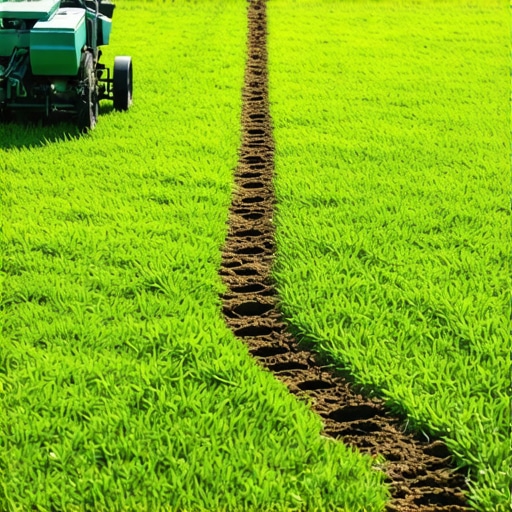
Identifying the Silent Killer of Professional Turf
Soil compaction is the physical compression of soil particles that eliminates macropores, leading to anaerobic conditions where roots suffocate. To fix this, you must use core aeration to extract soil plugs, allowing for gas exchange and better water infiltration into the root zone. You walk across your yard after a light rain and notice it is not soaking in. It is puddling. Your turf looks thin, yellowing, and stressed despite throwing 100 pounds of nitrogen at it last month. I see this every day. I always drill into my new crew members: if you do not fix the soil grading and compaction first, every plant you put in the ground is just expensive compost. You cannot grow a world-class lawn on a parking lot, even if that parking lot is covered in green blades. When the bulk density of your soil exceeds 1.6 grams per cubic centimeter for clay or 1.8 for sand, root growth stops. Period. The roots cannot exert enough pressure to penetrate the soil matrix. This leads to a shallow root system that is hypersensitive to drought and heat stress.
The Engineering Physics of Soil Aeration
Core aeration is not a cosmetic procedure; it is a mechanical intervention to restore the soil’s physical properties. By removing a plug that is 0.75 inches in diameter and 3 to 4 inches deep, you are creating a void. This void allows the surrounding soil to expand into the hole, effectively reducing the overall bulk density of the entire lawn area.
“Soil compaction is one of the most difficult challenges in maintaining high-quality turfgrass. It reduces the amount of oxygen available to the roots and restricts the movement of water into and through the soil profile.” – Penn State Center for Turfgrass Science
Many homeowners make the mistake of using spike aerators. This is a disaster. A spike does not remove material; it pushes it to the side. This increases the compaction in the immediate area surrounding the hole. It is the difference between a surgical extraction and a blunt force injury. For a professional result in 2026, we look for at least 20 to 40 holes per square foot to achieve significant reduction in soil strength.
How deep should core aeration go?
For effective compaction relief, core aeration tines must penetrate at least 3 inches into the soil profile to reach the rhizosphere where active root growth occurs. Shallow aeration of only 1 inch is ineffective for addressing bulk density issues and primarily serves only to remove a small portion of the thatch layer.
The Relationship Between Compaction and Sod Installation
If you are planning a sod install this year, aeration is not optional if the site has been subject to construction traffic. Laying sod over compacted soil is like laying a carpet over a sidewalk. The roots will never knit. They will simply sit in the thin layer of soil the sod came with, eventually drying out and dying as the summer heat rises. When we perform a yard cleanup for a new install, we first address the grading. We ensure a 2 percent slope away from all foundations. Then we aerate. If the soil is particularly heavy clay, we may even perform a top-dressing with 0.25 inches of high-quality compost or coarse sand after aeration to fill those core holes with material that will never compact. This creates a permanent drainage chimney into the subsoil. This is how you build a lawn that lasts twenty years instead of two.
| Soil Condition | Bulk Density Indicator | Compaction Severity | Recommended Treatment |
|---|---|---|---|
| Heavy Clay | 1.65 g/cm3 | High | Double-pass core aeration + top-dressing |
| Sandy Loam | 1.40 g/cm3 | Moderate | Single-pass core aeration annually |
| Silt Loam | 1.55 g/cm3 | High | Core aeration + irrigation adjustment |
| Compacted Sand | 1.75 g/cm3 | Very High | Deep tine aeration (6 inches) |
Irrigation Efficiency and Hydrostatic Pressure
Compacted soil creates a massive waste of water. When you run your irrigation system on a compacted lawn, the water hits the surface and immediately begins to run off into the storm drains. You might be paying for 2,000 gallons of water, but your grass only gets 200 of it. After a professional core aeration, the water infiltration rate increases by up to 400 percent. The water goes down into the profile where it belongs. This is also critical for managing hydrostatic pressure near hardscapes. If your yard grading is poor and the soil is compacted, water will build up behind retaining walls or under patios.
“A retaining wall does not fail because of the stone; it fails because of the water trapped behind it.” – Hardscape Engineering Axiom
Without aeration to facilitate drainage, your expensive hardscape becomes a dam. Eventually, that dam will break.
How much modified gravel do I need for a patio base?
Calculating base material depends on the soil type; typically, you need a minimum of 6 inches of compacted 2A modified gravel for a standard pedestrian patio. In poorly draining, compacted clay soils, this depth should be increased to 8 or 10 inches with the addition of a geotextile fabric to prevent the base from sinking into the subgrade.
The 2026 Yard Cleanup and Maintenance Checklist
Do not just mow the grass. You must manage the biology. Follow this sequence for professional results:
- Perform a soil pH test to determine if lime or sulfur is needed to adjust the Cation Exchange Capacity.
- Clear all debris, including downed branches and leaf litter that can harbor fungal pathogens like Rhizoctonia.
- Irrigate the lawn 24 hours prior to aeration to soften the soil, ensuring the tines can reach maximum depth.
- Execute a double-pass core aeration pattern, moving north-to-south and then east-to-west.
- Apply a high-phosphorus starter fertilizer if overseeding to encourage rapid root development.
- Monitor the irrigation system to ensure 1 inch of water per week, applied in two deep 0.5-inch sessions rather than daily misting.
Following this protocol ensures your lawn is not just green, but structurally sound. Deep, infrequent watering forces the roots to chase the moisture down into the holes created by the aerator. This builds a drought-resistant turf that will survive the hottest August heat. Skip the aeration, and you are just waiting for the next dry spell to kill your investment. It is that simple.