
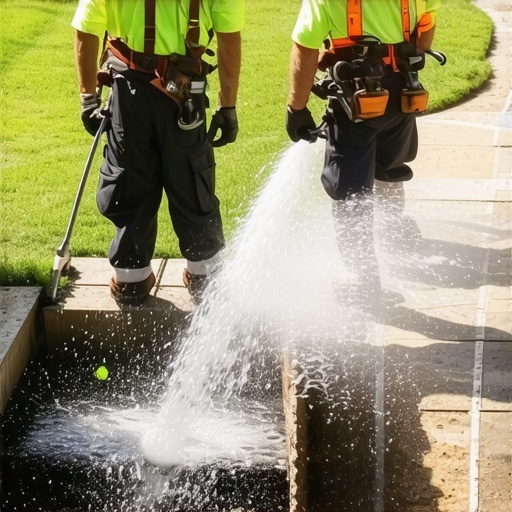
The Forensic Autopsy of a Failing Drainage System
The first sign of a dead French drain is the smell. It is a stagnant, anaerobic odor of sulfur and decaying organic matter trapped under your sod. You walk across your yard and the turf squelches like a water-logged sponge. This is not just a yard cleanup issue; it is a structural failure of your home’s exterior hydraulic management. I recently got called out to tear up a $30,000 patio that was sinking because the previous contractor used cheap, thin-wall corrugated pipe and skipped the filter fabric. The entire system was choked with six inches of compacted silt and clay. When I cut into the pipe, water didn’t just leak out; it exploded under the pressure of the hydrostatic load that had been building behind the retaining wall for months. This is what happens when you prioritize aesthetics over engineering. If your French drain is backing up, you are staring at a potential foundation failure. We do not just dig holes; we manage the movement of thousand-pound masses of water through subterranean soil structures. The solution in 2026 for a system that is not structurally collapsed is a professional jet flush. It is the only way to avoid a full-scale excavation.
What is a Jet Flush for French Drains?
A jet flush is a remediation technique using high-pressure water streams delivered through specialized oscillating nozzles to scour silt, sediment, and root intrusions from French drain pipes. This process restores the percolation rate of the surrounding aggregate and prevents hydrostatic pressure from damaging foundations or hardscapes. Unlike simple snaking, jetting cleans the entire 360-degree interior wall of the pipe. It is the difference between brushing your teeth and getting a professional scaling.
“A retaining wall doesn’t fail because of the stone; it fails because of the water trapped behind it.” – Hardscape Engineering Axiom
The Engineering Behind Siltation and System Failure
French drains fail because of a process called siltation. Most “mow-and-blow” contractors install 4-inch corrugated pipe without understanding the USDA soil texture triangle. If you have heavy clay, those tiny perforations in the pipe will clog in less than three seasons. The water carries fine particulates that settle at the bottom of the pipe, eventually forming a concrete-like sludge. This is compounded if your irrigation system is over-shooting, keeping the soil in a constant state of saturation. You need to understand the hydrostatic pressure. When soil becomes saturated, the weight of the water increases the lateral pressure against your basement walls or pool deck. A clogged drain is a ticking bomb.
“Proper drainage systems must account for the soil’s hydraulic conductivity to prevent long-term saturation of the root zone.” – Penn State Agricultural Extension
Why Traditional Snaking Fails for Yard Drainage
A plumbing snake is designed to punch a hole through a localized blockage like grease or hair. A French drain clog is usually 50 to 100 feet of sediment. A snake will just pass through the mud and leave the pipe 90% full. You need volume and pressure. Professional jetters use rear-facing jets that propel the nozzle forward while simultaneously washing the debris backward toward the cleanout. It is about fluid dynamics. We are using the water to move the earth out of the pipe.
| Feature | Traditional Snaking | Professional Jet Flush | Full System Replacement |
|---|---|---|---|
| Effective Diameter Cleared | 15-20% | 95-100% | 100% |
| Sediment Removal | Minimal | Total Removal | Complete |
| Impact on Geotextile | None | High Pressure Cleaning | New Installation |
| Average Cost (Residential) | $250 – $400 | $600 – $1,200 | $5,000 – $15,000 |
| Longevity Added | 6 Months | 5-10 Years | 20+ Years |
How to Execute a Professional Jet Flush
To perform a jet flush correctly, you must first locate the lowest point of the discharge. If you don’t have a visible daylight exit or a catch basin, you’re going to have to dig one. You cannot flush a system if the debris has nowhere to go. First, we use a borescope camera to inspect the integrity of the pipe. If the pipe is crushed, jetting is a waste of fuel. If it is just clogged, we insert the jetting hose. We start at 1500 PSI. If we hit heavy clay, we ramp up to 3000 PSI, but never higher. Too much pressure will blast through old corrugated walls. You need to feel the hose. It should vibrate in your hands as the oscillating head breaks up the debris. Once the water running out of the pipe turns from chocolate milk to clear, you are done. Don’t skip the final camera run. You need to verify that the perforations are clear so the water can actually enter the pipe from the soil.
The Restoration Checklist
- Locate all cleanout ports and discharge points.
- Perform initial borescope inspection to check for pipe collapse.
- Clear the discharge area of any yard cleanup debris or overgrown sod install material.
- Insert jetting nozzle and work from the lowest elevation upward.
- Monitor water color and particulate size at the exit point.
- Perform a flow test by dumping 50 gallons of water at the highest inlet.
- Verify that the irrigation lines are not leaking into the drainage trench.
How much does it cost to clean a French drain?
The cost typically ranges from $600 to $1,200 depending on the total linear footage and the severity of the clog. Most professionals charge a base mobilization fee plus a per-foot rate for the jetting service. If root cutting is required, expect the price to increase by 20%. This is significantly cheaper than a $10,000 sod install and drainage replacement.
Can I jet my own French drain with a pressure washer?
Consumer-grade pressure washers rarely have the GPM (gallons per minute) required to actually move sediment. While you might have the PSI, you need the volume of water to carry the mud out of the pipe. Without a specialized self-propelling nozzle, you will likely get the hose stuck, turning a maintenance job into a $5,000 excavation project. It is not worth the risk. It will fail.
Ensuring Longevity: Post-Flush Maintenance
After the flush, your job is not over. You need to look at the surface. If your sod install was done poorly, surface water is carrying fine particles straight into your aggregate. I recommend a 2-inch layer of decorative river rock over the top of the drain to act as a primary filter. Check your irrigation heads. If they are spraying directly over the drain line, you are forcing more water through the system than it was designed to handle. Adjust the zones. Keep the area clear of mulch. Mulch breaks down into fine organic matter that is the primary culprit in bio-clogging. A French drain is a piece of civil engineering. Treat it with the same respect you would your home’s roof. Neglect is the fastest path to a flooded basement. Done correctly, a jet flush every five years will keep your system running for decades. Don’t let a $200 ‘handyman’ with a garden hose tell you otherwise.