
Diagnosing Irrigation System Failures from the Ground Up
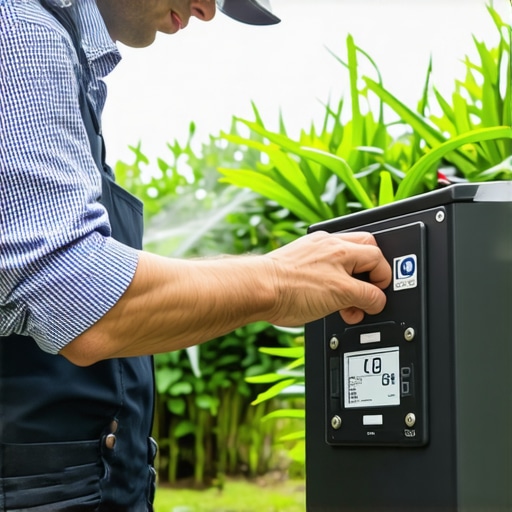
When you see a yellowing lawn or standing water in your flower beds, the gut reaction is to blame the hardware. You think a sprinkler head is busted or a solenoid valve has stuck. But in my twenty years of managing high-end landscape installs, I have learned that the hardware is usually just following bad orders. The real culprit is the logic inside the 2026 smart timers. Most homeowners treat their irrigation controller like a simple kitchen timer, but it is actually a hydraulic computer. If your yard cleanup doesn’t include a deep dive into your controller’s seasonal programming, you are flushing money into the storm drain. I always drill into my new crew members: if you don’t fix the soil grading first, every plant you put in the ground is just expensive compost. The same applies to irrigation. If the logic is flawed, the most expensive sod install will be dead before the first frost.
“Irrigation efficiency is not measured by how much water is applied, but by how much water is retained in the root zone for plant uptake.” – University of Florida IFAS Extension
Fault #1: Over-Cycling and Short-Interval Logic
Fixing over-cycling logic requires adjusting the cycle and soak settings to account for soil infiltration rates and slope. Most 2026 timers default to daily watering, which is a death sentence for turf grass. You want deep, infrequent watering. If you water for five minutes every day, the roots never have to work. They stay shallow, waiting for the next hit. When a heat wave strikes, those shallow roots cook. Instead, you need to program for longer durations with ‘soak’ intervals. This allows the water to penetrate 6 to 8 inches into the soil profile. On heavy clay, you might run a zone for 10 minutes, let it soak for 30 minutes, and run it again. This prevents runoff and ensures every drop hits the root flare where it belongs. It will rot if you leave water sitting on top.
Fault #2: Ignoring the Weather-Sensor Lag
Correcting weather-sensor lag involves calibrating your controller to local evapotranspiration (ET) data rather than generic regional forecasts. Many 2026 smart timers rely on Wi-Fi signals from airports 20 miles away. If it rains at the airport but not at your house, the timer skips a cycle. Conversely, if a micro-burst hits your neighborhood, the timer might keep running because the central station didn’t log the rain. You must install a physical rain-freeze sensor (like a Hunter Rain-Clik) and wire it directly to the controller. This provides an analog override. Don’t skip this. A sensor costs fifty bucks; a new sod install costs thousands. I have seen homeowners lose entire landscapes because they trusted an app over the physical reality of the sky. Check your sensor every spring during your yard cleanup.
How much water does my lawn actually need?
Most turf grass species require exactly 1 inch of water per week, delivered in two or three heavy applications. This forces the root system to chase moisture deep into the earth. If you are in a high-heat zone, you might bump this to 1.5 inches, but never more than that without a soil test indicating high drainage capacity. Use the ‘tuna can’ test to measure your output. Place three cans in a zone, run it for 20 minutes, and measure the average depth. That is your baseline. No app can tell you that as accurately as a physical measurement.
| Soil Type | Infiltration Rate (in/hr) | Recommended Run Time (Min) | Frequency |
|---|---|---|---|
| Heavy Clay | 0.05 to 0.15 | 12 (Multiple Soaks) | 2x Weekly |
| Sandy Loam | 0.25 to 0.50 | 25 | 3x Weekly |
| Course Sand | 0.60 to 1.00 | 40 | 4x Weekly |
Fault #3: Non-Linear Zoning for New Sod Installs
Fixing non-linear zoning means separating high-demand new sod from established landscaping beds to prevent over-saturation and root rot. New sod is a different beast. For the first 14 days, it needs to stay moist because the roots haven’t knitted into the native soil yet. But homeowners often make the mistake of leaving the entire system on the ‘New Sod’ program long after the roots have established. This leads to fungal outbreaks like Pythium blight. In 2026, the best practice is to isolate your sod zones. Once you can’t pull the sod up by hand, you must switch that zone back to a standard deep-watering schedule. If you don’t, you are just drowning the plant. A veteran landscaper knows that more plants die from over-watering than under-watering.
“Standard irrigation controllers often ignore the hydraulic limitations of the manifold, leading to pressure drops that compromise head-to-head coverage.” – Irrigation Association Technical Manual
What is the best time of day to water my lawn?
The optimal window is between 4:00 AM and 8:00 AM. Watering at night is a recipe for fungus because the grass blades stay wet for 10 hours. Watering in the afternoon is a waste because of evaporation loss and wind drift. By watering at dawn, you take advantage of low wind and high water pressure. Any excess moisture on the blades evaporates quickly as the sun rises. This keeps the soil wet but the foliage dry. It is a simple rule of biology. Don’t fight it.
- Check every sprinkler head for 100 percent head-to-head coverage.
- Verify the backflow preventer is not leaking or whistling.
- Flush the lateral lines to remove dirt from the winter.
- Replace 9V backup batteries in the timer.
- Adjust nozzles to avoid spraying the house or sidewalk.
Landscape engineering is about managing water, not fighting it. If your 2026 irrigation timer is acting up, look at the logic first. Check your GPM (Gallons Per Minute) against your meter. If you exceed your hydraulic capacity, your pressure will drop, and your coverage will fail. This isn’t magic; it is physics. Follow the data, trust your soil, and stop treating your yard like a hobby. It is an investment. Treat it with the same technical respect you would give your car’s engine. Keep the dirt under your fingernails and the water in the ground.