
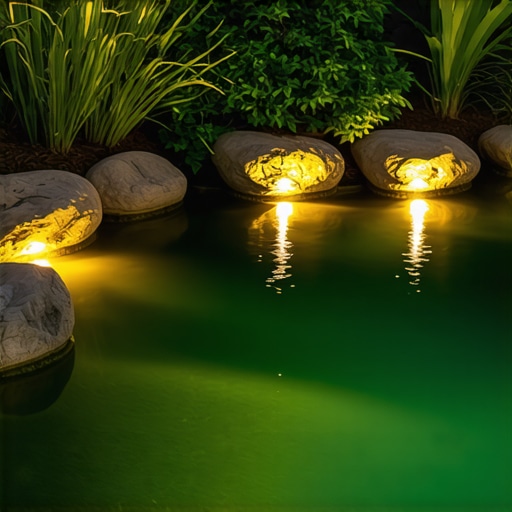
The Engineering Reality of Aquatic Illumination
Water and electricity are a lethal combination for the uninformed. I’ve seen ‘contractors’ throw standard outdoor lighting into a pond thinking a little silicone would save them. It didn’t. I recently got called out to tear up a $30,000 patio and pond feature that was literally electrifying the surrounding soil because the previous contractor used interior-grade wiring buried in a shallow trench without conduit. The homeowner noticed their dog wouldn’t go near the water. We found the insulation had cracked under the pressure of the freeze-thaw cycle, leaking current directly into the groundwater. Adding underwater lighting to your pond safely requires more than just buying a kit; it requires an understanding of IP68 ingress protection, low-voltage transformers, and GFCI (Ground Fault Circuit Interrupter) protection. If you skip the physics, you are building a hazard, not a water feature. This isn’t about aesthetics; it’s about civil engineering and electrical safety in a high-moisture environment.
Planning Your Underwater Lighting System
Successful underwater lighting requires IP68-rated fixtures, a dedicated low-voltage transformer, and a GFCI-protected circuit positioned at least 10 feet from the water’s edge to prevent equipment failure and lethal electrical leakage into the aquatic ecosystem. Planning starts with a load calculation. You must determine the total wattage of your fixtures and ensure your transformer can handle 120% of that load to account for voltage drop over long wire runs. Most amateurs forget that water acts as a massive heat sink, but it also exerts significant hydrostatic pressure on light seals. If your fixture isn’t rated for the specific depth of your pond, that pressure will eventually force moisture past the gaskets, shorting the system. Unlike a standard yard cleanup or basic landscaping project, pond lighting is a permanent mechanical installation.
“All underwater lighting fixtures must be specifically listed for use in submersed locations and must be installed in accordance with Article 680 of the National Electrical Code (NEC).” – Electrical Safety Standards Handbook
How much wattage do I need for pond lights?
For most residential ponds, 1-watt to 3-watt LED fixtures provide sufficient illumination without causing excessive light pollution or stressing fish. Total wattage should be dictated by the clarity of your water, as high turbidity requires more lumens to penetrate the suspended solids. High-intensity discharge lights are largely obsolete; LEDs are the industry standard for their low heat output and longevity.
The Critical Importance of IP68 Ratings
In the world of pond equipment, the IP (Ingress Protection) rating is your most important metric. An IP67 rating means a fixture can handle temporary submersion. For underwater lighting, you must use IP68. This rating signifies that the unit is designed for continuous submersion at depths specified by the manufacturer. If the box doesn’t say IP68, it stays on the shelf. I tell my crew: if you don’t see the rating, assume it’s a garden light that will die in a week. Beyond the fixture, you must use underwater-rated UF (Underground Feeder) cable or direct-burial low-voltage wire. Even with low voltage (12V-15V), the potential for corrosion at connection points is 100% if not sealed with resin-filled heat-shrink tubing or professional-grade waterproof grease caps. Wire nuts and electrical tape are for hobbyists, not professionals.
| Feature | LED Underwater Lights | Halogen Underwater Lights |
|---|---|---|
| Lifespan | 50,000+ Hours | 2,000 – 5,000 Hours |
| Energy Usage | Low (1-7 Watts) | High (20-50 Watts) |
| Heat Output | Minimal | High (Can damage liners) |
| Safety | Very High (Low Voltage) | Moderate (High Heat) |
| Water Clarity Impact | Low Heat/Less Algae Growth | High Heat/Promotes Algae |
Step-by-Step Installation: The Ground-Up Build
Before you even touch the water, you must install your GFCI outlet and low-voltage transformer. Mount the transformer on a sturdy post or house wall, at least 12 inches above the ground and away from any potential flood zones. Run your 12/2 or 14/2 multi-strand low-voltage wire through Schedule 40 PVC conduit for any sections that will be buried under sod or through high-traffic landscaping areas. This prevents accidental cuts during future yard cleanup or irrigation repairs. When you reach the pond edge, use a bulkhead fitting or a protected ‘over-the-liner’ path that doesn’t pinch the cable. If you are working with an EPDM (Ethylene Propylene Diene Monomer) liner, ensure no sharp edges of the light housing come into contact with the rubber. The weight of the water will push the light into the liner, and a small burr can cause a catastrophic leak over time.
- Verify GFCI protection at the power source.
- Check all fixtures for IP68 certification markings.
- Use a 12V or 15V transformer to reduce electrocution risk.
- Apply dielectric grease to all socket connections.
- Test the system in a dry environment before submersion.
- Anchor lights using heavy stones or integrated weighted bases.
How do I prevent my pond lights from floating?
Most professional underwater lights come with weighted bases or mounting brackets that can be screwed into a heavy stone. Never use adhesive or tape inside the pond; instead, wedge the fixture into a crevice in your rockwork or use a stainless steel tether. Ensure the wire has a ‘drip loop’ so that moisture doesn’t track back toward the electrical connections.
Managing Voltage Drop and Resistance
Physics doesn’t care about your design goals. When running low-voltage lines, you face voltage drop. This is the reduction in electrical potential as it moves through the wire. If your wire run is too long or the gauge is too thin, the lights at the end of the chain will be dim and orange-tinted. To combat this, use a multi-tap transformer that offers 13V, 14V, or 15V outputs. By starting with a slightly higher voltage at the source, you ensure that by the time the current reaches the submerged fixtures, it has dropped to the ideal 11.5V to 12V. This is especially critical in large-scale landscaping projects where the pond might be 50 feet from the nearest power source. Don’t guess. Use a voltmeter to check the terminal at the light fixture itself.
“Voltage drop is the silent killer of LED efficiency; even a 2-volt drop can reduce the lifespan of an LED driver by 30% due to increased amperage draw.” – Agronomy & Electrical Engineering Quarterly
The Biological Impact: Algae and Fish Health
Here is a contrarian point you won’t find in a big-box store manual: underwater lights can ruin your pond’s ecosystem if managed poorly. Light provides energy for photosynthesis. If you leave your underwater lights on 24/7, you are essentially fertilizing an algae bloom. I’ve seen clear ponds turn into pea soup in two weeks because the owner wanted the lights on all night. Use a photocell or a digital timer to limit illumination to 4-6 hours per evening. Furthermore, fish need a period of darkness to maintain their circadian rhythms. Constant light causes stress in koi and goldfish, suppressing their immune systems and making them vulnerable to parasites. Position your lights to point away from the deep ‘sleeping’ zones of the pond. A well-placed light should graze the surface of a waterfall or highlight a specific stone, not act as a floodlight for the entire basin.
Final Inspection and Long-Term Maintenance
Once the lights are submerged and positioned, your job isn’t over. Pond water is a living soup of minerals and organic matter. Over time, calcium deposits and biofilm will coat the lenses, significantly reducing light output. Every time you do a seasonal yard cleanup or sod install near the pond, check the fixtures. Clean the lenses with a soft brush and a mild vinegar solution to dissolve mineral scale. Inspect the wire insulation for any signs of chewing by rodents or abrasion against rocks. If you notice the GFCI tripping frequently, it’s a sign that moisture has entered the system. Don’t just reset it. Unplug the transformer and perform a forensic check on every seal. Maintenance is the difference between a system that lasts 10 years and one that fails before the first frost. This is precision work, and it demands a precision mindset. If you treat your pond like a bathtub, you’ll be disappointed. Treat it like a specialized aquatic laboratory, and you’ll have a feature that stands the test of time.